Governor Signs Four Education Bills Targeting Literacy, Math, and Special Education
New Mexico's reading scores ranked last in the country last year. Now four education laws aim to change that, starting in kindergarten.
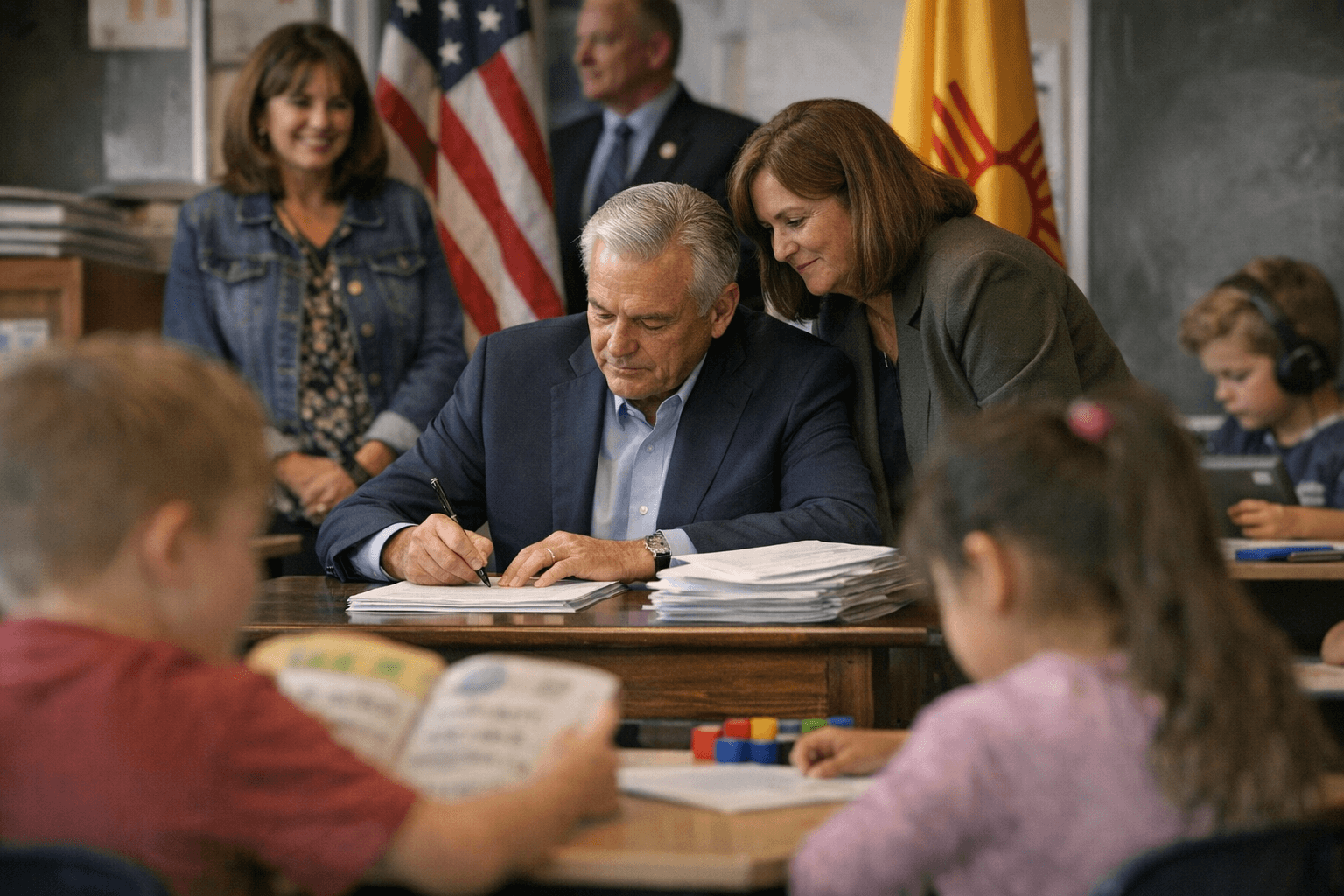
Surrounded by schoolchildren at the Roundhouse in Santa Fe, Governor Michelle Luján Grisham signed four education bills into law Monday, codifying what her administration calls a seven-year investment in New Mexico public schools. The legislation covers structured literacy instruction, math teacher preparation, special education oversight, and school employee health insurance, and passed both chambers of the legislature with near-unanimous bipartisan support.
The centerpiece of Monday's signings is SB 37, the High Quality Literacy Instruction Act, which requires schools to use evidence-based structured literacy instruction grounded in the science of reading. Schools must conduct reading assessments for students in kindergarten through third grade, notify parents when a child is struggling, and expand literacy coaching for classroom teachers. The urgency behind the measure is hard to overstate: New Mexico's reading scores ranked lowest in the country last year. The governor's office pointed to recent progress, citing a 10 percentage point increase in reading proficiency since 2022 and a $30 million summer reading intervention program that enrolled more than 16,000 students over two years and produced an 11% proficiency gain among participants.
SB 29, the math improvement measure, raises math coursework requirements for all teacher licensure levels statewide and mandates early math screening for grades K through 3 beginning in the 2027-28 school year, with required support plans for students who fall behind. Rep. Joy Garratt, D-N.M., described the teacher preparation component in remarks captured by KOB: "This really establishes an entire ecosystem so new trainees for teaching they get raining they into a classroom where an experienced teacher gives them 100 hours of hands on experience with real kids before they go into their own classroom."
SB 64 formally places the Office of Special Education within the New Mexico Public Education Department in state law, establishing clearer oversight and anti-discrimination protections for the roughly 61,000 students statewide who receive special education services. The legislation gives the office defined authority to track and prevent discrimination against students with disabilities. Special education teachers are also eligible for a $2,500 stipend under the bill, though full eligibility details were not available at time of publication.
HB 47 restructures how school employees receive health coverage, replacing a tiered employer contribution system with a flat minimum of 80% employer coverage for health insurance premiums. Lawmakers approved more than $73 million to help school districts and charter schools absorb the increased cost.
"Today marks another milestone in changing the trajectory of public education in New Mexico," Luján Grisham said in a statement. "Reading proficiency is up 10 percentage points since 2022. Teacher pay is 30% higher than when I took office. We moved that needle substantially, and we're not done. Thank you to every lawmaker who invested in New Mexico's students this session."
Teacher starting salaries have risen 30% since Luján Grisham took office, according to the governor's office. The four bills now signed into law are intended to lock those gains and new standards into permanent statute rather than leaving them dependent on executive priorities or annual appropriations.
For McKinley County schools, the practical implications will arrive on different timelines. The literacy assessment requirements under SB 37 take effect immediately, while the K-3 math screening component of SB 29 does not begin until the 2027-28 school year. Districts and charter schools should expect guidance from the New Mexico Public Education Department on implementation, funding distribution from the $73 million health insurance appropriation, and details on the special education teacher stipend eligibility process.
This article was produced by Prism’s automated news system from verified source data, official records, and press releases, then run through automated quality and moderation checks before publishing. The system is built and supervised by the people who set the standards it runs under. Read our full AI policy.
Did this article answer your question?