Navajo Nation Awards $7.3 Million Contract to Tribal Firm for Regional Water Pipeline
A $7.3M sole-source contract to tribal firm NECA advances the Navajo-Gallup pipeline, where 41% of residents still haul water from filling stations toward a 2028 delivery target.
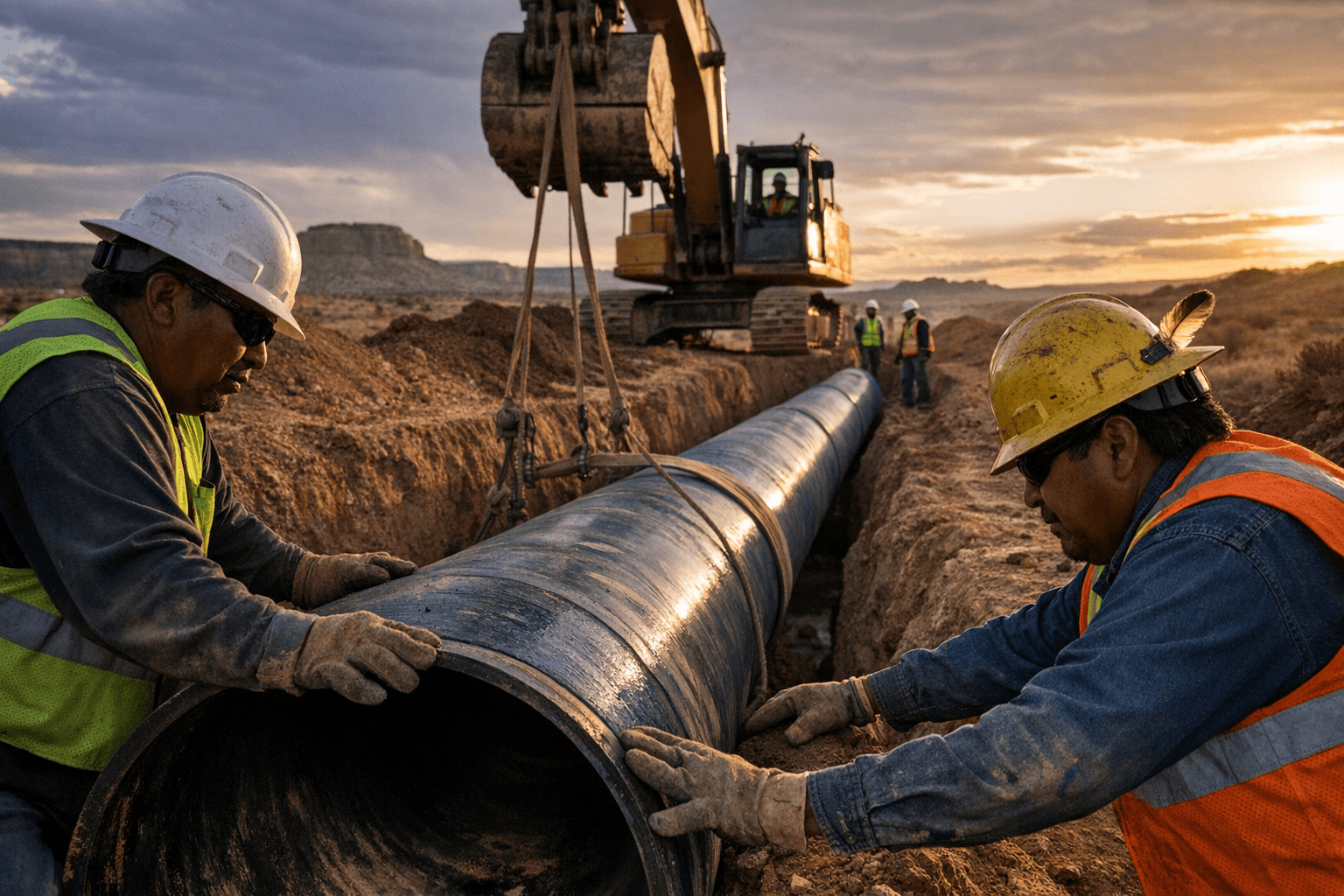
Four in ten Navajo Nation households get their drinking water by truck, barrel, or jug hauled from community filling stations. A $7.3 million contract awarded by the Navajo Nation to the tribal construction firm NECA moves that reality one phase closer to an end.
The Navajo Nation awarded the sole-source contract to the Navajo Engineering and Construction Authority for the next construction phase of the Navajo-Gallup Water Supply Project, the $2.2 billion, 300-mile pipeline system that will carry treated San Juan River water to 43 Navajo Nation chapter communities, the Jicarilla Apache Nation, and Gallup. Full water delivery is targeted for 2028.
NECA is the Navajo Nation's own tribally-owned construction enterprise and one of the largest of its kind in Indian Country. A sole-source award means the contract was negotiated directly with NECA rather than opened to competitive bidding, a practice authorized under the Buy Indian Act (25 U.S.C. § 47), a federal law that gives preference to Indian-owned enterprises in federal and tribal contracting. NECA has served as a contractor on prior phases of the project, and the arrangement generates skilled construction employment for Navajo Nation members.
About 100 of the pipeline's 300 miles are now in the ground, placing the project roughly one-third of the way through installation. Authorized under the Omnibus Public Land Management Act of 2009, the legislation also settled decades of unresolved Navajo Nation water rights claims in the San Juan River basin, making the pipeline both an infrastructure investment and the conclusion of a long legal struggle.
The contract's stakes are immediate in McKinley County, where approximately 75% of the population is Native American and the county ranks among the poorest in New Mexico. Gallup, the county seat, serves as the region's primary commercial hub for the Navajo Nation. Families that haul water typically pay far more per gallon than households connected to a municipal system, piling financial burden on top of the hours spent collecting and transporting it.
The water-access gap is severe by any national measure: Native American households are approximately 19 times more likely than white households to lack complete indoor plumbing, according to U.S. Water Alliance research, compared to a national rate of less than 1%. That disparity drew global attention in spring 2020, when the Navajo Nation recorded one of the highest per-capita COVID-19 infection rates in the United States, briefly surpassing New York and New Jersey. Public health officials linked water hauling directly to residents' inability to follow basic handwashing guidelines.
Project funding comes from New Mexico state appropriations, the Navajo Sihasin Fund, a settlement trust fund whose name derives from the Navajo word for "hope" or "security," and the U.S. Bureau of Reclamation, the Department of the Interior agency that co-manages the effort. With 100 miles laid and a 2028 target unchanged, the pipeline's next chapter now rests with NECA's crews.
This article was produced by Prism’s automated news system from verified source data, official records, and press releases, then run through automated quality and moderation checks before publishing. The system is built and supervised by the people who set the standards it runs under. Read our full AI policy.
Did this article answer your question?