Menominee County tops Wisconsin hardship rate, report says
Menominee County's hardship rate hit 48%, the highest in Wisconsin. Housing, child care and gas are pushing more families past the breaking point.
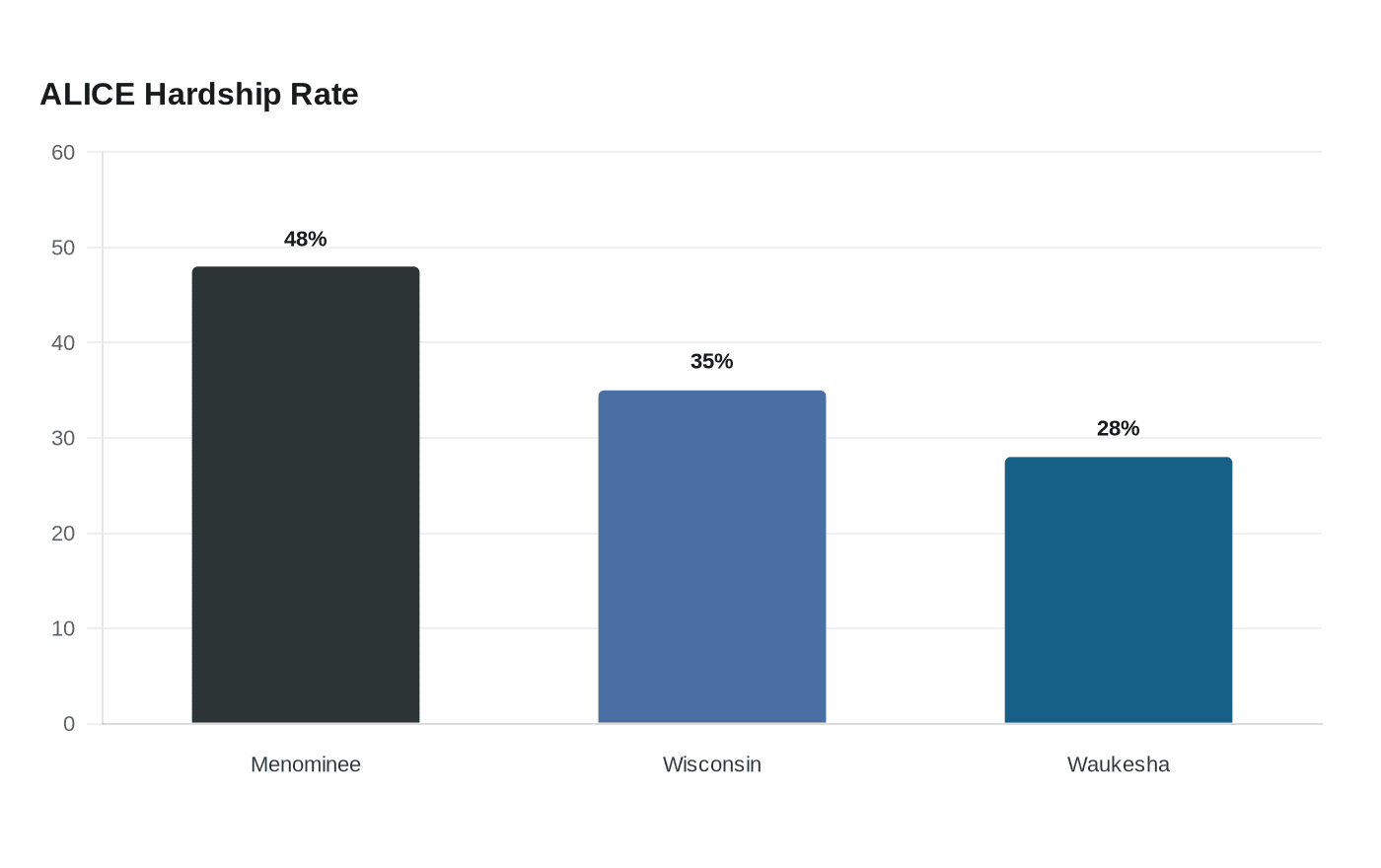
Nearly half of Menominee County households, 48%, could not afford the basic cost of living in 2024, the highest hardship rate in Wisconsin. The new State of ALICE report, released July 2, puts a hard number on what families in Keshena, Legend Lake and across the Menominee Reservation have been feeling in their kitchen-table budgets: the cost of staying housed, getting to work and caring for children is outrunning paychecks.
ALICE stands for asset limited, income constrained, employed households. In the 2026 Wisconsin report, that means families earning above the Federal Poverty Level but still not enough to cover the county’s household survival budget, which includes housing, child care, food, transportation, health care, technology, taxes and a small amount for other needs. The report says those households are often forced to choose between utilities and gas, food and prescriptions, or a cheaper home and a longer commute. Menominee County’s rate was higher than any other county in the state; Waukesha County had the lowest rate at 28%. Statewide, 35% of Wisconsin households were below the ALICE Threshold in 2024, putting Wisconsin 7th among states and the District of Columbia.
The trend in Menominee County has been moving in the wrong direction for several years. The county snapshot showed 45% of households below the threshold in 2022, then 47% in 2023, before reaching 48% in the 2026 update. At the same time, median household income slipped from $62,194 in the 2024 snapshot to $59,528 in the 2025 snapshot. Labor force participation also edged down, from 51.2% to 50.5%. The county snapshots show how wide the gap is between wages and real costs: the 2024 budget put monthly living expenses at $1,990 for a single adult and $5,781 for two adults with one infant and one preschooler, while the 2025 budget rose to $2,177 and $5,856.
The report’s help network is small but practical. Shawano Area United Way says roughly 40% of households in its service area fall into the ALICE category and points residents to a Diaper Bank, Volunteer Income Tax Assistance and Community Dinners. Those programs do not erase the county’s affordability problem, but they give families immediate places to turn when rent, food and child care all land in the same week.
The broader message in the 2026 report is that Menominee County’s hardship is structural, not temporary. United For ALICE says there is no single fix, and the pressure reaches beyond low-income households into the local workforce, schools, employers and community groups that rely on families who are working but still falling short of the cost of living.
This article was produced by Prism’s automated news system from verified source data, official records, and press releases, then run through automated quality and moderation checks before publishing. The system is built and supervised by the people who set the standards it runs under. Read our full AI policy.
Did this article answer your question?