Dry Tortugas National Park preserves Monroe County’s remote frontier beauty
Seventy miles from Key West, Dry Tortugas turns a park visit into a remote-water crossing. Fort Jefferson and the reefs are iconic, but distance defines every decision.

Dry Tortugas National Park is Monroe County’s westernmost frontier, and the distance is the first fact that shapes every visit. Almost 70 miles west of Key West, the 100-square-mile park is mostly open water, divided among seven small islands and reached only by boat or seaplane. That isolation is part of its appeal, but it also means every trip depends on timing, weather, water conditions, and advance planning.
Remote by design
Dry Tortugas is not a park that grew around easy access. The National Park Service expanded protection in 1983 and re-designated the area as a national park on October 26, 1992, with a mission that went beyond scenery alone: protect island and marine ecosystems, preserve Fort Jefferson and submerged cultural resources such as shipwrecks, and allow public access in a regulated way. That balance is still visible in the way the park operates, from limited transportation to the small number of people who live and work there year-round.
The park’s human footprint is thin. A ferry operator says about a dozen National Park Service personnel live and work in the Dry Tortugas, including rangers, maintenance workers, and their families. That small presence underscores how far the park sits from Monroe County’s more familiar road network, bridges, and harbor traffic. Out here, the frontier feel is not a slogan. It is the reality of managing a national park at the edge of the map.
Garden Key is the center of the park
Most visitors end up on Garden Key, the second-largest island, which is about 14 acres in size and has seen the most human impact. It is where the park headquarters, visitor center, campgrounds, and swimming and snorkeling areas are located, and it is where Fort Jefferson dominates the horizon. Garden Key is the place that turns the park’s abstract history into something immediate, because the fort sits right in the middle of the experience rather than off in the distance.
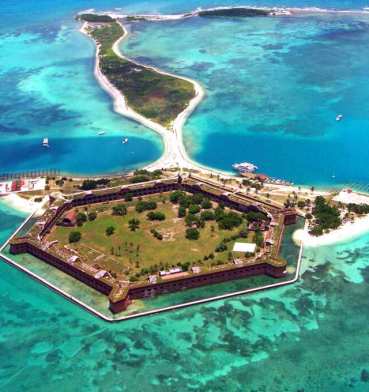
Fort Jefferson itself was built to protect one of the most strategic deepwater anchorages in North America. The National Park Service describes it as one of the nation’s largest 19th-century forts and the largest masonry fort in the western hemisphere. That scale matters in a park where the surrounding islands are small and the water stretches in every direction. Fort Jefferson gives the Dry Tortugas its signature silhouette, but it also explains why Monroe County still treats this far-off corner of the Keys as a place of military history, navigation, and control of the sea.
Getting there takes planning
There is no drive to Dry Tortugas. The only ways to visit are by boat or seaplane, and ferry and seaplane passengers travel directly from Key West to Garden Key. The daily concession ferry, private boats, charter boats, and seaplane service all shape the trip differently, but each option starts with the same fact: you are crossing open water to reach one of the most isolated destinations in the Keys.
That is why reservations matter. The park’s access is limited enough that a casual, last-minute approach can leave visitors stranded on the dock in Key West. Recreation.gov is part of the booking system, and the ferry operator remains the main point of access for many day-trippers. For anyone planning a visit, the practical question is not just when to go, but whether the day trip, the ferry schedule, or a seaplane landing best matches the kind of time you want to spend in a place this remote.
Camping turns the visit into a longer test of readiness
Overnight stays make the remoteness even more obvious. The campground is on Garden Key, the park is open 24 hours a day, seven days a week, and camping capacity is capped at 68 people. The group site is limited to 10 to 20 people, so even a small gathering requires attention to the park’s limits and the available reservations.
Camping is one of the clearest ways to experience Dry Tortugas because it extends the visit into sunset, stargazing, and sunrise without ever leaving the island. But it also asks more of visitors than a same-day ferry ride. With no road access and no mainland backup around the corner, campers have to arrive with what they need and understand that every supply, every meal, and every change in weather has to be managed inside the park’s narrow margins.
The waters are as important as the fort
The Dry Tortugas are more than an island stop. NOAA’s Florida Keys National Marine Sanctuary says Florida’s Coral Reef stretches more than 350 miles from the Dry Tortugas to Martin County, and the Tortugas marine area includes seagrass beds, coral reefs, and hard-bottom habitats. That places this corner of Monroe County inside a much larger ecological system that ties the county’s far western edge to the broader reef line running up the peninsula.
The park’s marine setting is also why shipwrecks, coral reefs, and bird life remain part of the Dry Tortugas story. The same waters that protect submerged cultural resources also support the habitat that gives the park its sense of movement and continuity. It is one of the few places in Monroe County where deep history, fragile marine ecology, and the logistics of getting there all press against each other in a single day’s trip, and that is what keeps Dry Tortugas both iconic and high-stakes.
This article was produced by Prism’s automated news system from verified source data, official records, and press releases, then run through automated quality and moderation checks before publishing. The system is built and supervised by the people who set the standards it runs under. Read our full AI policy.
Did this article answer your question?