Key West mixology class blends cocktails, chemistry and island history
At 291 Front St., Key West mixology turns cocktails into history lessons, with Brad Rouge using the island’s past to shape a signature visitor experience.
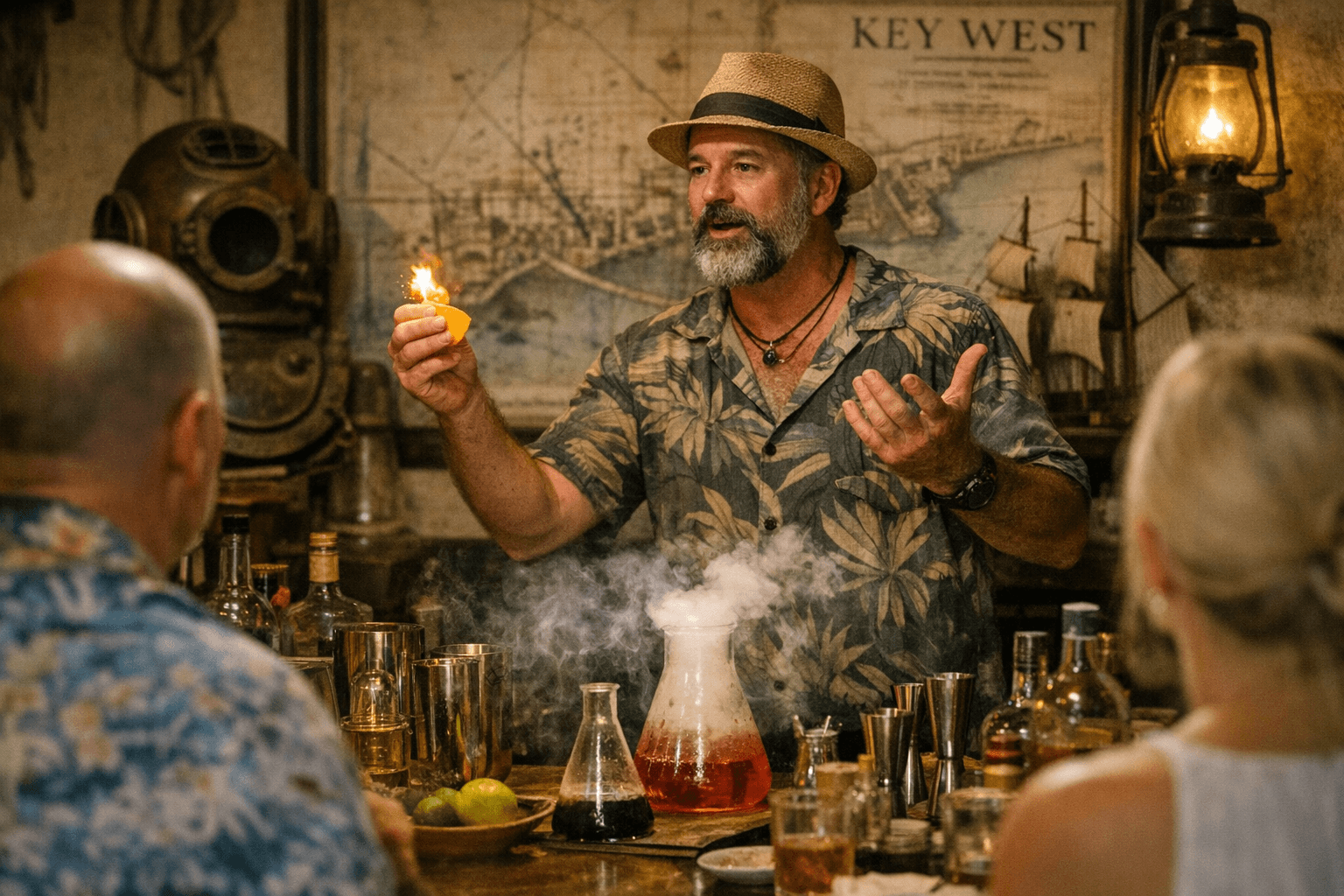
A Front Street room where the drink is only part of the point
Inside the Key West Cooking Show and Bar 1 at 291 Front St., the cocktail class is built like a local history lesson with ice, citrus and spirits. Brad Rouge, the operations manager, treats mixology as both art and science, pushing staff to understand chemistry, ratios, technique and the story behind each pour. The result is a hospitality experience that feels distinctly Key West, where a drink is never just a drink if it can also carry the island’s memory.
That approach matters in Monroe County because it gives bars, restaurants and hospitality workers a stronger reason to stand out in a market built on tourism and repeat visits. Guests do not come only to consume, they come to be told something about the place they are in, and that makes the glass part of the revenue story as well as the entertainment.
Why the building itself sells the experience
The setting at 291 Front St. gives the program an anchor that is hard to fake. The structure was built by the U.S. Navy from 1856 to 1861 and is known historically as Building Number One, the Naval Depot and Storehouse, and later as U.S. Coast Guard headquarters and station. Historical marker sources describe it as the oldest brick building on Key West and the first permanent Naval building on the island, which gives any class held there an immediate sense of depth.
That history is not window dressing. It helps explain why the Key West Cooking Show has leaned into the idea that education and entertainment belong in the same room. The venue’s public-facing model is part cocktail bar, part interactive class space, where guests learn mixology techniques while also hearing how Key West’s flavors and stories evolved. In a town that markets itself through place-based experiences, the building becomes part of the brand.
Keys Weekly has recently described Bar 1 as using a “sip-and-learn” format that spotlights island history through cocktails, and the venue’s identity has become even clearer since the former Key West Cooking School was renamed the Key West Cooking Show to better communicate that entertainment-and-learning model. That is a small naming change with a bigger economic message: the business is selling an experience, not just a lesson.
Brad Rouge’s approach: chemistry, technique and storytelling
Rouge’s philosophy starts with a simple idea that is not always common behind the bar: staff should not think of themselves as just bartenders. He wants them to know why certain spirits and ingredients work together, when to shake and when to stir, and how a recipe can communicate something about the island that made it. In practice, that means cocktails become a way to train workers and entertain visitors at the same time.
The chemistry piece is important because it gives the class technical credibility. The history piece is what turns it into a Key West story. When Rouge talks about passion and storytelling, he is also defining what makes a hospitality job in this setting different from a routine service role. A bartender who can explain a drink’s structure, plus its local roots, becomes part of the visitor experience and part of the island’s economic identity.
A few things define the style of the class:
- attention to ratios and balance, not just flavor
- an emphasis on shaking versus stirring
- an understanding of how spirits and ingredients interact
- historical context behind signature cocktails
- the idea that every drink should tell a story
That formula helps explain why the experience resonates with travelers looking for more than a generic bar stop. In Key West, where the competition for tourist dollars is intense, a class that teaches technique while celebrating local lore gives the business a sharper edge.
The Curry old fashioned and the island’s merchant past
One of the clearest examples of that approach is the Curry old fashioned, a drink that ties the bar program directly to Key West’s commercial past. William Curry was a major island merchant whose business interests included wrecking, shipbuilding and tobacco trading, and historical marker sources say he was reportedly Florida’s first millionaire. Other historical sources note that he served as mayor of Key West in 1854 and 1855, which shows how deeply his name was woven into the island’s civic and economic life.
Curry’s business footprint also ran through a warehouse built in 1878 as a Hall and Bonded store, later associated with tobacco trading and Cuban cigar-factory owners storing and drying tobacco leaves. That kind of detail matters because it explains why a cocktail named for Curry is more than a clever label. It is a salute to an entrepreneur whose work helped shape the island’s maritime and mercantile identity.
For visitors, that turns a drink into a mnemonic device. For locals, it reinforces that Key West’s history is not confined to plaques and museum cases. It is still showing up in menus, in storytelling, and in the way hospitality businesses differentiate themselves.
Why Prohibition still fits Key West’s drink culture
The island’s cocktail storytelling also makes sense against the backdrop of Prohibition. Prohibition began on January 17, 1920, and rum-running intensified within weeks. Key West’s proximity to the Caribbean made it a natural place for the illicit liquor trade, which helped establish a long-running association between the island and drinking culture.
That history helps explain why a sip-and-learn program feels authentic here rather than forced. Key West has long been a port town shaped by sailors, transient workers and later Navy personnel, all of whom helped make bars and saloons central to everyday life. A class that links modern mixology to that past is not inventing a tradition, it is repackaging one that has long been part of the island’s social economy.
What the model means for Monroe County’s visitor economy
This kind of program does more than entertain a room full of guests. It creates a higher-value experience for a tourism market that depends on memorable, shareable moments, and it helps bars and hospitality workers earn from knowledge as much as from volume. In a place like Key West, where personality and place matter, the ability to tell a story can be as valuable as the ability to pour a perfect drink.
That is why the mixology class at the Key West Cooking Show fits so neatly into the island’s broader identity. It links a historic Navy building, a merchant like William Curry, the memory of Prohibition and the practical craft of cocktails into one local product. In the end, the class is not just about what is in the glass. It is about how Key West keeps turning its history into something visitors can taste.
This article was produced by Prism’s automated news system from verified source data, official records, and press releases, then run through automated quality and moderation checks before publishing. The system is built and supervised by the people who set the standards it runs under. Read our full AI policy.
Did this article answer your question?