Illinois College marks nearly two centuries of Jacksonville history
Illinois College still anchors Jacksonville with 890 on-campus students, 87.6% bed occupancy, and Beecher Hall, the state’s first college building.
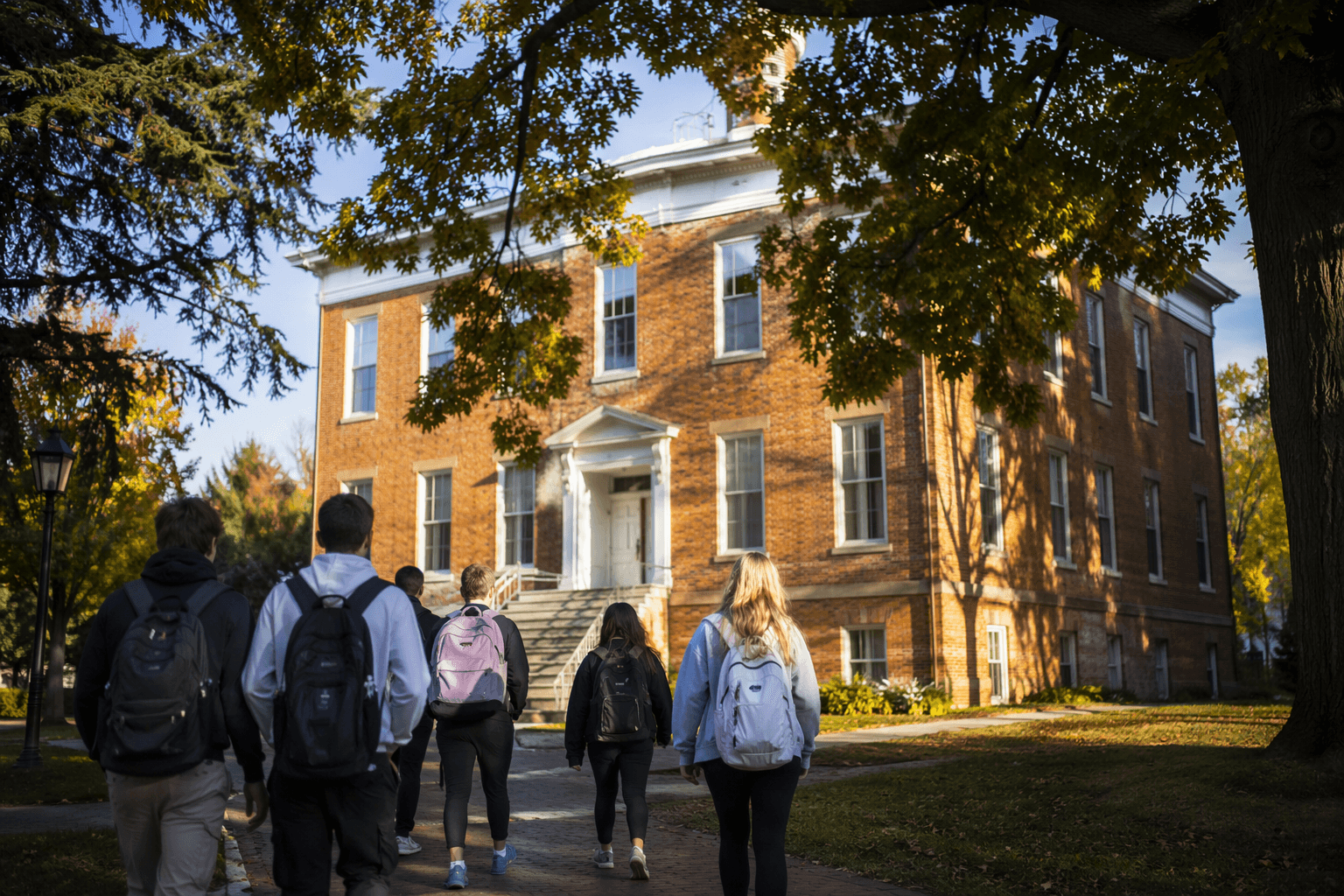
Illinois College is more than a campus on the west side of Jacksonville. With 890 students living on campus in fall 2025, 886 of them full time, it still supplies a steady daily presence that reaches into the town’s identity, its workforce pipeline, and the institutions Morgan County relies on. The oldest buildings on the grounds are not museum pieces frozen in time, either. Beecher Hall still stands in use, giving Jacksonville a rare landmark that connects present-day life to the first decades of Illinois statehood.
A living campus, not a relic
The most telling number in Illinois College’s current profile is not just enrollment, but occupancy. The fall 2025 fact sheet reports 87.6% bed occupancy, a sign of a residential campus that still draws students into Jacksonville for the full rhythm of college life. That matters in a place like Morgan County, where a campus population this size helps sustain local routines, from weekday foot traffic to the steady turnover of students who study, work, and spend their time in town.
The college also remains broader than its ZIP code. Its diversity data shows students from 27 countries and 25 other states, while 99% of degree-seeking students receive financial aid. That mix tells a familiar local story in a more complicated way: Illinois College is rooted in Jacksonville, but it keeps pulling people and resources into the community from far beyond central Illinois. The college’s denominational ties to the United Church of Christ and Presbyterian Church USA are part of that long institutional identity, even as the campus functions today as a modern liberal arts college.
How Illinois College began
Illinois College began in 1829 in Jacksonville, when the Rev. John M. Ellis envisioned a seminary of learning in the new state of Illinois. Seven Yale students, remembered as the Yale Bands, came west to help launch the school, and instruction began on January 4, 1830. That founding moment makes the college one of the earliest academic institutions in Illinois, not simply one of the oldest names still in circulation.
The school’s early place in state history is visible in a milestone that followed only a few years later. In 1835, the first two college graduates in Illinois received their degrees from Illinois College. For Morgan County, that is more than a date in an institutional timeline. It is evidence that Jacksonville was already shaping the state’s educated class before many Illinois communities had even settled into their modern forms.
Beecher Hall and the physical memory of the campus
Beecher Hall is the clearest reason the college still matters as a built place. Constructed between 1829 and 1830, it is the first college building in Illinois and is also widely described as the oldest college building in the state. Its later listing on the National Register of Historic Places formalized what Jacksonville residents already live with every day: a structure that is both an active part of campus life and one of the state’s most important educational landmarks.

The building’s history reaches beyond classroom use. Before the Civil War, Beecher Hall was a stop on the Underground Railroad, and the college’s founders were abolitionists. The campus sits about 25 miles from the Illinois River, a major transportation route, which helps explain how a college in Jacksonville became tied to antislavery networks that moved people through central Illinois. Beecher Hall also housed the first medical school in Illinois in 1843, adding another layer to the building’s role in early state development.
A center of abolition, ideas, and public life
Illinois College’s history is inseparable from the abolitionist movement. President Edward Beecher was an outspoken opponent of slavery, and that stance shaped the campus’s identity in the decades before the Civil War. The college says two campus houses are believed to have been part of the Underground Railroad, a reminder that the school’s moral commitments were not abstract. They were built into the places where students lived and learned.
The college also became a magnet for public figures whose names still carry weight in Illinois history. Abraham Lincoln, Ralph Waldo Emerson, Bronson Alcott, Mark Twain, Horace Greeley, and Wendell Phillips all visited or lectured on campus in the early years. Illinois College says many of those appearances, including Lincoln’s, came through the work of literary societies, which helped make the campus a serious venue for civic and intellectual debate. That tradition continues to shape how Jacksonville sees the college: not only as a school, but as a place where the region encountered national ideas.
Why Jacksonville still feels the college’s influence
Illinois College’s later milestones show how its influence widened without losing local roots. It became coeducational in 1903 by incorporating Jacksonville Female Academy, and in 1932 it received a Phi Beta Kappa chapter, one of only 11 in Illinois. Those developments signal an institution that kept adapting while remaining tied to Jacksonville’s center of gravity. Its alumni list includes William Jennings Bryan, class of 1881, who went on to become a three-time presidential nominee, secretary of state, and congressman.
That combination of old and active is why decisions about Illinois College carry civic weight in Morgan County. Beecher Hall’s preservation, the upkeep of the campus, and the college’s ability to keep drawing students all affect how Jacksonville presents itself to the state and to the people who come here to study, work, and stay. Nearly two centuries after the first classes began, Illinois College still shapes the city’s skyline, its story, and its future.
This article was produced by Prism’s automated news system from verified source data, official records, and press releases, then run through automated quality and moderation checks before publishing. The system is built and supervised by the people who set the standards it runs under. Read our full AI policy.
Did this article answer your question?