North Slope Borough search and rescue expands airborne emergency response
A beacon call can pull aircraft, village volunteers, and medevac planning into motion across 95,000 square miles of Arctic terrain, where delays can stretch to days.
North Slope Borough stretches across nearly 95,000 square miles, and a rescue there rarely begins with a helicopter lifting off. More often, it begins with a weather check, a beacon signal, a phone call to a village coordinator, and a race against distance. North Slope Borough Search and Rescue handles medevac, search and rescue, and other emergencies across a landscape where roads, hospital access, and daylight can all be in short supply.
A rescue system built for an enormous borough
North Slope Borough is the farthest north municipal government in the United States, and it includes Utqiaġvik and eight other communities spread across northern Alaska. Its footprint runs about 650 miles east to west and 225 miles south from Point Barrow, which helps explain why local response is so tightly linked to aircraft, village volunteers, and location technology.
The department’s mission reflects that geography. Search and Rescue is not just a medevac arm or a lost-person team; it is a transport network for injured hunters, travelers with broken-down equipment, workers caught out in bad weather, and residents who need help far from road access or hospital-level care. The department flies hundreds of missions each year across the North Slope, often in extreme weather conditions, and works with village, air, water, and government partners on ground, air, and water missions.
How the fleet became central to the mission
The current system grew step by step. Search and Rescue was established in 1977 as part of the North Slope Borough Police Department, then became a separate department in 1980. The borough acquired its first two aircraft in 1979, setting the foundation for the airborne response that now defines the service.
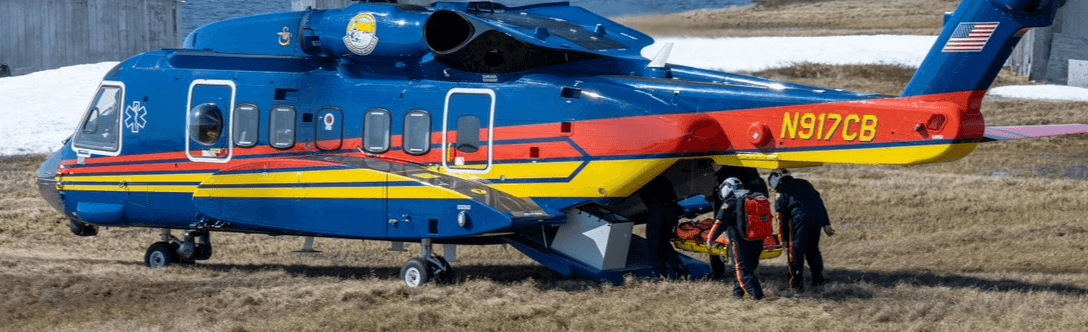
Aircraft upgrades have tracked the needs of the region. A medically configured Learjet 31A was added in 2000 to speed aeromedical transport to hospital facilities outside the borough. In 2012, the department added a King Air 350CER to replace the King Air 200. By 2016, the borough had acquired a Sikorsky S-92A to increase helicopter capabilities and restore helicopter search and rescue coverage everywhere in the borough.
Chief pilot Josh Grier said that when a rescue depends on Coast Guard or National Guard assets, staging it can take days, and in some cases at least 24 hours. The closest U.S. Coast Guard base is in Kodiak, about 940 miles south of Utqiaġvik, a distance that turns a weather problem into a logistics problem almost immediately.

What happens when someone goes missing or gets stranded
When someone is overdue in the field, the borough’s response starts with information. The fastest way to shorten a search is often the Personal Locator Beacon program, a free service for North Slope residents traveling about their homeland. Activating a PLB sends the user’s exact location to Search and Rescue, giving dispatchers and crews a fixed point in a region where a person on the tundra can be nearly invisible from the air.
The SAR Coordinator oversees that PLB program and also serves as the liaison with federal and state agencies while assisting village search and rescue coordinators and volunteers. In practical terms, the borough does not rely on a single centralized response from Utqiaġvik alone. It relies on village-level people who know the terrain, the weather, the routes in and out of town, and the difference between a routine delay and a survival emergency.
Once a mission is underway, the response may combine village volunteers, borough aircraft, and outside support if conditions demand it. The borough’s own system is designed to cover ground, air, and water missions in a region where a person can be stranded on ice, along the coast, on the tundra, or far from any drivable route. In bad weather or darkness, the flight crew’s ability to reach a signal, a village, or a missing traveler can shape whether the search begins the same day or is pushed into the next.
What residents should know before heading out
The most important preparation tool in the borough’s system is simple: carry a PLB when traveling into remote country, and make sure someone knows your route. The beacon is free for North Slope residents, and the borough treats it as a core safety device, not an optional extra. For hunters, travelers, and workers moving beyond town limits, it is the clearest way to turn a vague emergency into a location that Search and Rescue can act on.
A few practical realities define safe travel on the North Slope:
- Weather can close the window for flying quickly, so a clear forecast matters before departure.
- Darkness and distance can slow visual searches, especially outside village centers.
- A PLB gives Search and Rescue a fixed location instead of a wide search area.
- Village coordinators and volunteers are part of the response, so notifying local contacts early helps.
- The region’s size means outside help can take far longer than most people expect.
The people keeping the system moving
The borough is also trying to build the next generation of that workforce. Its outreach program includes an aviation mentorship effort for student pilots and student mechanics.
The King Air 350CER is a workhorse for Arctic operations, and the Sikorsky S-92 provides range and all-weather capability. The borough has also ordered two AW189 helicopters to replace its current helicopter fleet.
This article was produced by Prism’s automated news system from verified source data, official records, and press releases, then run through automated quality and moderation checks before publishing. The system is built and supervised by the people who set the standards it runs under. Read our full AI policy.
Did this article answer your question?