Beatty museum preserves Nye County's Bullfrog Mining District history
The Beatty Museum turns the Bullfrog Mining District into a stop that brings Death Valley travelers into Beatty, with free admission and railroad-era artifacts.
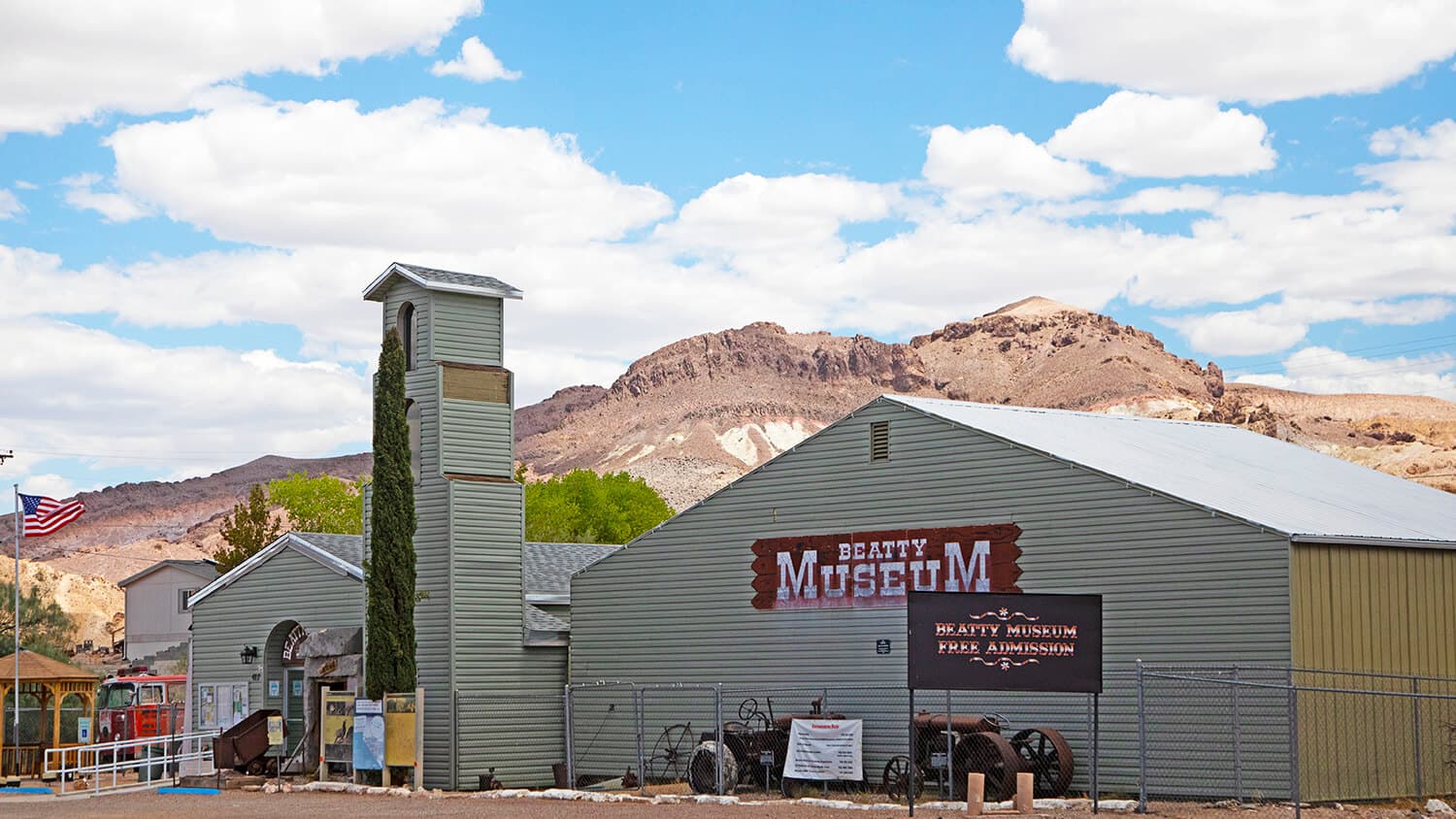
The Beatty Museum and Historical Society gives Beatty something many pass-through towns never get: a reason to stop, look around, and spend time downtown. Housed in a former Catholic church, the museum turns the Bullfrog Mining District into a visible part of Nye County’s present economy by drawing Death Valley travelers off the highway and into a town that still has a story to tell.
A museum built to keep Beatty on the map
Travel Nevada treats the museum as a place to explore Beatty and the Bullfrog Mining District one photograph, document, and Wild West tale at a time. That framing fits Beatty’s current role as the gateway to Death Valley National Park, where visitors often arrive with a quick photo stop in mind and leave with a better sense of how the town grew around mining, rail traffic, and supply work.
The collection is built for that kind of visit. It includes books, photographs, documents, and artifacts from the early 1900s, and the museum adds an outdoor display of mining equipment that helps connect the paper record to the physical labor that shaped the district. The point is not just to remember what happened in the hills around Beatty, but to show how the town functioned when mines, rail lines, and supply houses made it one of the key places in southern Nye County.
From a coffee meeting to a community archive
The museum began in May 1995, when Claudia Reidhead, Vonnie Gray, and Mary Revert held a coffee meeting and decided to start the Beatty Museum & Historical Society. The first donated items were displayed in a cottage next to Reidhead’s home, a small beginning that reflects how often rural preservation starts with volunteer work, local memory, and whatever space a town can spare.
The group moved into the local water department building on December 31, 1996. In 2002, the museum bought its current building from the Catholic Diocese in Las Vegas, and in 2003 Les and Kay Parsons donated another large building to serve as an annex. Travel Nevada says the building was originally a Catholic church built in the 1950s, and that history gives the site a second life as a public archive instead of a vacant structure.
The museum’s setup also makes it practical for travelers. Admission is free, and the hours are 10 a.m. to 3 p.m. Tuesday through Saturday. That low barrier matters in a town where many visitors are weighing a full day in Death Valley against a shorter stop in Beatty, and it helps the museum function as an accessible public-history space rather than a niche repository.
What the exhibits explain about Beatty
The strongest reason to visit is that the museum explains how Beatty became more than a name on the road into the park. The town grew as a supply hub for the Bullfrog Mining District, the early-1900s cluster of claims and camps that included Beatty and nearby Rhyolite. The museum gives that history a local frame: not just the boom, but the people, buildings, and transport routes that kept the district moving.
That matters because Beatty is still a living community. University of Nevada, Las Vegas Libraries notes that the town still supports several hundred people, which means the museum preserves the record of a place that never fully disappeared. It is not a sealed-off ruin; it is a town where historical memory still sits beside daily life, school runs, errands, and visitors looking for something more than a roadside pullout.
The museum also preserves the human scale of mining history. Its archive and displays help explain how people lived and worked in the district, how supplies moved in, and why Beatty became the hub that tied scattered camps together. For family historians, rail enthusiasts, and anyone trying to understand the social life of early mining towns, that combination of artifacts and local context is the difference between a ghost-town snapshot and a real account of Nye County’s past.
The railroads that made Beatty a crossroads
Beatty’s importance becomes clearer when you trace the rail lines that passed through it. The Las Vegas & Tonopah Railroad was built in 1906 and 1907 and had stops in Beatty, Bullfrog, Rhyolite, and Goldfield. The Bullfrog Goldfield Railroad, incorporated in 1905, ran a main line from Beatty to Goldfield, about 78.95 miles, while the Tonopah & Tidewater Railroad ran from Ludlow, California, via Death Valley Junction to Gold Center, just two miles south of Beatty.
University of Nevada, Las Vegas Libraries adds two key milestones: Beatty served as the southern terminus of the Bullfrog Goldfield Railroad until 1928, and the northern terminus of the Tonopah and Tidewater Railroad until 1940. Those dates show that Beatty stayed tied to regional transportation long after the mining peak faded, which helps explain why the town remained relevant even as surrounding camps declined.
That rail history gives the museum practical value today. Visitors who see the railroad beds, surviving historic buildings, and mining references around town can place the artifacts in a real network of movement and trade. The museum becomes the place where those threads come together.
Why the Bullfrog story still matters
The Bullfrog Mining District was not just a local curiosity. A Bullfrog District history source says the district produced $1,687,792 worth of ore between 1907 and 1910, a figure that puts a hard number on why the area briefly mattered so much in Nevada’s economy. That output helped drive traffic, supply needs, and settlement patterns that still shape how Beatty is understood today.
The museum’s preservation work keeps that record in public view. It protects the names of the people who started it, the buildings that housed it, and the transportation routes that fed it. In a county where many historic sites are scattered and easy to miss, the Beatty Museum and Historical Society turns the Bullfrog story into something visitors can actually find, enter, and learn from before they head back out toward Death Valley.
This article was produced by Prism’s automated news system from verified source data, official records, and press releases, then run through automated quality and moderation checks before publishing. The system is built and supervised by the people who set the standards it runs under. Read our full AI policy.
Did this article answer your question?