Pahrump cleaning business grows on trust, personal service, local loyalty
In Pahrump, Amy Carbajal’s cleaning business runs on repeat clients, referrals and trust. A five-person crew now turns a four-hour job into about one hour.
Trust is the real transaction in Pahrump
In Pahrump, inviting someone into your home is the real transaction. That is the foundation Amy Carbajal has built over about 15 years cleaning homes here, turning Amy’s Cleaning Service into a business that depends less on advertising than on the kind of trust people extend to family.
Carbajal has lived in the area since she was 18, and that long local connection matters in a town where reputation travels faster than any marketing campaign. The clients she serves often become friends, and the conversations do not always stop when the vacuum turns off. In a place like Pahrump, that kind of familiarity is not a side benefit. It is the business model.
How the service works, from routine upkeep to deep cleans
Amy’s Cleaning Service is built around repeatable, practical work that helps households stay ahead of the mess instead of catching up to it. Standard recurring cleanings include vacuuming and mopping floors, wiping down surfaces, and detailed kitchen and bathroom cleaning. For many homes, that baseline is what keeps weekly life manageable, especially when work schedules, family responsibilities and aging-in-place needs all compete for time.
The company also handles more detailed requests. Appliances such as microwaves can be cleaned inside and out, and extra tasks can include ovens, refrigerators, baseboards, ceiling fans and sliding glass doors, depending on what a home needs. For clients with bigger projects, Carbajal offers deep cleans and clean-outs, which gives the business a broader role than a simple maintenance service.
A five-person crew has changed the scale, not the standard
What began as one person’s labor has grown into a crew of five employees, and that shift has changed the pace of the work without changing the expectations. Carbajal said a job that used to take her about four hours on her own can now be done in roughly one hour with the team in place. That kind of efficiency is more than a convenience. In a service business, it can mean taking on more households, keeping schedules tighter and responding faster when homes need attention.
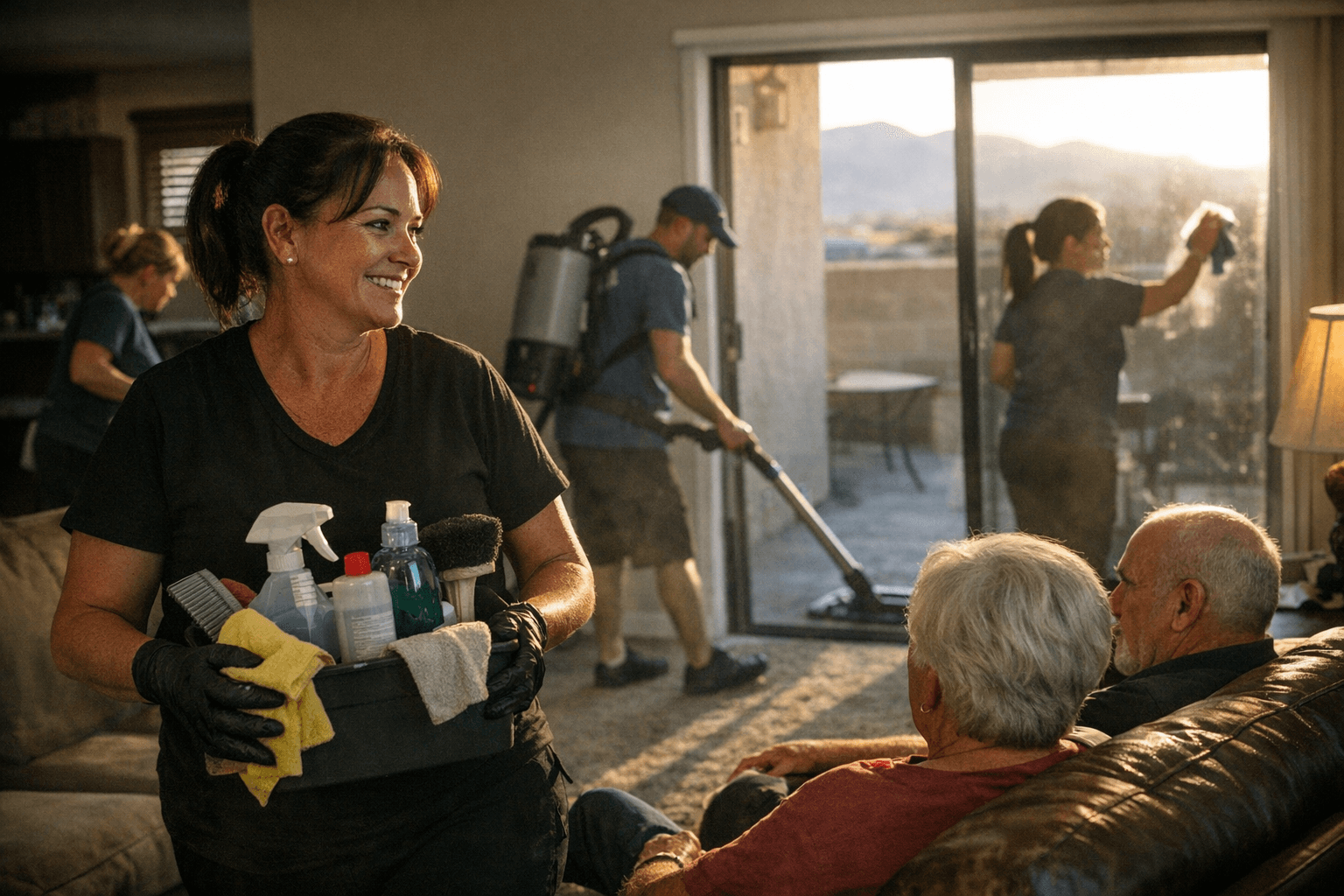
Still, she says consistency remains the priority because the company bears her name. That is the hidden risk and the hidden strength of a small business built on personal service: every clean room, every missed corner and every satisfied customer feeds the next referral. In a word-of-mouth market, the brand is not a logo. It is the owner’s reputation, carried from one home to the next.
Why Pahrump is fertile ground for a trust-based business
The local market helps explain why that model works. Pahrump’s population was 44,738 in the 2020 census, and Nye County’s population estimate rose to 57,336 by July 1, 2025, up from 51,591 in the 2020 census. The county is also older than the country as a whole, with 31.6% of residents age 65 and over in the U.S. Census Bureau’s latest QuickFacts profile. In a community with many older residents and many homeowners trying to keep up with maintenance, dependable in-home service can become less of a luxury and more of a necessity.
Income levels also shape the market. Pahrump’s median household income was $58,560 in the Census Bureau’s 2019-2023 QuickFacts profile, a figure that helps explain why many households weigh value, reliability and familiarity when choosing a cleaner. In that setting, the difference between an independent operator and a larger chain is not just price. It is whether the person walking through the door feels like a stranger or a known quantity.
Local businesses rely on the same discipline
Carbajal’s work is not limited to homes. She also cleans local businesses, helping maintain professional spaces through dusting, surface cleaning and restroom upkeep. That side of the operation matters because it shows how a small cleaning company can move between residential and commercial work without losing its local identity.
The business also reflects a simple operational fact: clients want predictability. Amy’s Cleaning Service brings its own supplies, though customers can request specific products, and new clients often receive an in-person estimate based on the size and condition of the home, along with any special requests. Many customers schedule biweekly service, a rhythm that keeps homes from sliding into bigger, more expensive problems.
Why chamber support and small-business numbers matter here
The Pahrump Valley Chamber of Commerce says its mission is to promote, educate and represent its members to enhance the economic development of the Pahrump Valley and Nye County. That kind of mission is especially relevant in a community where small businesses survive by staying visible, building relationships and proving dependable over time. For businesses like Amy’s Cleaning Service, chamber networking is not abstract economic development. It is the local infrastructure of referrals, introductions and repeat work.
The broader state numbers show why this kind of owner-operated service matters. Nevada had 333,471 small businesses, representing 99.3% of all businesses in the state, and those firms employed 524,247 people, or 45.3% of the Nevada workforce, according to the U.S. Small Business Administration’s Nevada 2024 Small Business Profile. From March 2022 to March 2023, Nevada small businesses added a net 36,664 jobs, which was 75.0% of the state’s total net job growth. Even in a state known for large employers and major destinations, the small-business sector remains the main engine of job creation.
Financing shows the same pattern. In 2022, reporting banks issued $665.5 million in loans to Nevada businesses with revenues of $1 million or less. That is the kind of capital that helps local operators buy equipment, hire help and take on more work without losing the flexibility that makes them valuable in the first place.
A labor market built for steady, physical work
The cleaning field itself reinforces the durability of this kind of business. The Bureau of Labor Statistics says janitors and building cleaners are projected to grow 2% from 2024 to 2034, with about 351,300 openings per year on average. That is not a flashy growth story, but it is a steady one, and steady is often what keeps a rural service market alive.
Amy Carbajal’s business fits that pattern. It is built on physical work, regular schedules, personal familiarity and the simple promise that when someone opens the door, the job will get done the same way every time. In Pahrump, that promise is worth more than a billboard, because trust is what gets a service business into the home in the first place, and keeps it there.
This article was produced by Prism’s automated news system from verified source data, official records, and press releases, then run through automated quality and moderation checks before publishing. The system is built and supervised by the people who set the standards it runs under. Read our full AI policy.
Did this article answer your question?