Round Mountain Gold Mine Remains Northern Nye County's Economic Backbone
Kinross Gold's $425M Phase X underground construction at Round Mountain just launched — here's what it means for blasting, dust, water, traffic, and jobs in northern Nye County.
Northern Nye County's Longest-Running Economic Engine
Gold has driven northern Nye County's economy for well over a century, and today the Round Mountain Gold Mine, operated by Kinross Gold Corporation along State Route 376 north of Tonopah, remains the most significant employer, tax generator, and infrastructure driver in the region. With Kinross formally proceeding in early 2026 with Phase X, an underground expansion that transitions Round Mountain beyond its open-pit origins, the mine is entering its most consequential construction period in years. For anyone living within earshot, driving SR-376, drawing water from a local well, or relying on county emergency services, understanding what this operation does, and how to track changes to what it is permitted to do, is practical necessity.
From 1906 to Phase X: A Century of Continuous Mining
Gold was first discovered in the Round Mountain district in 1906, making this one of Nevada's longer-lived continuous mining districts. Early operations ran as underground workings, and over the following decades the district produced hundreds of thousands of ounces before converting to large-scale open-pit extraction in the latter half of the 20th century. The mine reached a defining milestone in 2018 when it poured its 15 millionth ounce of gold, a figure that underscores the sheer scale of cumulative extraction. Kinross has operated the mine since 2003, consolidating it into a Nevada portfolio that also includes the Bald Mountain operation in White Pine County.
Phase X represents the next structural shift: a move to higher-grade underground mining beneath the existing open pit. Kinross announced in January 2026 that federal permits for underground mining at 3,000 tons per day had already been secured, with a state mining authorization modification expected to be finalized in the first quarter of 2026. The company projects approximately $425 million in total capital expenditures across its 2026 growth projects, with Phase X and the Curlew underground mine in Washington absorbing a significant share. The stated goal is grade enhancement and mine life extension well into the 2030s.
What the Operation Means for Blasting and Noise
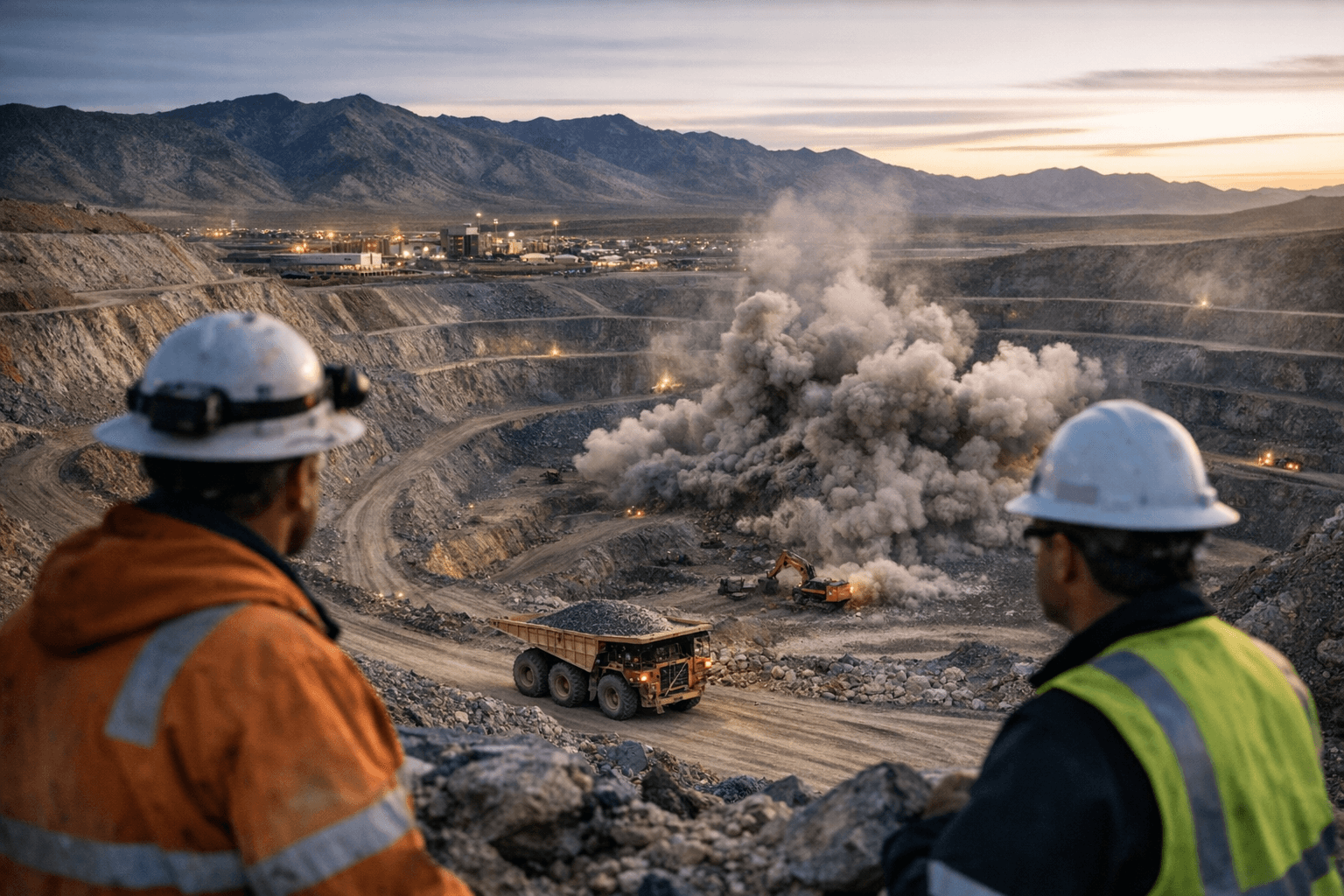
Open-pit gold mining at the scale Round Mountain operates requires regular blasting to fracture ore and waste rock before haul trucks can move material. Blasts generate ground vibrations and airblast overpressure that residents within several miles can feel as a concussive thump or a rattling of windows. Nevada mining law requires operators to control ground vibration and airblast within permitted limits, but those thresholds are set to protect structures, not to eliminate the sensory experience of proximity to an industrial blast.
As Phase X underground construction accelerates, blast character may change: underground detonations are generally more contained than open-pit shots, but surface activity, including portal construction, haul road development, and continued open-pit stripping in adjacent areas, will continue. If you notice an increase in vibration frequency or intensity, the sequence to follow is: document the date, time, and nature of the event; contact Kinross' community relations office directly; and, if unresolved, file a complaint with the Nevada Division of Environmental Protection's Bureau of Mining Regulation and Reclamation, which conducts regular compliance inspections at active mine sites.
Dust, Air Quality, and What to Watch
Fugitive dust is the most persistent day-to-day air quality concern near any large open-pit mine. At Round Mountain, dust sources include active pit faces, haul roads, waste rock placement, heap leach pad surfaces, and wind erosion across disturbed ground. An environmental assessment for an earlier Round Mountain expansion found that cumulative dust impacts were expected to be short-term and localized, provided the operator maintained controls such as water truck suppression on haul roads and revegetation on inactive surfaces.
Residents should track air quality through NDEP's publicly available permit files and inspection reports for Round Mountain, which are searchable through the Bureau of Mining Regulation and Reclamation database. Dust complaints can also be directed to the Nevada Division of Environmental Protection directly. Watch for permit amendments tied to Phase X construction that would authorize new surface disturbance areas, as each new disturbance footprint triggers updated dust control plan requirements under state regulations.
Groundwater, Wells, and the Heap Leach Question
Water is the sharpest long-term concern in an arid basin like the one surrounding Round Mountain. Open-pit mining removes groundwater from the pit floor through dewatering wells, altering the local water table in ways that can affect nearby private wells over years or decades. The heap leach process, in which cyanide solution is applied to crushed ore stacked on engineered pads, poses a separate contamination risk: liner failures or solution spills can mobilize metals and process chemicals into shallow alluvial aquifers.
The Nevada State Engineer's office issues and tracks water rights for mining operations, and those filings are public record. NDEP's Water Pollution Control Permits for Round Mountain govern liner standards, leak detection requirements, and groundwater monitoring well networks around the heap leach pad. If your well shows changes in taste, odor, or chemistry, the first call should be to NDEP's Bureau of Mining Regulation and Reclamation. Baseline well-water testing records, if you have them, are invaluable in establishing whether any change predates or postdates mine activity.
Traffic and Road Wear on SR-376
The haul trucks that move ore and waste rock within Round Mountain's permit boundary do not travel public highways, but the mine's workforce, supply chain, and contractor fleet absolutely do. State Route 376 north of Tonopah absorbs daily traffic from mine employees commuting on the 7-on/7-off, 12-hour shift schedule that Kinross uses for most site positions, as well as fuel tankers, reagent deliveries, equipment transports, and contractor vehicles. During Phase X construction, which involves portal development, conveyor installation, and underground infrastructure buildout, the volume of oversized loads and heavy equipment on SR-376 is likely to increase.
Pavement wear from heavy loads is cumulative and accelerates on roads that are already lightly maintained. Monitor Nevada Department of Transportation's project pages for SR-376 for planned resurfacing and any load restriction postings. Oversized load movements typically require advance permits from NDOT and may be accompanied by pilot cars; travel timing around early-morning and end-of-shift windows (typically around 6 a.m. and 6 p.m.) will overlap with the heaviest mine-related traffic.
Emergency Response Capacity
A working open-pit and underground gold mine brings both industrial hazard and emergency response capacity to a rural area. Kinross maintains an on-site emergency response team trained for industrial incidents including fires, chemical spills, and underground rescue. For the broader community, the mine's presence has historically contributed to Nye County's healthcare and public safety infrastructure, including improvements in local health services.
However, rural Nye County's public emergency response resources remain thin relative to the mine's workforce size. Residents should know their nearest emergency contact points: Tonopah is the nearest significant service hub, and Nye County's Emergency Management office coordinates with the mine operator on mutual aid agreements. If Phase X underground development proceeds to full production, the permanent underground workforce will add a new category of industrial emergency scenario that county and state responders will need to be prepared to support.
Your Watch List: Permits, Reports, and Notification Channels
Tracking what the mine is authorized to do, and whether it is doing it, requires monitoring several distinct regulatory channels simultaneously. Below are the specific instruments that matter most:
- NDEP Water Pollution Control Permit for Round Mountain: governs heap leach pad construction, liner requirements, groundwater monitoring wells, and stormwater management. Available through NDEP's Bureau of Mining Regulation and Reclamation permit database.
- BLM Plan of Operations and NEPA documents: any significant new surface disturbance on federal land, including Phase X portal development, requires an Environmental Assessment or Environmental Impact Statement. These are filed through the Bureau of Land Management's ePlanning portal and are open for public comment during scoping and draft periods.
- Nevada State Mining Authorization: Kinross was expected to finalize its state authorization modification for Phase X in Q1 2026. State-level mine permits are tracked through the Nevada Division of Minerals.
- Nevada State Engineer water rights filings: any change to dewatering volume or new well installation by the mine operator requires a water rights action. These are searchable through the State Engineer's online database.
- Nye County Agenda Center: county commission meetings address mine-related land use, special use permits, and fiscal agreements. Meeting agendas are posted at the Nye County Agenda Center website at least three days before each session.
- Kinross investor relations releases: the company publishes quarterly production reports and news releases that include Round Mountain-specific output, capital spend updates, and project timeline revisions. These are the earliest public signal of major operational changes.
- NDEP complaint line: for dust, water quality, or other environmental concerns, NDEP accepts complaints through its online portal and by phone. Document the date, time, weather conditions, and nature of the issue before filing.
The Long View on Post-Mining Land Use
Nevada mining law requires operators to submit and fund reclamation plans that return disturbed land to a stable, productive condition after mining concludes. For Round Mountain, where open-pit mining has created a pit that will eventually fill with groundwater to form a pit lake, post-closure planning is a multi-decade obligation. Kinross is required to maintain a reclamation bond sufficient to cover closure costs, and NDEP reviews that bond amount periodically.
The transition from a producing mine to a closed facility changes the county's economic equation sharply: tax revenues decline, employment contracts, and the infrastructure built to serve the mine must find new purpose or be decommissioned. Phase X's mine life extension means that reckoning is further away, but Nye County's long-term planning should account for it. Residents and county officials who engage now with reclamation plan public comment periods are positioned to shape what northern Nye County looks like in the generation after gold.
This article was produced by Prism’s automated news system from verified source data, official records, and press releases, then run through automated quality and moderation checks before publishing. The system is built and supervised by the people who set the standards it runs under. Read our full AI policy.
Did this article answer your question?