Where to Find Geodes, Thundereggs and Agate Beds Near Gabbs, Nye County
Gabbs-area rhyolite flows yield quartz-lined geodes, thundereggs and agate nodules; expect gravel two-track approaches, minimal services in Gabbs and check BLM boundaries before you go.

The volcanic terrain around the small mining town of Gabbs produces geodes, thundereggs, and agate nodules from Tertiary rhyolite flows. That simple fact frames where to look in northern Nye County and what to expect when planning a trip: hard-packed volcanic rock, scattered pockets of attractive material, and access that runs on gravel and two-track roads.
Overview and purpose “Overview and purpose: This is a locally relevant, evergreen field guide-style resource for recreational rockhounds and outdoor visitors interested in collecting geodes, thundereggs and agate nodules in Nevada — with practical notes about locations near Gabbs in northern Nye County. The guide explain” This guide uses that premise to gather the explicit location notes, specimen descriptions, road and vehicle guidance, and land-status warnings in the available local material so you can plan trips grounded in the facts.
Why Nevada produces geodes “Nevada is geode country. The state is 87% public land (BLM and National Forest), and the geology is dominated by Tertiary-age volcanic rock — rhyolite flows, welded tuffs, and volcanic ash deposits laid down between roughly 5 and 40 million years ago across the Basin and Range Province. This volcanic terrain is the same type that produces geodes, thundereggs, and agate nodules throughout the western US.” That passage explains the why: the Basin and Range’s Tertiary rhyolite flows and associated welded tuffs create cavities and silica-rich fillings ideal for quartz-lined geodes, chalcedony shells, thunderegg interiors and agate nodules. The statewide context—87% public land—also means many collecting opportunities sit on BLM or National Forest ground rather than private parcels.
Where to look near Gabbs “The Paradise Range and Gabbs Valley Range contain known geode-bearing outcrops.” Focus searches on outcrops in those ranges east and south of Gabbs, where Tertiary rhyolite host rock is reported. “The geodes are quartz-lined with chalcedony shells, similar to the Garfield Hills material. Some specimens contain blue chalcedony or pink opal fills.” Those descriptive details tell you what to expect when you crack a nodule: quartz crystals lining the cavity, a chalcedony shell, and occasional colored fills such as blue chalcedony or pink opal that raise collector interest.
Access, services and terrain around Gabbs “Gabbs itself has minimal services (gas station, small store). The collecting areas are accessed from gravel and two-track roads east and south of town.” Plan logistics accordingly: fuel and basic supplies are limited in the small mining town of Gabbs, so top off before you head into two-track country. “The terrain is typical Nevada basin-and-range — valley floors at 4,500 to 5,000 feet surrounded by low mountain ranges reaching 7,000 to 8,000 feet,” a useful elevation profile for anticipating temperature swings and travel times between valley and ridge. For vehicle guidance the available material for this area states, “Vehicle: High-clearance recommended.”
Southern Nevada volcanic fields: Lincoln and Nye Counties “5. Southern Nevada Volcanic Fields (Lincoln and Nye Counties) [...] GPS (general area): 37.50°N, 115.20°W” If you expand your search southward, the southern volcanic fields of Lincoln and Nye counties also yield material, though it is described as more scattered. “Tertiary rhyolite flows in the volcanic fields of Lincoln and Nye counties produce scattered geodes and thundereggs. The Delamar Mountains, Hiko Range, and Pahranagat Range all contain volcanic rock with geode potential. This area is less well documented than northern Nevada localities, which means less collecting pressure but also less reliable information about specific productive outcrops.” Land status for the southern area is explicit: “Land status: BLM — public land (verify boundaries near Nellis Air Force Range).” The vehicle recommendation in that section is also specific: “Vehicle: High-clearance 4WD.” Importantly, the material includes a legally critical warning: “Warning: The Nellis Air Force Range and Nevada Test Site border this area. Do not cross onto military land — boundaries are marked and enforced. Verify your position with GPS and BLM maps before collecting.”
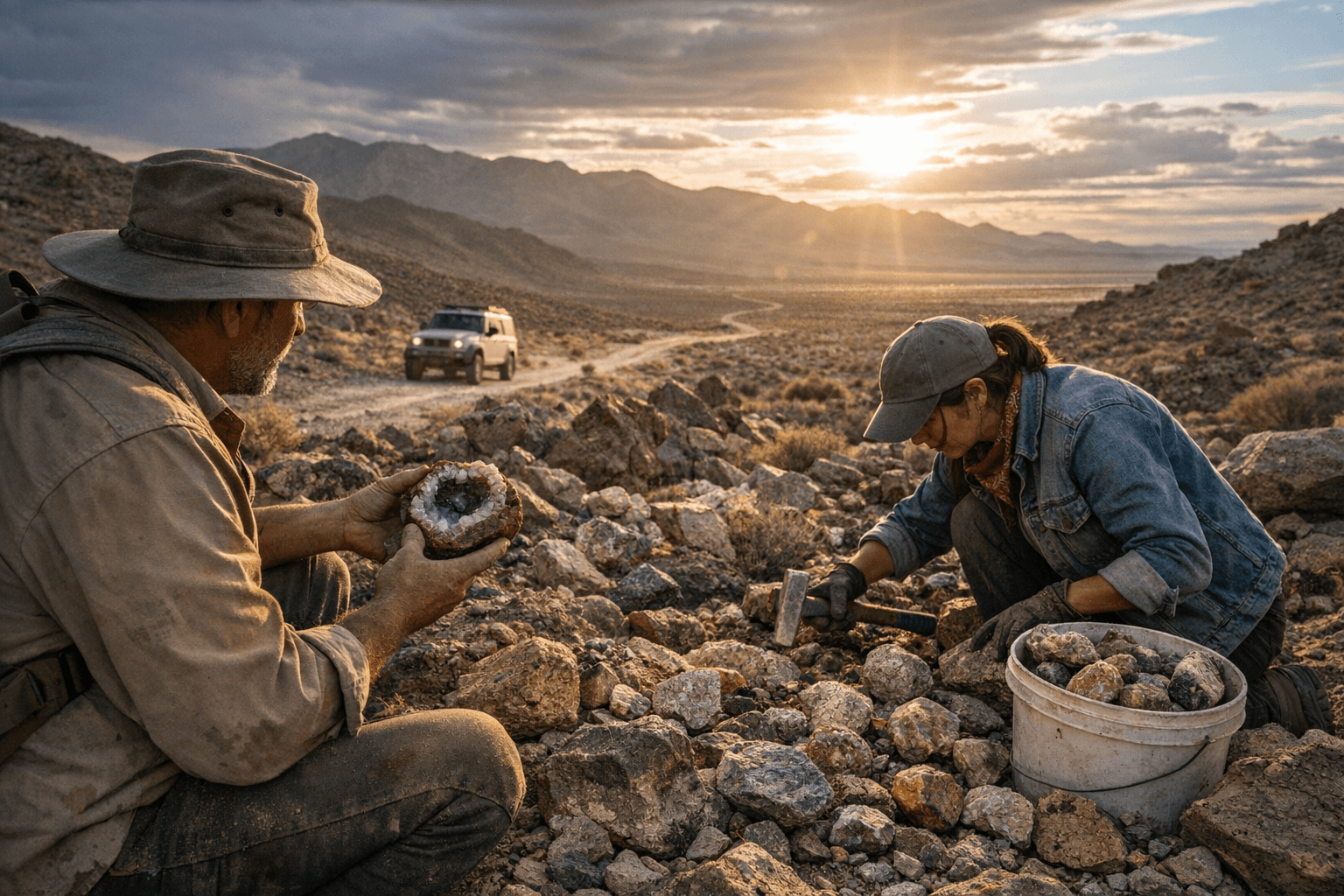
- Expect Tertiary rhyolite-hosted geodes, thundereggs and agate nodules in the Gabbs-area volcanic terrain.
- Near Gabbs, search the Paradise Range and Gabbs Valley Range; access is by gravel and two-track roads east and south of town.
- Sample appearance to anticipate: quartz-lined interiors, chalcedony shells, and occasional blue chalcedony or pink opal fills, similar to Garfield Hills material.
- Services in Gabbs are minimal, limited to a gas station and a small store.
- Vehicle guidance: “Vehicle: High-clearance recommended” for Gabbs-area approaches; for the southern volcanic fields use “Vehicle: High-clearance 4WD.”
- Land and boundary checks: Nevada is 87% public land, but “Land status: BLM — public land (verify boundaries near Nellis Air Force Range).” “Do not cross onto military land — boundaries are marked and enforced. Verify your position with GPS and BLM maps before collecting.”
Practical takeaways and checklist
Reconciling vehicle guidance and documentation gaps Two explicit vehicle phrases appear in the compiled material and should be preserved as written: “Vehicle: High-clearance recommended” (Gabbs-area notes) and “Vehicle: High-clearance 4WD” (southern volcanic fields). Similarly, documentation differs by area: northern Nye County localities are comparatively better documented, while the southern fields are “less well documented,” which means less collecting pressure but also fewer reliable reports of productive outcrops. Treat both conditions as factual constraints rather than assumptions when you plan.
Reporter follow-ups and verification items The supplied material flags several verification steps before publishing more prescriptive directions: confirm precise BLM boundary maps for Paradise Range and Gabbs Valley Range outcrops; verify whether any specific collecting permits or local restrictions apply on BLM or National Forest lands in Nye County; and obtain precise coordinates for productive outcrops if you plan to publish detailed maps. The southern area’s general coordinate, 37.50°N, 115.20°W, is given as a starting point but not as a definitive outcrop location.
Final note The facts gathered here point to a clear local pattern: Tertiary rhyolite flows around Gabbs and in parts of southern Nevada produce attractive quartz-lined geodes, thundereggs and agate nodules, but the work of finding them depends on careful planning, boundary verification and appropriate vehicles. With those checks in place and respect for marked military and BLM boundaries, these parts of Nye County offer genuine field-collecting opportunities grounded in the region’s volcanic geology.
This article was produced by Prism’s automated news system from verified source data, official records, and press releases, then run through automated quality and moderation checks before publishing. The system is built and supervised by the people who set the standards it runs under. Read our full AI policy.
Did this article answer your question?