Burnt HVAC motor sends firefighters to Port Jervis High School
Smoke inside Port Jervis High School sent crews rushing in, but firefighters traced it to a burnt rooftop HVAC motor and found no other hazards.
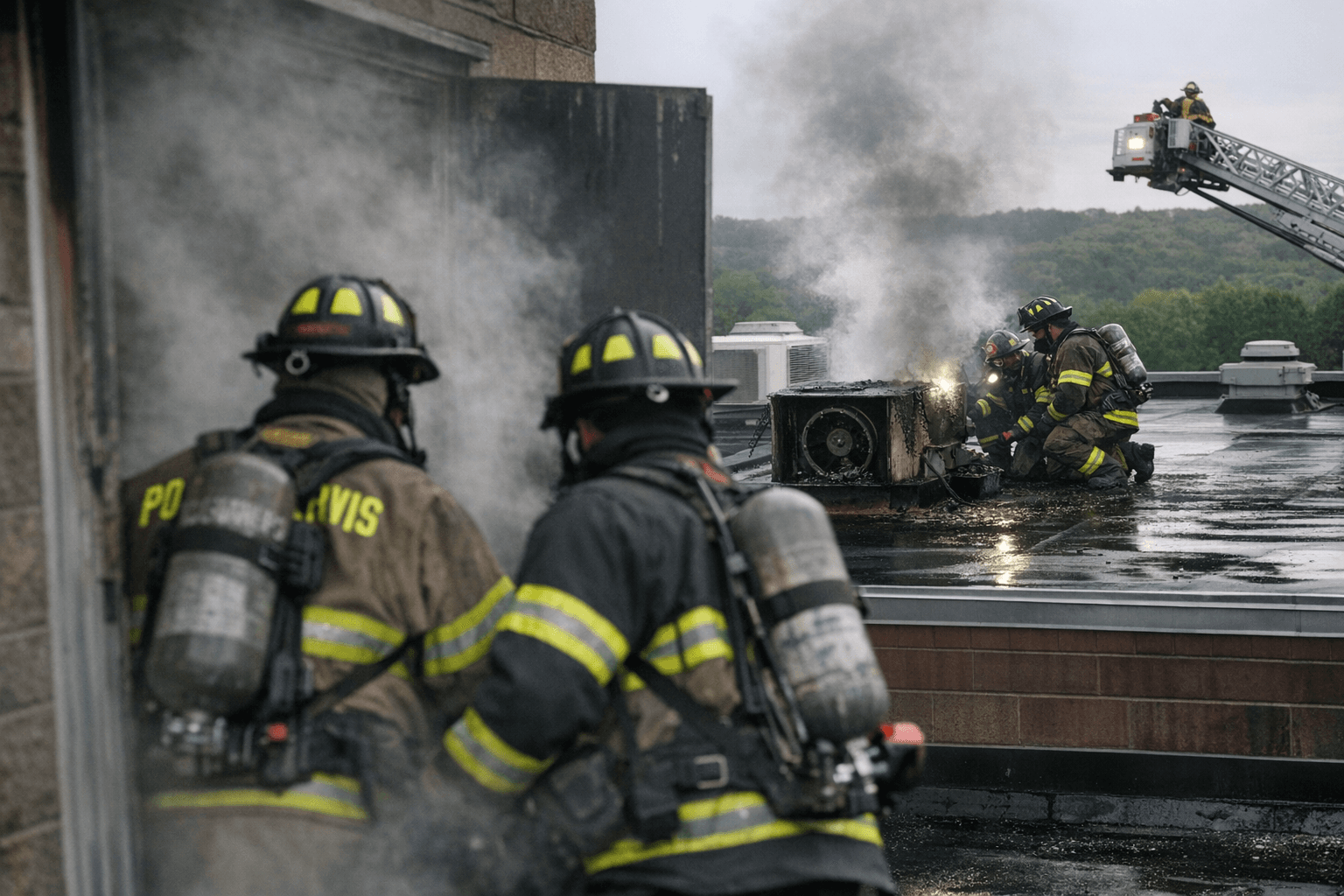
Smoke inside Port Jervis High School triggered a fast-moving response Thursday night, April 9, as crews from the Port Jervis Fire Department and Huguenot Fire Department were dispatched to the building on 10 Route 209 in Port Jervis.
Firefighters investigated the smoke condition inside the school and then moved to the roof, where they traced the problem to a burnt motor in a rooftop HVAC unit. The finding ruled out a structural fire and a classroom emergency, and the department said no other hazards were found.
Photos shared by the Port Jervis Fire Department showed multiple fire units on scene as crews worked both inside the building and above it to pinpoint the source and make sure the system was safe. In a school setting, that kind of response matters because even a brief smoke event can force immediate questions about evacuation, air quality and whether students and staff can stay in the building.
Port Jervis Senior High School is a regular public school serving grades 9 through 12. The National Center for Education Statistics lists 743 students for the 2024-25 school year, along with 62.63 classroom teachers and a student-teacher ratio of 11.86. The broader Port Jervis City School District enrolled 2,265 K-12 students in 2024-25, according to the New York State Education Department.
The incident also lands in the context of New York’s school safety rules. Education Law section 807 requires drills for sudden emergencies, while section 807-a requires school buildings to be inspected at least annually for fire hazards. That framework is designed for exactly this kind of situation, when a mechanical failure can look far more serious before responders determine what actually happened.
Orange County’s Division of Fire Services plays a role in that larger safety net as well. The county office coordinates firefighting resources and mutual aid and provides technical support, including fire investigation and hazardous materials response, which helps explain how local departments can move quickly on a school call that could have turned into a larger emergency.
For Port Jervis families, the outcome was limited to disruption rather than damage. The smoke came from a mechanical failure, not a fire spreading through the school, but the response underscored how quickly an HVAC problem can become a public safety concern inside a crowded public building. The question now is whether this was an isolated scare or a warning sign the district has to address.
This article was produced by Prism’s automated news system from verified source data, official records, and press releases, then run through automated quality and moderation checks before publishing. The system is built and supervised by the people who set the standards it runs under. Read our full AI policy.
Did this article answer your question?