How to Track Criminal Cases Through Orange County Courts Online
Orange County courts process over 1,700 DWI cases a year; here's exactly how to follow any one of them from arraignment to sentencing using free state tools.
Nicholas Cicio, 31, of Newburgh received a sentence of one and one-third to four years in state prison at Orange County Court in Goshen on March 26, 2025, after pleading guilty to Vehicular Assault in the First Degree. District Attorney David M. Hoovler's office posted the announcement that afternoon. Within hours, the case was effectively closed on the public docket. If you had not been tracking it since arraignment, you almost certainly missed the sentencing date entirely.
That gap between what happens in a Goshen courtroom and what the public actually sees is the problem this guide solves. Orange County's courts process roughly 21,000 criminal cases each year across 59 separate local criminal courts, including more than 1,700 DWI cases and over 2,000 misdemeanor drug matters. Most of those cases move through the system with little public notice. Here is how to follow any one of them, from first appearance to final judgment, using tools that are free and largely available from your phone.
Start by identifying the right court
Before you search for anything, you need to know which courthouse holds the case. In Orange County, that answer depends on the charge. Felonies and serious violent crimes are heard in Orange County Court, which sits at the county seat in Goshen. Misdemeanors and minor violations typically land in one of the county's town or village courts; Goshen Town Court, for instance, hears all criminal and traffic matters arising from incidents in that jurisdiction, with its own weekly calendar set by the court clerk. Some major criminal matters can also move through New York Supreme Court depending on the circumstances of the charge.
Federal charges are a separate track entirely. Cases involving federal statutes or agencies go to the U.S. District Court for either the Southern District or Northern District of New York, not to any state courthouse in Goshen. Most local violent-crime prosecutions, the DWIs, assaults, and public-corruption cases that dominate Orange County's court calendar, stay in County Court and are handled by the District Attorney's Office. Confirming state versus federal jurisdiction first will save you from searching the wrong system entirely.
Search the public docket using New York's eCourt tools
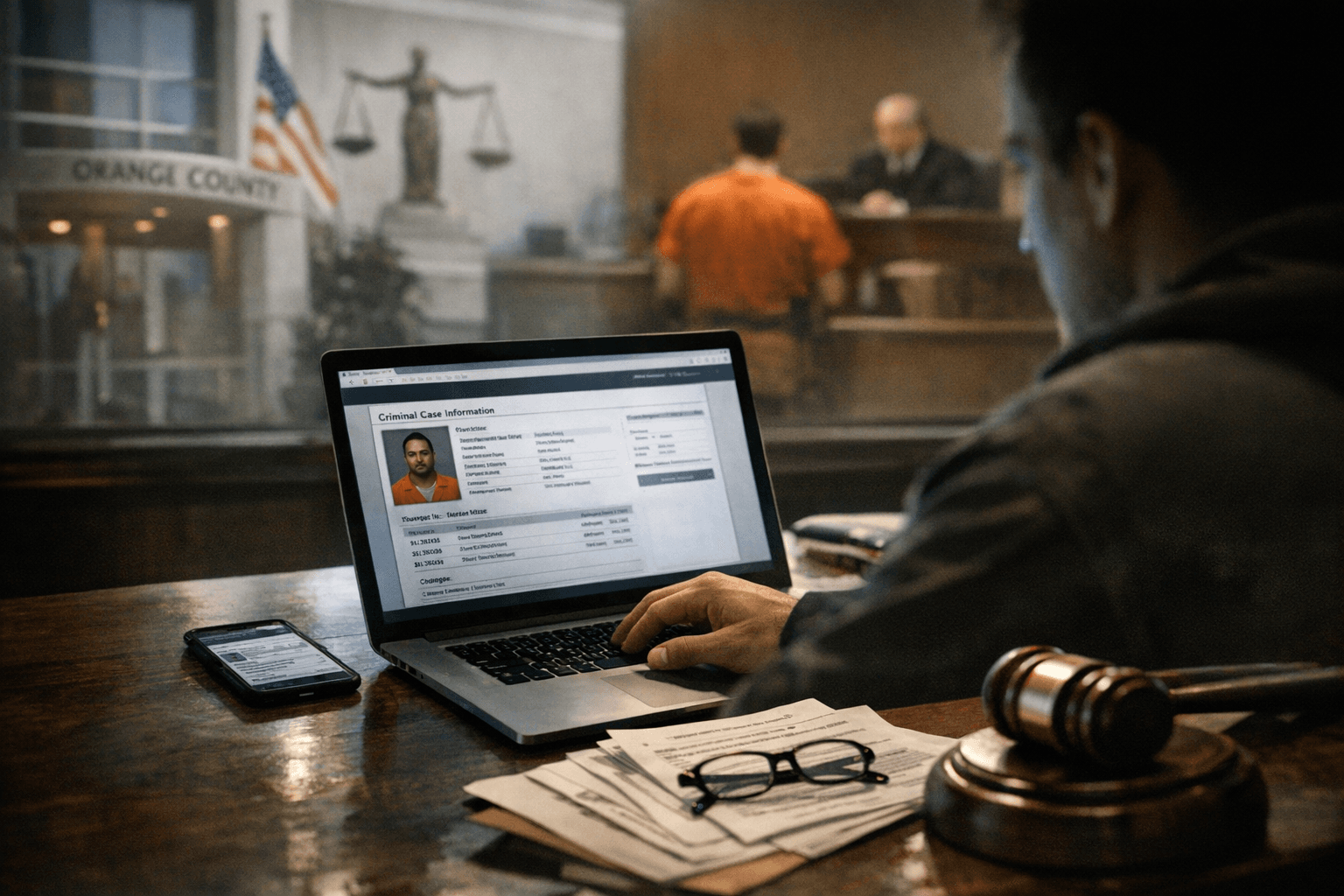
Once you know the court, the New York Unified Court System gives you two primary online portals. The first is eCourts, available through the state's court system website, which provides future appearance dates for cases in Criminal and Family Courts and allows you to view both active and disposed cases. The second is NYSCEF (New York State Courts Electronic Filing), which holds electronic filings for cases that have been e-filed. You can search both systems as a guest without creating an account, using a party name, case or index number, or the assigned judge's name.
For ongoing cases, sign up for eTrack through the eCourts platform. It sends email alerts when docket activity is recorded on cases you are watching, which matters enormously for fast-moving matters. A DWI case like the Cicio matter can move from guilty plea to sentencing in a single session; a public-corruption case can drag through years of motions, adjournments, and sealed hearings. eTrack removes the need to manually check every morning.
Work directly with the Orange County Clerk
Not every Orange County case is fully digitized. Older cases, Local Criminal Court matters from town and village courts, and records from proceedings that predate electronic filing may exist only in paper form at the courthouse. For those, contact the Orange County Clerk's office directly. The clerk maintains the official docket and can confirm the next scheduled appearance date, the precise charging instrument (indictment, superior court information, or complaint), and what portions of the file are accessible to the public.
The clerk is your authoritative source. When publishing a hearing date or case status, cite the clerk's office as confirmation rather than relying solely on a DA press release or a third-party court-records aggregator. For records that require a formal written request, the Orange County Clerk's office processes those requests and can direct you to the correct form. The county's online records search, provided through a records management platform, covers some court documents and can be a useful starting point before making a formal request.
What is public, what is sealed, and how to request what is not posted
The general rule in New York is that the public can view any legal or court document except matrimonial records and sealed records. Sealed records in criminal cases typically include cases that were dismissed and sealed under state law, juvenile matters, and portions of cases under active protective orders. The clerk will tell you which parts of a file are sealed and, where applicable, the legal basis for the sealing; they will not hand over sealed documents regardless of the request.
When documents are not posted online and you believe they should be public, New York's Freedom of Information Law (FOIL) is the mechanism to use. A FOIL request submitted to the Orange County Clerk's office or to the relevant court clerk compels a formal response. You do not need a lawyer to file a FOIL request, but you do need to be specific: identify the case number, the type of document you are seeking, and the date range. For sealed records you believe were improperly sealed, FOIL is not the right tool; that requires a court application.
A note on minors: cases involving defendants under 18, and in many circumstances victims under 18, carry additional privacy protections. Do not publish names from records involving minors without consulting the relevant statutory authority and, if you are working for a news outlet, your editor or legal counsel.
Follow DA announcements and court calendars in tandem
District Attorney Hoovler's office, like most county DA offices in New York, posts sentencing announcements, indictments, and conviction statements directly to the county government's website and social media channels. These releases are valuable, authoritative, and fast; the Cicio sentencing announcement went up the same day as the hearing. But they represent the prosecution's framing of the outcome and should always be checked against the court docket for the complete legal context, including counts that were dismissed, plea agreements, and restitution orders that may not make the headline.
Local court calendars, posted weekly by individual courthouses, list arraignments, motion hearings, trials, and sentencing sessions. For a high-profile DWI or corruption case, the morning of any scheduled hearing is the critical check: defense attorneys and prosecutors file motions that can adjourn, accelerate, or restructure a proceeding with very little public notice. A docket check at 8 a.m. on hearing day can prevent a wasted trip to Goshen and, more importantly, will surface any last-minute filings that change what you expect to see in the courtroom.
Practical tips for following cases accurately
- Always verify defendant names and spellings against the court docket, not a police press release. Clerical differences in spelling can send you to the wrong case file.
- Distinguish rigorously between an arrest, a charge, and a conviction. An arrest record is not evidence of guilt; a charge is an allegation; a conviction follows a guilty plea or a jury verdict.
- Use the official charging instrument, whether that is a grand jury indictment, a superior court information, or a felony complaint, to identify the precise statutory counts. DA press releases often use shorthand that omits relevant legal nuance.
- For cases involving digital or forensic evidence, look for chain-of-custody entries in the docket and seek copies of dispositive orders that reference laboratory or forensic analysis. These filings are typically public and provide the evidentiary backbone of the prosecution's case.
- Subscribe to DA Hoovler's press office, the New York State Police Troop F public information feed, and local police department news releases for immediate notification of arrests and indictments that precede any court filing.
Getting alerts and sustaining coverage
The combination of eTrack notifications, DA press releases, and weekly court calendars covers most of what you need to follow a case end to end. For matters that generate prolonged public interest, the county government's website at orangecountygov.com and the New York Unified Court System's CourtHelp pages provide orientation on rights, procedures, and formal records-request pathways. The eCourts and NYSCEF portals are where the actual searching happens.
Orange County's courts produce consequential outcomes every week: prison sentences, acquittals, corruption pleas, and DWI convictions that directly affect families across Newburgh, Middletown, Port Jervis, and every town in between. The information to track those outcomes is largely public and largely free. The barrier has always been knowing exactly where to look.
This article was produced by Prism’s automated news system from verified source data, official records, and press releases, then run through automated quality and moderation checks before publishing. The system is built and supervised by the people who set the standards it runs under. Read our full AI policy.
Did this article answer your question?