Middletown’s Hillside Cemetery reflects Vaux and Olmsted’s landscape legacy
Hillside Cemetery is Middletown’s rare 52-acre landscape of bluffs, lakes and memorial art, linking Orange County history to Vaux and Olmsted’s design legacy.
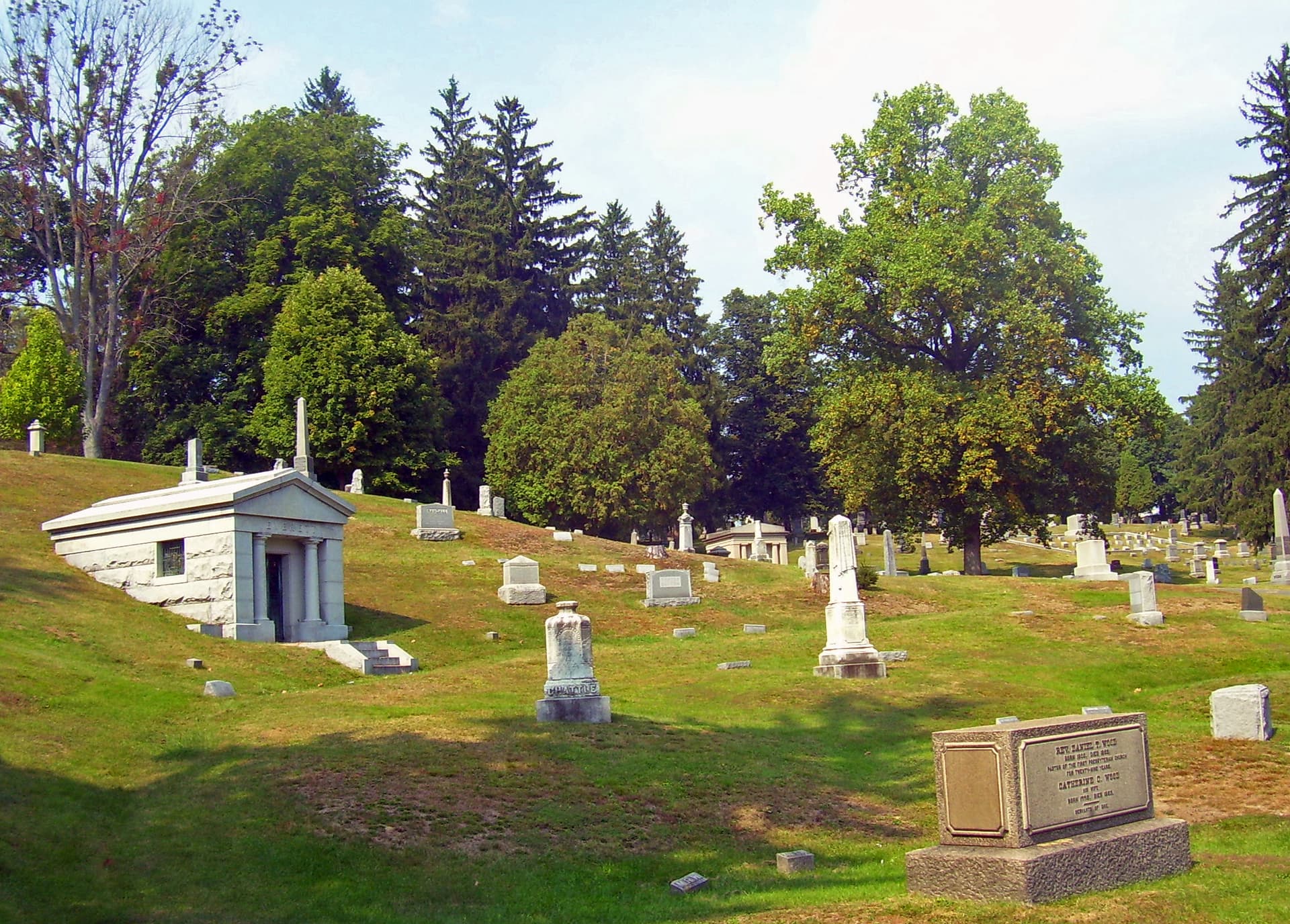
Hillside Cemetery is one of Middletown’s most revealing historic places because it is not just a burial ground. It is a designed landscape, a civic archive, and a visible record of how Orange County grew around memory, craftsmanship, and public space. Set on 52 acres and only about 60 miles from Manhattan, the cemetery still shows the reach of Calvert Vaux and Frederick Law Olmsted’s rural cemetery vision in a setting that feels distinctly local.
A landscape built to be visited
Hillside began in 1860, when the Hillside Cemetery Association bought 44 acres of sloping farmland near Middletown. The cemetery opened the following year, and its layout was shaped by Vaux with Olmsted’s assistance, placing it squarely in the 19th-century rural cemetery movement that treated burial grounds as parks for remembrance, reflection, and public use. Instead of a flat grid of graves, the original plan used bluffs, gravel walks, and a perimeter drive to turn the hillside itself into part of the design.
That landscape still matters because it connects Middletown to a larger story in American planning. Vaux and Olmsted were already collaborating on Central Park, and Hillside shows the same design language scaled to a smaller Hudson Valley setting. The cemetery’s entry on Mulberry Street was meant to be part of that experience, drawing people from town into a carefully arranged landscape rather than separating the cemetery from daily life.

What makes the design so distinctive
The original plan was more ambitious than a typical 19th-century burial ground. Existing springs and streams were diverted to create two lakes, and more than 2,000 trees and shrubs were planted, including cypress, magnolia, and elm. Those details help explain why Hillside still reads like a designed landscape rather than simply a place of internment. The terrain, water, and tree canopy were all part of the architecture.
That design legacy also explains why Hillside has drawn preservation attention for generations. In 1986, the cemetery association hired landscape architect Louis Miller Jr. to rehabilitate and expand the grounds. His work included paving the central drive, adding a new entrance ensemble that memorialized Vaux, and creating a new master plan for future burials. A stone chapel built in 1930 later became a gatehouse residence, another layer in the site’s long evolution from 19th-century landscape experiment to functioning community cemetery.
What you see on a walk through the grounds
A visit to Hillside is best understood as a walk through several overlapping histories. There are several thousand graves, and the cemetery contains notable 19th-century funerary art, including mausolea, obelisks, and ornamental headstones. Those markers do more than identify the dead. They show family status, changing tastes in monument design, and the material culture of Middletown and the wider Orange County area.
The cemetery’s artistic features are part of what makes it feel like an outdoor archive. The stones, paths, trees, and slopes preserve evidence of how people wanted to be remembered, and how a growing railroad and manufacturing town presented itself in stone. That is why Hillside is useful not only to historians but to anyone trying to understand Middletown as a place shaped by commerce, civic pride, and community memory.
- The Mulberry Street entrance, which still frames the transition from town to cemetery grounds
- The bluffs and perimeter drive, which reveal the original rural cemetery layout
- The two lakes created from diverted water sources, a key feature of the site’s design
- The chapel and gatehouse area, which reflect later adaptations of the landscape
- The variety of monuments, from mausolea to obelisks to carved headstones, that turn the cemetery into a record of local taste and family history
A visit can focus on a few clear elements:
Why Hillside belongs in Orange County’s preservation conversation
Hillside was listed on the National Register of Historic Places on September 7, 1994, which formally recognizes what the grounds already show in person: this is a protected historic resource with significance far beyond Middletown. Its association with Vaux and Olmsted places it in the same design tradition that shaped major American landscape history, while its everyday use keeps it rooted in Orange County life.
That dual identity is what makes preservation so important now. In a county where land use, growth, and redevelopment are constant pressures, Hillside demonstrates that some places hold value precisely because they slow people down. The cemetery preserves not just graves but a way of seeing the land, one that connects public memory to ecological design and civic identity.
For Middletown, Hillside is more than a historic landmark. It is a place where the city’s past remains legible in topography, trees, and stone, and where Vaux and Olmsted’s influence can still be read without entering a museum. For Orange County, it stands as one of the clearest reminders that landscape architecture can shape memory as powerfully as any monument.
This article was produced by Prism’s automated news system from verified source data, official records, and press releases, then run through automated quality and moderation checks before publishing. The system is built and supervised by the people who set the standards it runs under. Read our full AI policy.
Did this article answer your question?