New Windsor Cantonment links Revolutionary War history to modern honor
Temple Hill in New Windsor ties Washington’s 1783 cease-fire to the Purple Heart’s local origin. The site still draws families, students and veterans year-round.

On Temple Hill in New Windsor, one Orange County site carries two of the nation’s most durable military stories: the end of the Revolutionary War and the living legacy of the Purple Heart. The New Windsor Cantonment and the National Purple Heart Hall of Honor sit side by side, turning a single stop on Route 300 into a place where national history and local memory meet in the open air.
A Revolutionary War ending preserved in Orange County
George Washington moved his army to New Windsor in October 1782 for winter quarters, and the cantonment grew into a major military community. By late December 1782, nearly 600 log huts stood on the site, which housed about 7,500 soldiers along with 500 women and children. Washington issued the cease-fire orders here on April 19, 1783, ending the eight-year War of Independence and closing the military chapter in a place that still feels removed from the modern strip of shops and roads below.
The word “cantonment” matters because it describes more than a temporary camp. It referred to a more permanent post than a tent encampment, and that idea is still visible in the way the site is interpreted today. New York State Parks places the New Windsor Cantonment State Historic Site on 120 acres of the original 1,600-acre cantonment, a scale that helps explain why the grounds still read as expansive rather than compressed into a museum lot.
The site is also part of the Hudson River Valley National Heritage Area Revolutionary War trail, which gives it a wider regional role beyond Orange County. It is listed on the National Register of Historic Places, with one source giving the listing date as July 31, 1972. That designation reflects more than the battlefield significance of the ground itself: it recognizes one of the clearest surviving landscapes connected to the war’s final phase.
What remains to see at New Windsor Cantonment
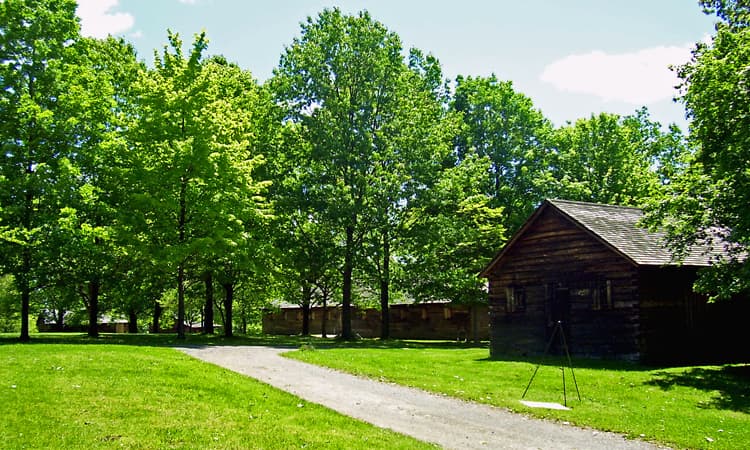
The site does not rely on a single plaque or one preserved building to tell its story. Year-round visitor-center exhibits, reconstructed structures and living-history demonstrations give the cantonment a working educational role instead of a static memorial feel. The Temple of Virtue, the Mountainville Hut and the Temple Hill Monument help visitors connect Washington’s winter headquarters to the daily routines of the soldiers who lived here.

The interpretive focus reaches into the practical details of 18th-century military life. Annual living-history programs center on the skills, labor and discipline that kept a winter encampment functioning, which makes the site especially useful for students and families trying to understand the Revolutionary War as more than dates and famous names. The landscape and the reconstructed buildings together show how a post that was once a military necessity became one of the Hudson Valley’s most important historical classrooms.
The visiting schedule is straightforward and built for year-round use. The grounds are open from sunrise to sunset throughout the year. Visitor-center exhibits are open Tuesday through Saturday from 10 a.m. to 5 p.m. and Sunday from 1 p.m. to 5 p.m., and the site is closed on most holidays except Presidents Day, Memorial Day, Independence Day and Veterans Day.
The Purple Heart Hall adds a second, modern layer
The National Purple Heart Hall of Honor turns the same New Windsor ground toward a later chapter in military memory. New York State Parks says the Hall commemorates the awarding of the Purple Heart to 136 local World War I veterans on these same grounds on May 28, 1932; another state reference places the number at nearly 138, but the historical point is the same. The Purple Heart itself is America’s oldest military decoration, which gives the site a direct line back to the Revolutionary era and George Washington’s decision to establish the award in Newburgh on August 7, 1782.
That local 1932 ceremony is why the Hall belongs here rather than in a distant capital city. The institution says its mission is to collect, preserve and share the stories of all Purple Heart recipients, and it is building the Roll of Honor as the nation’s foremost repository of Purple Heart recipients and their stories. The Hall’s Roll of Honor database allows visitors to search names and explore individual service stories, which makes the experience personal instead of abstract.
The Hall also gained a major physical upgrade in recent years. After a $17 million expansion, it officially reopened on Veterans Day, November 11, 2020, with new exhibits, better visitor circulation and improved audio-visual displays. General admission is free, and the Hall offers educational programs for schools, camps, Scout groups and organized adult tours, making it a strong stop for classes and civic groups as well as families passing through Orange County.
How to use the site as a day trip
The strongest way to experience New Windsor is to treat the cantonment and the Hall as one visit, not two separate attractions. Together they tell a full arc: the place where the Continental Army ended the war, and the site where the local legacy of Purple Heart service was formally honored generations later. That combination is rare, and it gives Orange County a historical anchor that goes beyond ceremonial holidays.
A practical visit can be built around a few simple stops:
- Start at the visitor center to get the Revolutionary War context, then walk the grounds while the daylight is still good.
- Look for the Temple of Virtue, the Mountainville Hut and the Temple Hill Monument to connect the landscape to the winter encampment.
- Move next door to the Purple Heart Hall to see how military sacrifice is interpreted for modern visitors through exhibits and the Roll of Honor.
- Plan around the posted hours, since the grounds and the exhibits run on different schedules.
What makes the site especially useful for Orange County is its scale and specificity. It is not a distant monument to a national story, and it is not a general museum of war. It is the place on Temple Hill where Washington’s cease-fire orders ended the Revolutionary War, and where the Purple Heart’s local history was placed into permanent public view.
This article was produced by Prism’s automated news system from verified source data, official records, and press releases, then run through automated quality and moderation checks before publishing. The system is built and supervised by the people who set the standards it runs under. Read our full AI policy.
Did this article answer your question?