Orange County Arboretum offers free year-round nature, learning in Montgomery
Free daily access, garden rooms, and quiet walking space make the Orange County Arboretum a practical Montgomery stop for families, gardeners, and anyone needing a low-cost outdoor reset.
A free public landscape with a practical purpose
The Orange County Arboretum in Montgomery is not just a place to stroll. It is a working public landscape, built on 35 acres of former pastureland, where trees, shrubs, and specialty plantings are arranged for both enjoyment and instruction. Open daily from dawn to dusk and free to enter, the arboretum gives Orange County residents a no-cost outdoor option that fits everyday life, whether the goal is a quiet walk, gardening ideas, or a few peaceful minutes away from traffic and routine.
The site is operated and maintained by the Orange County Parks Department in cooperation with the advisory Friends of the Orange County Arboretum, a nonprofit 501(c)(3). That partnership has shaped the arboretum into something more purposeful than a decorative garden. The county describes it as an environmental resource whose primary purpose is the display of tree collections, and the layout makes that mission visible in the way the grounds are organized.
What the arboretum offers on the ground
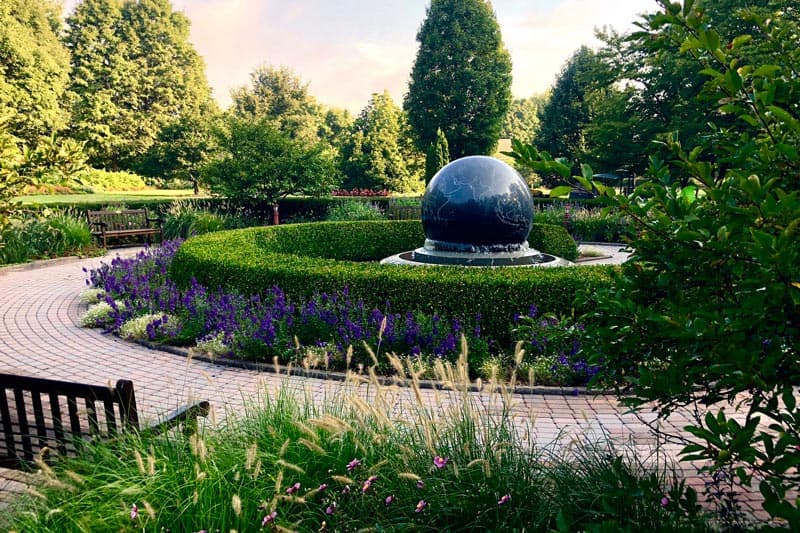
Visitors entering from the Grove Street entrance off State Route 416 find a landscape designed for repeated use, not a one-time photo stop. The arboretum includes pathways with teak benches, raised gardens, cascading water features, and the Ruth and Jim Ottaway Education Center. Picnic tables are available, and the setting is built to support both quiet visits and small gatherings.
The collection itself is arranged around botanical family relationships, tree habitats, and wetland characteristics, which gives the grounds a clear educational structure. That makes the arboretum useful for students, homeowners, and anyone comparing plant selections for landscape design in a Hudson Valley climate. It functions as an outdoor living laboratory, where the practical differences between species and growing conditions can be seen in real time rather than read about in a book.
The arboretum’s setting adds to that experience. It looks out toward the Shawangunk Mountains and borders the six-acre Al Durland Memorial Pond, giving the grounds a broader natural frame that changes with the seasons. The county’s rules are straightforward: admission is free, the arboretum is open daily rain or shine, and dogs are not allowed inside the grounds.
Why this space matters in Orange County life
In a county where development and traffic continue to grow around villages and transportation corridors, public open space carries a real civic value. The arboretum matters because it gives residents an accessible place to slow down without planning a long trip or paying for an attraction. For families looking for affordable recreation, it is one of the few places where a brief outing can also double as a chance to see, learn, and breathe.
That everyday usefulness is part of what sets the arboretum apart. Walkers can use it as a destination rather than just a pass-through. Gardeners can study how different trees and plantings perform. Parents can bring children to see the seasonal changes in a controlled landscape that still feels alive. County and arboretum materials also frame the site as a stress-reducing retreat, and the mix of benches, water, and plant collections gives that description practical weight.
The value is not only aesthetic. Free access means the arboretum lowers the barrier to outdoor recreation in a county where affordability matters as much as scenery. It helps make public land feel useful in daily life, not just impressive on special occasions.

Part of a much larger park system
The arboretum sits within Thomas Bull Memorial Park, which is itself a major county asset. The park spans more than 719 acres and is the second largest developed facility in the Orange County park system. That larger setting adds context to the arboretum’s role: it is one piece of a broad recreation network that includes an 18-hole golf course, driving range, banquet facility, tennis courts, boat house, ball fields, horse-riding area and stables, a 5-acre pond, fishing, picnic shelters, playgrounds, volleyball courts, horseshoe pits, Hill-Hold Historic Museum, and the arboretum itself.
The park’s roots go back to 1965, when development began with the acquisition of four dairy farms. In that same year, the park was renamed Thomas Bull Memorial Park after descendants of Thomas Bull donated adjacent 189 acres and the Hill Hold homestead. That history matters because it explains how a working landscape became a public park system that now serves a wide range of county needs, from recreation to education to historic preservation.
For visitors, the arboretum is one destination inside that larger map. A trip there can stand alone, or it can be part of a longer afternoon at the park with picnics, sports, or seasonal events nearby. The combination gives Montgomery and the surrounding county a place where a simple outing can stretch into an entire day without much cost or complexity.
Built over time through planning, grants, and volunteer effort
The arboretum’s current shape did not happen quickly. A master plan was drafted in 1990, the Orange County Legislature approved construction in 1993, and a $20,000 matching grant was secured in 1994 to buy trees for the gardens. The Education Building was erected in 1997 thanks to Ruth and Jim Ottaway, and Friends of the Orange County Arboretum, Inc. was incorporated in 1998.
That timeline continued with raised beds in 2002 and the Kosuga Greenhouse and classroom in 2004. Over time, the site added a water feature, perennial garden, Asian Maple Garden, Alpine Garden, Woodland Garden, Children’s Garden, Ceremony Garden, Veteran’s Garden, Remembrance Walkway and Garden, and an apiary. Each addition strengthened the arboretum’s identity as a place for both learning and reflection, with plantings that serve a public purpose rather than a purely ornamental one.
Holiday programming has also become part of the arboretum’s public life. Holiday Lights in Bloom was described as the 15th annual event in 2023, showing how seasonal programming has become part of the site’s identity across the year. In September 2025, County Executive Steve Neuhaus toured the arboretum with Peter Patel, identified as the horticulturist and president of the Friends group, and Parks Commissioner Travis Ewald, a sign that county leadership continues to view the grounds as an asset worth maintaining and improving.
A civic asset built for repeat visits
The Orange County Arboretum works because it serves several needs at once. It gives Montgomery and the wider county a free place to walk, a live demonstration of plant design, a quiet setting for families, and a year-round reminder that public land can be both useful and restorative. In a county that keeps changing, that combination is not a luxury. It is part of the basic infrastructure of quality of life.
This article was produced by Prism’s automated news system from verified source data, official records, and press releases, then run through automated quality and moderation checks before publishing. The system is built and supervised by the people who set the standards it runs under. Read our full AI policy.
Did this article answer your question?