Orange County grows as Hudson Valley faces aging, population gaps
Orange County’s gains are adding students, renters and commuters even as nearby Hudson Valley counties age and shrink, creating both opportunity and pressure.
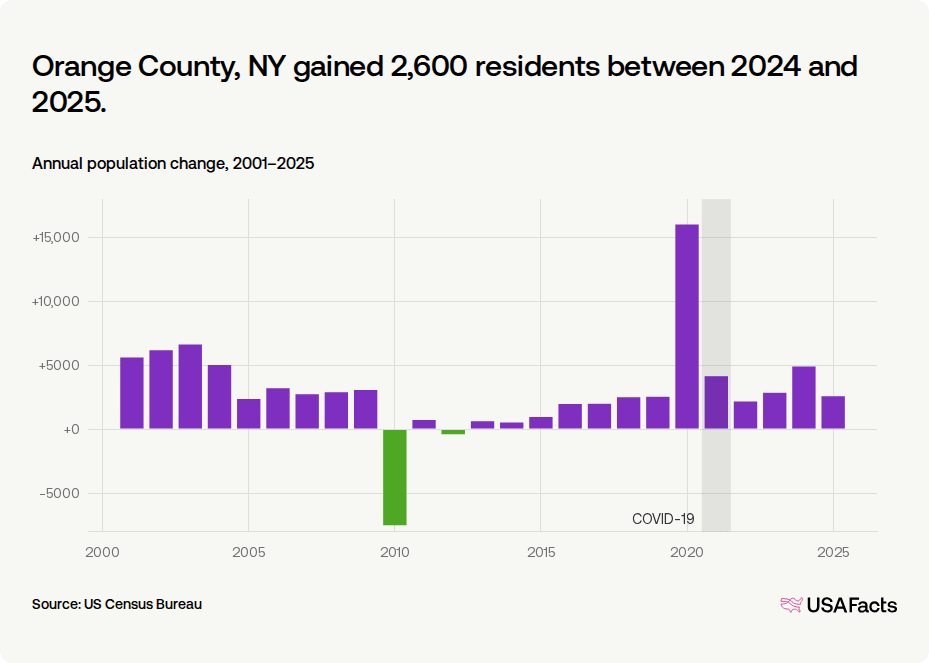
Orange County is still adding residents, and the change is already visible in places from Monroe to Palm Tree. That matters because the Hudson Valley is not growing evenly: some counties are aging faster, some are losing people to domestic migration, and the region’s schools, housing market and county budgets are absorbing those shifts in different ways.
Orange County is the Hudson Valley’s growth pocket
The Citizens Budget Commission of New York’s Competitive NYS dashboard makes the statewide paradox easier to see: New York can post overall population growth while many places outside New York City continue to lose residents or age faster than the state average. The broader pattern is clear in Census Bureau data covering 2020 through 2025, which show that migration has become a major driver of recent demographic change and that international in-migration has helped offset part of the domestic outflow.
Orange County sits on the stronger side of that divide. USAFacts estimates that about 417,700 people lived in the county in 2025, up by about 2,600 from 2024, making it the 12th-most populous county in New York and home to 2.1% of the state’s residents. A Straus News analysis of census data for Monroe, Woodbury, Tuxedo, Goshen, Chester, Warwick and Palm Tree found Orange County had the third-fastest growing population in New York State, underscoring how the county can keep gaining ground even when the broader Hudson Valley remains uneven.
That relative strength matters because population growth does not stay on a spreadsheet for long. In Orange County, it shows up first in the places that have room to grow, the districts that need to add seats, and the road network that must carry more daily trips.
Schools and housing feel the first squeeze
The education side of the story is one of the clearest pressure points. Planning documents prepared in 2017 for the Village of Kiryas Joel projected that the village’s population would rise from 22,851 in 2015 to 48,003 by 2027, with 42% of residents school age and student enrollment expected to grow by about 10,000. Those projections also said additional school facilities would be needed, a reminder that in fast-growing parts of Orange County, population change quickly becomes a classroom-capacity problem.
That same logic reaches beyond one village. When Orange County keeps adding households, housing demand rises for both owners and renters, especially in communities that already sit within commuting distance of jobs across the Hudson Valley and the New York City metro area. More residents also mean more pressure on municipal infrastructure, because new housing does not arrive alone, it brings more school buses, more utility demand and more need for local permits, inspections and services.
The contrast with shrinking places nearby is just as important. A county or town that is still losing residents may be able to breathe a little easier on school capacity, but it usually loses leverage on tax base, labor supply and the ability to spread fixed costs across more households. Orange County’s growth gives it the opposite problem: more demand to meet, even as the region around it remains brittle.
Commuting patterns are shifting with the population mix
Orange County’s growth also changes how people move through the Hudson Valley each day. More residents in Monroe, Woodbury, Tuxedo, Goshen, Chester, Warwick and Palm Tree means more commuting in every direction, toward local job centers, across county lines and, for many households, down toward larger labor markets. That has direct implications for traffic, parking, road maintenance and the timing of transit investments.
The Census Bureau’s release on decreasing net international migration slowing population growth nationwide is a useful reminder that movement, not just birth rates, is reshaping where people live and work. In Orange County, the practical result is a more complex commuting picture: the county can continue to attract families and workers while still depending on a regional economy that is not expanding evenly from county to county.
That matters for employers, too. A growing resident base can help businesses recruit workers and fill shifts, but it also raises the cost of doing business if housing is tight and the commute gets longer. In a place like Orange County, growth is an asset only if there is enough housing and enough transportation capacity to support it.
County services are being pulled in two directions
The Census Bureau’s release Older Adults Outnumber Children in 11 States and Nearly Half of U.S. Counties adds another layer to Orange County’s outlook. A county can grow overall and still age at the same time, which means the public sector ends up serving both more families and more seniors. Older populations rely more heavily on health care access, transportation and senior programs, so even steady population gains can translate into heavier service demand.
That is where Orange County’s position becomes especially complicated. The county is growing while the Hudson Valley as a whole faces the kind of domestic outmigration that Hudson Valley Pattern for Progress says left the region with a net departure of more than 10,000 people in 2021-2022 and nearly $600 million in local incomes relocating. Pattern for Progress has tied that population loss to affordable housing shortages, an aging population and high costs of living and taxes, a combination that weakens workforce retention even in places that are still attracting some new residents.
For Orange County government, the policy challenge is not just whether the county grows. It is what kind of growth it gets. A larger population can support retail, schools and local hiring, but it can also stretch housing, transportation and health and senior services if the county does not keep pace.
What Orange County’s growth means for the Hudson Valley
The regional map now has clearer winners and losers. Orange County is one of the Hudson Valley’s growth engines, with enough momentum to keep adding people while many nearby places remain stuck with aging populations and slower labor-force replenishment. Some communities will feel the upside first, especially where new housing, schools and employers can absorb more people; others will feel the strain first, especially where affordability is already weak and services are already thin.
That is why Orange County’s growth should be read as both opportunity and overcrowding. The county has room to capture jobs, investment and young families, but only if school enrollment, housing supply, commuting patterns and county services are planned around the reality that growth in the Hudson Valley is no longer broad-based. It is concentrated, uneven and increasingly tied to which places can still welcome people and which ones are still losing them.
This article was produced by Prism’s automated news system from verified source data, official records, and press releases, then run through automated quality and moderation checks before publishing. The system is built and supervised by the people who set the standards it runs under. Read our full AI policy.
Did this article answer your question?