Storm King Art Center blends sculpture and landscape in New Windsor
Storm King turns 500 acres in New Windsor into a living public landscape, with more than 100 sculptures, seasonal walking paths, and a 2025 expansion that widened access.
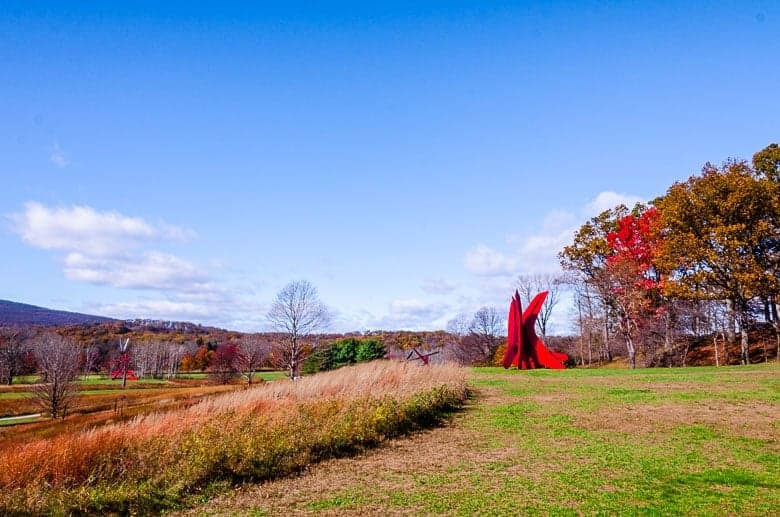
Storm King Art Center in New Windsor is not built like an indoor museum, and that is the point. On its 500 acres, Orange County residents move between rolling fields, woodlands, ponds, and open sky while more than 100 large-scale sculptures sit in the landscape, changing with the weather and the season. What makes it matter locally is not only what is on view, but that preserved open land remains available as a place people can return to again and again.
A landscape made for walking, not just looking
Storm King’s setting is the work as much as the sculptures are. The founders commissioned landscape architect William A. Rutherford to shape the grounds into a pastoral site with vistas, hills, meadows, ponds, stands of trees, allées, and walking paths, and the result still gives the place its distinct rhythm. The center says the landscape is meant to frame views, encourage movement, and support wildlife and seasonal change, which is why a visit in spring does not feel like a visit in late fall.
That experience is anchored by scale. The site spans about 500 acres and includes 100 acres of native grass meadows and hayfields, along with farmed fields, natural woodlands, lawns, wetlands, and water. For people coming from around Orange County, that means the grounds are large enough to hold a long walk without ever feeling enclosed, and open enough for the sculptures to be read against distant hills rather than against walls.
From a Hudson River School idea to modern sculpture
Storm King opened to the public in 1960, founded by Ralph E. Ogden and H. Peter Stern, co-owners of the Star Expansion Company in Mountainville. The original vision was a museum devoted to Hudson River School painting, but by 1961 the founders had committed to modern sculpture, and that turn defined everything that followed. The Ralph E. Ogden Foundation, Inc. made the initial gift that became the Museum Building and its surrounding property.
The collection took on its open-air identity quickly. In 1967, the purchase of 13 David Smith works pushed sculpture into the landscape itself, and early purchases were placed directly outside the Museum Building as part of a formal garden scheme. Over time, Star Expansion Company donated 300 contiguous acres and another 2,100 acres of Schunnemunk Mountain, preserving the viewshed that gives the site its broad, uninterrupted horizon.
Today, the collection includes works by Alexander Calder, Mark di Suvero, Andy Goldsworthy, Maya Lin, Louise Nevelson, Isamu Noguchi, Claes Oldenburg, Richard Serra, and David Smith. That mix matters because the art is not isolated from the land; it is tested by it. Distance changes the scale of each piece, wind changes the way it reads, and weather can alter a sculpture’s presence in a single afternoon.
The 2025 expansion changed how people enter and stay
Storm King’s growth in recent years has been driven by demand. Visitor numbers rose from about 80,000 in 2012 to nearly 222,000 in 2021, with projections of 240,000 in 2022, and the institution responded with its first-ever capital project. The $53 million expansion reopened in 2025 and added visitor welcome pavilions, accessible amenities, a dedicated conservation, fabrication, and maintenance building, and five acres of reclaimed landscape created from former parking lots.
The project was not only cosmetic. New York State backed it with an $11.3 million investment through the state’s arts, economic development, and energy agencies, underscoring how central the center has become to the Hudson Valley’s cultural and tourism economy. The design team brought together Heneghan Peng Architects, WXY Architecture + Urban Design, Reed Hilderbrand, and Gustafson Porter + Bowman, pairing building work with landscape restoration so the arrival experience feels less like a parking field and more like the beginning of the site itself.
A telling detail is the stewardship work beneath the surface. The landscape plan included replacing 24 maple trees with black gum trees, a reminder that maintaining an open sculpture park means treating planting, habitat, and sightlines as operational decisions. At Storm King, preservation is not frozen in place; it is managed continuously so the views remain open and the grounds remain usable.
Leadership, programming, and how to plan a visit
Storm King has also been formalizing its leadership as it grows. In late 2024, John P. Stern, grandson of Ralph E. Ogden and son of H. Peter Stern, moved from president to president and senior advisor after 16 years leading the institution. Nora Lawrence became the center’s first Executive Director, a change that reflects the scale of the operation and the long-term demands of running a major cultural landscape.
The programming continues to evolve alongside the grounds. Recent exhibitions, acquisitions, and residencies have kept the center active rather than static, with new work such as LinienLand by Alicja Kwade and a major 2024 Arlene Shechet exhibition showing that the institution is still commissioning and presenting contemporary art even as it preserves its permanent setting. The result is a place that works on two levels at once: as a destination for sculpture and as a public landscape that Orange County can claim as its own.
For visitors, the practical rhythm is straightforward. Storm King is open Wednesday through Monday from 10 a.m. to 6 p.m., rain or shine. That schedule makes it one of the county’s most dependable places to spend a half day outdoors, whether the goal is to walk the full grounds, return for a specific sculpture, or simply see how the same open land reads differently from one season to the next.
This article was produced by Prism’s automated news system from verified source data, official records, and press releases, then run through automated quality and moderation checks before publishing. The system is built and supervised by the people who set the standards it runs under. Read our full AI policy.
Did this article answer your question?