Farmer-Lunch Lady Speed Dating Event Brings Local Produce to School Cafeterias
26 of 36 Minnesota schools surveyed didn't know they could buy directly from local farms. A free roadshow is trying to change that for Otter Tail County cafeterias.
Sara George had one statistic she wanted every food service director in the room to absorb. Of the 36 institutions she surveyed before joining the Minnesota Farm to Kids Roadshow, 26 said they had no idea they could legally buy produce directly from a local farm.
"If you take nothing else from today, product of the farm is legal," said George, the farmer-focused program manager for the nonprofit Renewing the Countryside. "Farmers grow local foods. That's where food comes from."
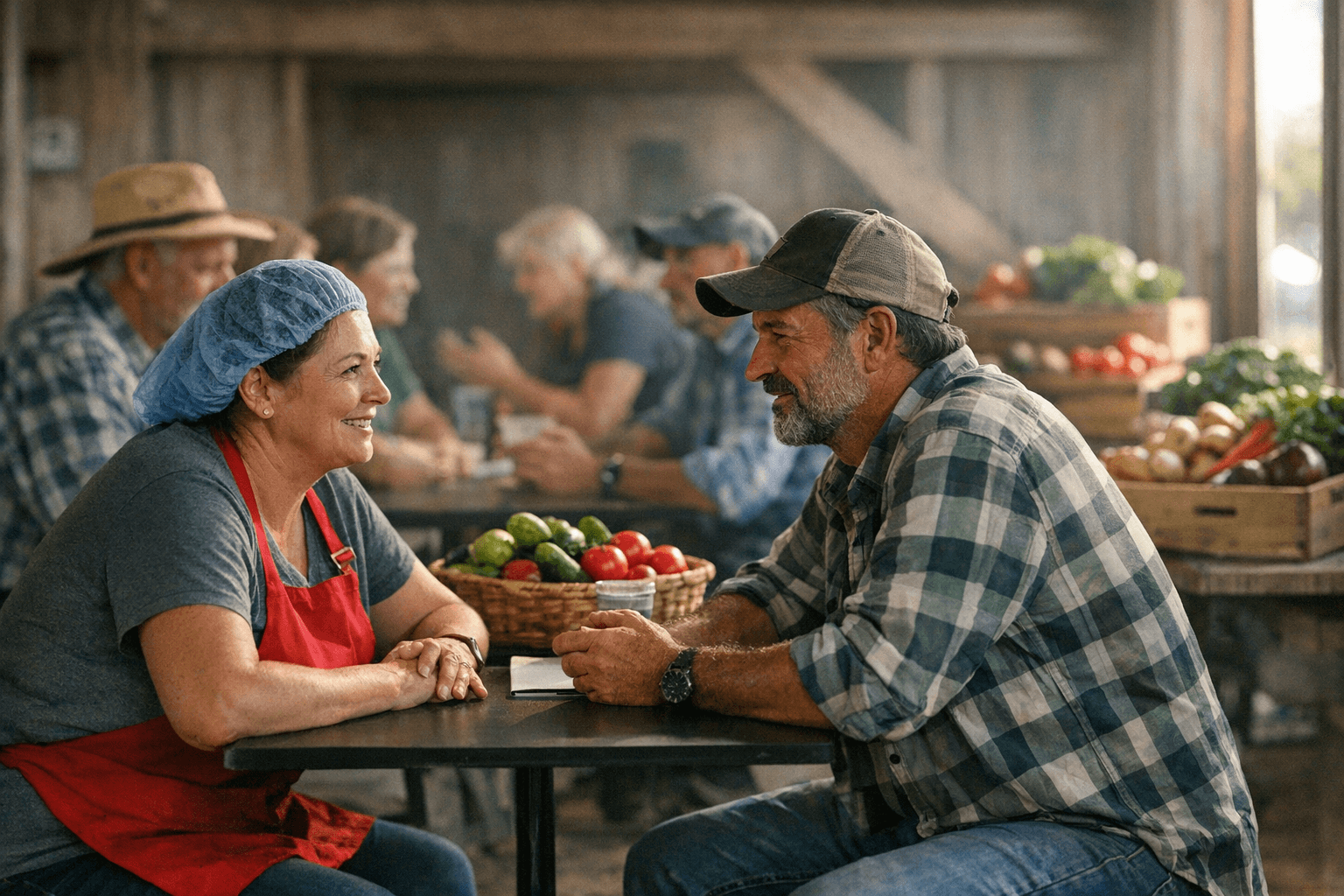
That knowledge gap, and a practical path around it, is precisely what the Roadshow was designed to address. The free, traveling event connects school nutrition staff with nearby farmers through a format Brett Olson, co-founder of Renewing the Countryside, branded the "Farmer-Lunch Lady Speed Dating." The official title was a "local producer-institutional buyer networking workshop," which Olson called "a snooze."
The format moves fast by design. Farmers sit across from school representatives, describe what they grow and what they can sell, and swap contact information if there is mutual interest. Attendees leave with a supply-and-demand spreadsheet and a resource list. The most recent stop was Bagley High School on March 19, where Marcus Langevin of Tintah Beach Farm was among the producers at the table. Previous stops have included Rochester on February 7, 2024, Cloquet, and Mankato.
For school districts in Otter Tail County, including Fergus Falls, Perham, Battle Lake, and Henning, the program offers a direct path to getting locally grown food onto lunch trays. George deflects concerns about scale immediately. "You don't have to feed all thousand students, and maybe it's one meal a month. Or maybe it's in the salad bar."
The case she and her colleagues make is rooted in children's health as much as agriculture. "The kids are winning because they're getting healthy, nutrient dense foods that were just harvested," George said at the Cloquet stop. "These kids are learning to eat different foods than they're used to eating, and they start developing that not just in the school, but at home and in restaurants."
Reaching that outcome requires solving for cost, seasonality, and logistics on both sides of the transaction. Farmers often don't know which school contact to approach, and food service directors rarely have bandwidth to seek out individual producers. "The schools don't have capacity to have contact with all the farmers, and the farmers don't have capacity to leave the farm," George said.
The roadshow is organized through Renewing the Countryside in partnership with the Minnesota Departments of Education and Agriculture and the University of Minnesota Extension. Olson says stops are chosen deliberately for communities "that often have the challenge of nobody coming to add that technical assistance."
The financial stakes are measurable. According to the University of Minnesota Extension and the Institute for Agriculture and Trade Policy, every $1 spent on the Farm to School program generates an additional 94 cents in local economic activity. Minnesota's participation has grown from 18 districts in 2006 to 262 in 2019, reaching more than 520,000 students. By 2019, participating schools were spending an average of 16 percent of their food budgets on local products, up 3 percentage points from 2015.
Currently, 51 Minnesota school districts provide locally sourced food with roughly $1.3 million in state support, a figure that has taken on new importance after the USDA announced it was ending $17 million in expected three-year funding for local food purchasing programs at schools. Kate Seybold of the Minnesota Department of Agriculture told a February forum in Morris: "We're seeing some new momentum right now." That momentum is formalized in Minnesota's first Farm to Kids Strategic Plan, released in fall 2024 as a five-year roadmap covering 2025 through 2030.
This article was produced by Prism’s automated news system from verified source data, official records, and press releases, then run through automated quality and moderation checks before publishing. The system is built and supervised by the people who set the standards it runs under. Read our full AI policy.
Did this article answer your question?