Maplewood State Park and Fergus Falls Walking Tour Highlight Otter Tail Spring
Joe Whitford found Fergus Falls on a stranger's directions; the same county now offers $7 hiking, a new downtown sculpture walk, and enough trail miles to earn the drive.
Joe Whitford didn't find Fergus Falls on his own. Sent in 1857 by his employer James Fergus to locate a town site in what is now Otter Tail County, Whitford was directed to a set of falls on the Otter Tail River by a Native family he encountered along the way. That moment placed a city on every Minnesota map that followed. The same county that grew around it now holds two high-value spring outings within twenty miles of each other: Maplewood State Park near Pelican Rapids and a revitalized downtown walking circuit in Fergus Falls. Together, they add up to a full Saturday for under ten dollars.
Maplewood State Park: Nine Thousand Acres in the Glacier's Wake
Established in 1963 and officially designated a Minnesota state park in 1965, Maplewood covers exactly 9,250 acres in the Leaf Mountains of Otter Tail County. The park sits atop the Alexandria Glacial Moraine, shaped by sediment deposited at the edge of the last Ice Age. The terrain it left behind was too varied and hilly for large-scale agriculture, which is precisely why it became a park and why it remains one of the most biologically distinct stretches of land in the state.
That distinction shows in the numbers. The park documents more than 150 bird species that breed within its boundaries, alongside 40 mammal species and 25 reptile and amphibian species. Maplewood is also one of the stops on the Pine to Prairie International Birding Trail, a 200-plus-mile route that traces the forest-prairie transition zone where species from both ecosystems overlap. In spring, watch for scarlet tanagers and indigo buntings, as well as ospreys and turkey vultures flying overhead. The hardwood canopy is a mix of sugar maple, basswood, American elm, and oak; the maples that give the park its name are the same trees that make it a fall-color landmark each October.
Hallaway Hill and the Villages No One Built Alone
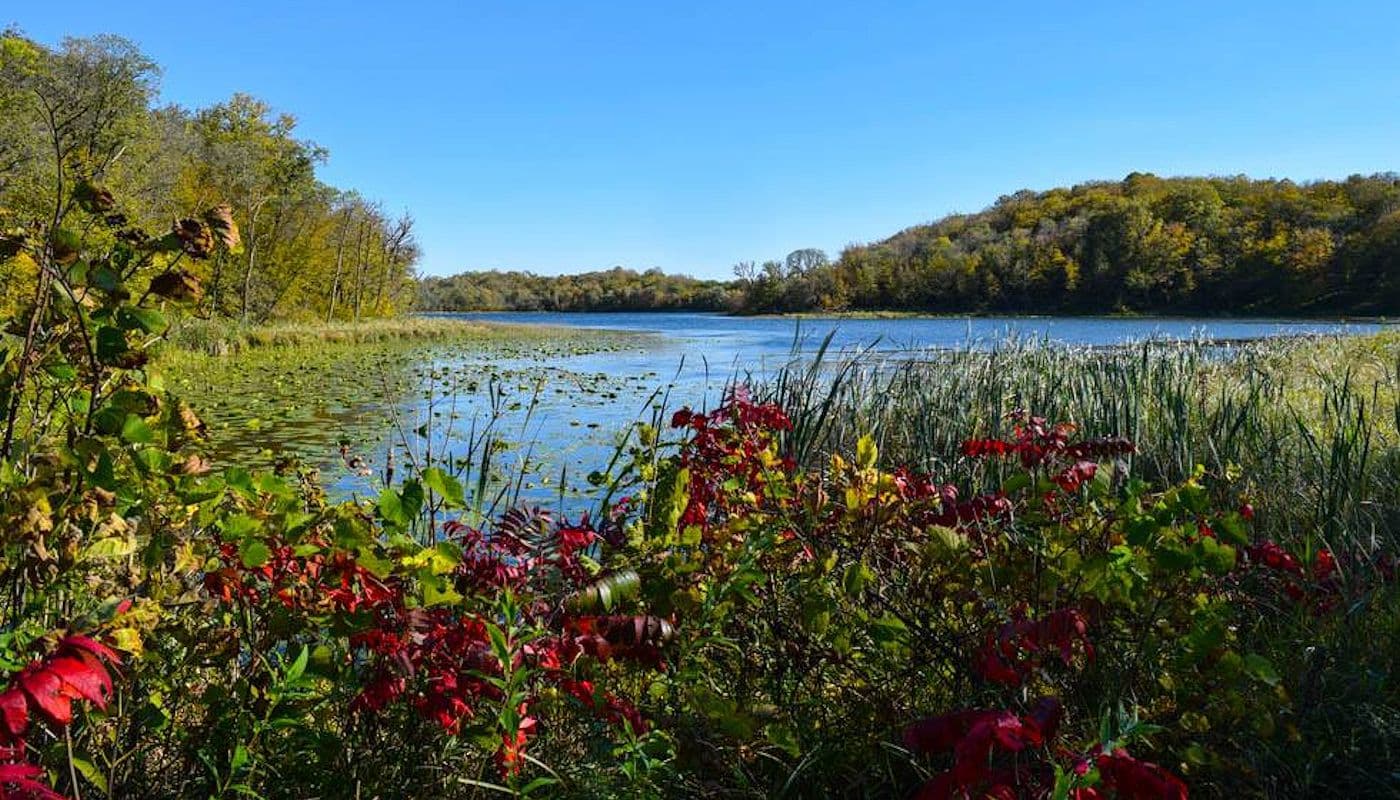
The park's 25 miles of hiking trails connect short family loops to multi-mile backcountry routes. The single best stop on a spring morning is Hallaway Hill, a named overlook in the park's northwestern corner where an interpretive sign and bench sit above the water. Hallaway Hill Overlook provides a panoramic view of the south arm of Lake Lida, one of the largest lakes in the area, with a striking vista of rolling hardwood ridges across open water.
Worth the detour: local author Jim Fletcher, whose work appears in The Lore Adventure Trilogy, built a series of small replica villages inside the park with the help of students from Pelican Rapids High School and community volunteers. One village is accessible by hiking trail; a second sits within one of the park's eight major lakes. They are not prominently marked on trail maps, which makes finding them feel earned.
Accessibility and What to Pack
The park offers All-Terrain Track Wheelchairs to allow visitors using wheelchairs or mobility equipment access to trails that are not typically wheelchair-friendly. The beach on South Lida Lake and the surrounding picnic areas are the most reliably flat and stroller-accessible terrain in the park.
Spring-specific notes:
- Waterproof footwear is non-negotiable; trails stay muddy through May in wet years
- Layer clothing: mornings can run 20 degrees cooler than afternoon highs
- Canoe and kayak rentals are available at the park; launch early to avoid wind-driven chop on open-lake sections
- Anglers should verify current Minnesota fishing regulations before heading out
- Day-use permit: $7 daily or $35 annual; camping is booked separately at 866-857-2757 (April through September, 8 a.m. to 8 p.m.)
Before leaving home, check the Minnesota DNR's Maplewood State Park page for current trail and facility opening status. Spring access is staggered, and a two-minute check saves a wasted hour.
One More Layer: The Park's Pre-Contact Past
Long before Maplewood was a park, this land was home. The Maplewood Site, a pre-contact Native American habitation location within park boundaries, was occupied during two documented periods: 650 to 900 CE and again from 1450 to 1650 CE. It was listed on the National Register of Historic Places in 1978. That listing quietly reframes every hike through these hills: the lake edges and ridgelines that feel untouched today were sustained community ground for centuries before European settlement.
Downtown Fergus Falls: Walking the City That Whitford's Directions Built
Twenty miles north, Fergus Falls is navigable on foot in under two hours and tells a longer civic story than most Midwest downtowns of its size. After Whitford's 1857 land claim eventually lapsed, George B. Wright located it at the St. Cloud land office in 1867, secured the parcel, and built what is now the Central Dam around 1871. That stone structure still anchors the downtown riverfront. Wright died in 1882 and his son Vernon moved from Boston to take over; in 1907, Vernon Wright co-founded the Otter Tail Power Company, the institution that shaped regional economic development across generations.
The city's principal streets carry deliberate history. Lincoln Avenue and Union Avenue were named to honor the Civil War experience of the earliest English and Scottish settlers, many of whom were veterans. Older streets bear names like Sherman and Sheridan. Two major tornadoes struck the city in the early 20th century; the 1919 Fergus Falls tornado was the more devastating, reshaping the city's physical footprint in ways still visible in the built environment. The Union Avenue Bridge, spanning the Otter Tail River at the center of downtown, was reconstructed in 2004.
The Sculpture Walk and the Riverfront in Spring 2026
This spring adds a new layer to the downtown circuit. The Fergus Falls Sculpture Walk meanders through downtown, passing local businesses, galleries, and the historic theater, leading toward the scenic Otter Tail River and Riverfront Splash Pad. Works selected for the 2026 installation will be on display from May 2026 through April 2027. The path also connects to the farmers market at Spies Park, open on Wednesdays and Saturdays during market season. The combination of public art, local produce, and a family-friendly water feature makes this the most complete downtown spring outing the city has assembled in recent years.
For deeper context, the Otter Tail County Historical Society offers guided walking tours of Historic Downtown Fergus Falls and the Fergus Falls River Walk. Check their schedule for spring availability before you go.
One-Afternoon Itinerary
Screenshot this and go.
*Morning at Maplewood (arrive by 9 a.m.):*
- Pay the $7 day-use permit at the entrance
- Drive or walk to the Hallaway Hill trailhead in the park's northwestern corner; plan 45 to 90 minutes depending on pace and trail conditions
- Optional detour toward Jim Fletcher's trail-accessible replica village
- Finish at the South Lida Lake beach and picnic area; stroller- and All-Terrain Wheelchair-accessible flat terrain
- Watch for indigo buntings and scarlet tanagers in the canopy on the way back to the car
*Afternoon in Fergus Falls (arrive by 1 p.m.):*
- Park free along Lincoln Avenue or near the riverfront
- Walk to the Central Dam for a look at the 1871 structure that started the city
- Follow the Sculpture Walk through downtown toward the Otter Tail River and Riverfront Splash Pad
- Stop at the Otter Tail County Historical Society for guided tour options or exhibits
- End with a meal or coffee at a downtown cafe before driving home
Planning Checklist
- Permit fees: $7 daily or $35 annual at Maplewood; no fee for the Fergus Falls walking circuit
- Trail status: check the Minnesota DNR Maplewood State Park page before departure in spring
- Reservations and camping info: 866-857-2757, April through September, 8 a.m. to 8 p.m.
- Accessibility: All-Terrain Track Wheelchairs available at Maplewood; South Lida Lake beach and downtown Fergus Falls sidewalks are the most stroller- and wheelchair-friendly areas
- Fergus Falls Sculpture Walk: active downtown starting May 2026; farmers market at Spies Park runs Wednesdays and Saturdays in season
- Pack: layers, waterproof footwear, water and snacks, binoculars for spring migration
The county that Vernon Wright helped build from a lapsed land claim and a riverside dam still offers the same essential draw it always has: terrain worth moving through, history worth slowing down for, and enough trail miles to make April feel like an accomplishment.
This article was produced by Prism’s automated news system from verified source data, official records, and press releases, then run through automated quality and moderation checks before publishing. The system is built and supervised by the people who set the standards it runs under. Read our full AI policy.
Did this article answer your question?