Otter Trail Scenic Byway showcases Otter Tail County's lakes and history
The Otter Trail Scenic Byway turns a 150-mile loop into a shortcut through Otter Tail County’s lakes, mills and history. It is the county’s clearest road-trip map.
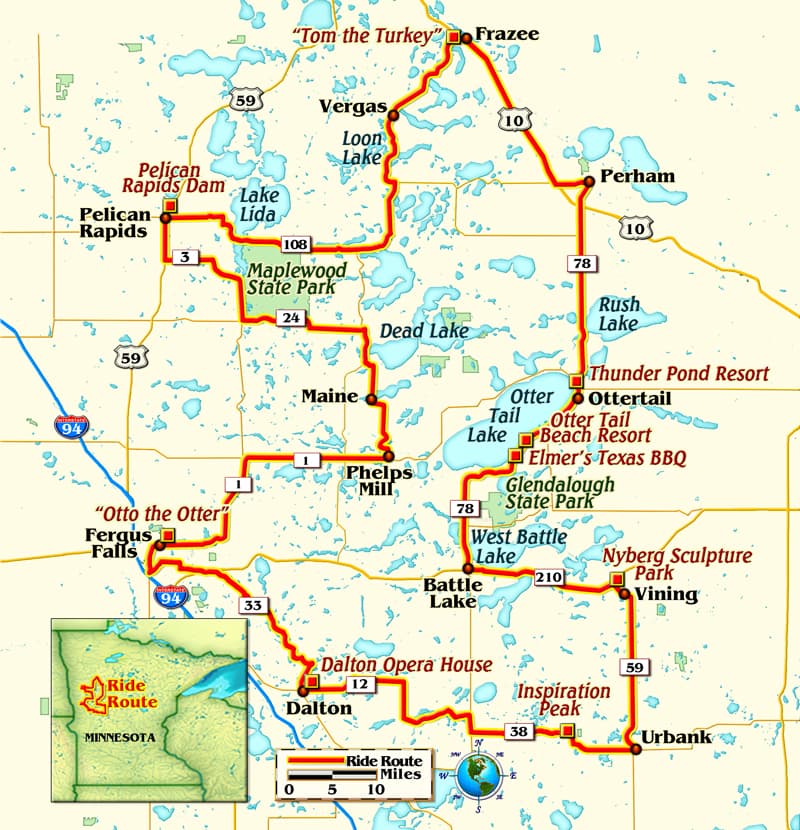
The Otter Trail Scenic Byway turns Otter Tail County into a single 150-mile loop of lakes, wetlands, mill sites, and small-town stops. Travelers can start anywhere, follow the highway signs, and use the route as a one-day drive or stretch it into a weekend. The appeal is practical: the byway shows how water, settlement, recreation, and industry fit together across the county.
Why this loop belongs on the county’s best trip list
The route was created to showcase the cultural, historical, and natural significance of Otter Tail County, and it fits Minnesota’s scenic-byway system squarely. MnDOT defines scenic byways as roads with scenic, historic, recreational, cultural, natural, or archaeological significance, and Minnesota’s Scenic Byways Commission was established under a 1992 memorandum of understanding among MnDOT, the Department of Natural Resources, the Minnesota Historical Society, and Explore Minnesota Tourism. That puts Otter Trail in a statewide framework built to protect and interpret roads that tell a place’s story.
The Otter Tail Lakes Country Association describes the drive as one of Minnesota’s most diverse landscape routes, with plenty of places to stop throughout the 150-mile loop. Explore Minnesota adds the bigger picture: more than 1,000 lakes, wildlife-filled wetlands, 19th-century flour mills, scenic trails, roadside sculptures, historic sites, and the natural and cultural resources that shaped the region. Taken together, those details make the byway a compact county primer rather than just a scenic drive.
Where the road leads
The loop is especially useful because it is not a dead-end sightseeing road. It threads through Fergus Falls, Battle Lake, Perham, and Pelican Rapids, with other maps also including Henning, Ottertail, Parkers Prairie, and Vining. That matters for planning, because the route can work as a quick loop with a few targeted stops or as a slower trip that spends more time in town.
Visit Fergus Falls says the byway includes 23 sites, many with interpretive signs, trails, picnic facilities, and opportunities to view wildlife. That makes the route easy to use for families, photographers, and anyone who wants to break up the drive without losing the thread of the story. The best way to think about it is not as a single attraction, but as a chain of stops that each explain a different layer of the county.
Among the most useful anchors are:
- Glendalough State Park
- The Otter Tail County Historical Museum
- Orwell Lake and Dam
- Ottertail City
- Otter Tail Lake
Those sites are enough to turn the loop into a full day on the road, and they give the county’s landscape a clear sense of scale. A traveler who moves from lake to park to downtown to museum sees the county as a working map of water, roads, and communities.

History you can see from the windshield
The county history page puts the oldest part of the story in plain view: before roads, water was the best transportation network in the wilderness area. Early explorers portaged from Leaf Lake to Portage Lake to Donald Lake to Pelican Bay on Otter Tail Lake on the route toward Hudson Bay, which shows how central the lakes and portages were long before the byway existed. That is the kind of history the scenic route reveals without needing a detour into a textbook.
Phelps Mill County Park adds the milling story. Otter Tail County was considered a prime location for mills because of the abundant water power from the Otter Tail River, and by the late 1800s nearly 1,000 mills were operating throughout Minnesota. That helps explain why the byway connects naturally to flour mills and historic sites: the road is following an old working landscape, not just a pretty one.
The Otter Tail County Historical Society deepens that context. It was organized on July 31, 1927, at Amor Park, and its research library includes township history boxes covering the county’s 62 townships and 289 rural schools, churches, and villages. For a traveler who wants to understand why the county’s towns, rural schools, and churches sit where they do, that archive gives the road trip a backbone.
What makes the route work in every season
The byway is not only a summer lake drive. The National Scenic Byway Foundation describes it as year-round recreation territory, with fishing, golf, hunting, snowmobiling, and cross-country skiing all part of the mix. That range matters in Otter Tail County, where the landscape changes sharply with the season but the route still holds together as an orientation drive.
MnDOT’s scenic-byway planning also shows that the route is an active collaboration, not just a line on a map. Corridor management plans are community-based planning documents that deal with tourism development, historic and natural preservation, roadway safety, and economic development. A byway addendum developed with West Central Initiative identifies and prioritizes Otter Trail Scenic Byway projects from 2015 onward, which means local partners have continued to shape how the route is used and maintained.
That ongoing work helps explain why the byway remains such a strong county guide. It connects public lands, historical stops, lake country, and town centers into one loop that is easy to follow and rich in detail. By the time the road comes full circle, the county’s story is not abstract anymore: it is visible in the water, the mills, the towns, and the preserved places that still line the route.
This article was produced by Prism’s automated news system from verified source data, official records, and press releases, then run through automated quality and moderation checks before publishing. The system is built and supervised by the people who set the standards it runs under. Read our full AI policy.
Did this article answer your question?