Volunteers restore historic White Earth cemetery markers, preserving local history
Volunteers at Calvary Cemetery are restoring markers for chiefs, traders and veterans, turning a summer cleanup into a living act of White Earth memory.

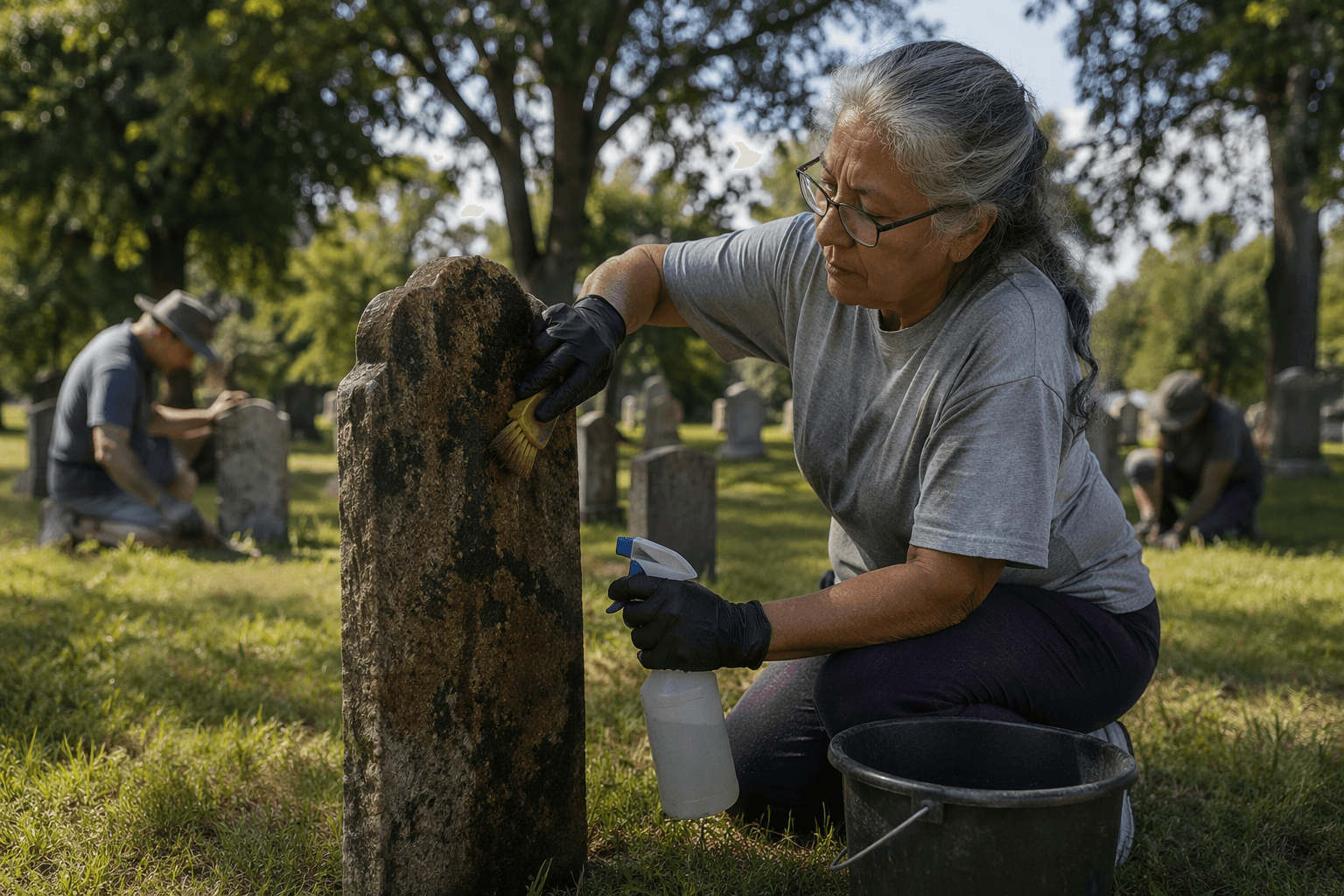
At Calvary Cemetery on the White Earth Reservation, volunteers are doing more than resetting stones. They are making the names of Anishinaabe chiefs, early fur traders and Civil War veterans readable again at a burial ground that sits about two miles from the village of White Earth. For Budd Parker and the Richville United Methodist Church crew, each marker they lift is a small act of repair for families, faith communities and local history.
A burial ground that holds more than names
Calvary Cemetery, also known by its Ojibwe name Aun-Way-Bewin, is the Catholic cemetery for St. Benedict’s Church and one of the oldest burial grounds in the area. That alone gives the site weight, but the people buried there give it deeper meaning. The cemetery includes the graves of Anishinaabe chiefs, early fur traders and Civil War veterans, linking White Earth family memory to the broader history of northwestern Minnesota.
That mix of histories matters because the markers are not just stone. They are records of identity, kinship and service. When a headstone sinks, tilts or becomes illegible, the loss is not cosmetic. It makes it harder for descendants, community members and visitors to read the story of the place as it was meant to be remembered.
The work happening this summer
The restoration effort is a hands-on summer project, and the progress is already visible. By the end of the day on May 27, 2026, the crew had fixed 20 markers. The work includes refurbishing stones and resetting markers that had sunk or deteriorated over time, which is the kind of careful labor that takes patience as well as respect.
Budd Parker, a White Earth community member and Navy veteran, has been at the center of that work. He is joined by volunteers from Richville United Methodist Church, a pairing that shows how preservation on White Earth often depends on relationships that reach beyond one institution or one neighborhood. The result is not a symbolic gesture but a physical recovery of names, dates and places that families can actually see.
Why this cemetery matters to White Earth families
The cemetery restoration sits inside a much larger story about memory and belonging. White Earth is the largest of Minnesota’s 11 reservations and covers more than 1,300 square miles in northwestern Minnesota. The reservation includes communities such as White Earth, Pine Point/Ponsford, Naytahwaush, Elbow Lake and Rice Lake, so the work at Calvary Cemetery speaks to families spread across a wide geography.
For those communities, preserving a cemetery is part of preserving continuity. The White Earth Reservation Business Committee says it is committed to preserving traditions, language and culture, and this project reflects that broader mission in a very concrete way. When burial sites are cared for, the reservation’s history remains visible in a place where people can stand, read and remember.
The preservation framework behind the effort
The restoration also fits within a formal tribal preservation structure. The White Earth Reservation Tribal Council adopted a Private Cemetery Ordinance on July 3, 2006, with the stated goal of creating, protecting and preserving burial sites on tribal or private land within the reservation. That policy gives historical care a legal foundation and signals that cemeteries are part of the reservation’s cultural infrastructure, not simply old ground to be maintained when convenient.
White Earth’s Tribal Historic Preservation Office is the official tribal representative for historic and cultural preservation, which adds another layer of significance to work like this. The office’s role underscores a larger point: preserving graves is part of safeguarding language, traditions and heritage. In that sense, the cemetery project is not separate from tribal history. It is one of the ways that history is actively defended.
A longer effort to correct the record
The current work at Calvary Cemetery is part of a much longer pattern of care. Earlier reporting said Budd Parker and other volunteers from Calvary Cemetery and St. Benedict’s Catholic Church have spent more than 30 years correcting mistakes on headstones. That history matters because it shows the restoration is not a one-season campaign but a sustained community effort to make sure the record is accurate.
That earlier work also produced 12 new headstones for families on the reservation after the names on the old ones were found to be wrong. In a place where names connect living families to ancestors, correcting a marker is an act of justice as well as maintenance. It acknowledges that memorials have to be legible and correct if they are going to serve the people who rely on them.
Why this story reaches beyond White Earth
For Otter Tail County readers, the story resonates because it shows a kind of local leadership that is quiet but durable. Instead of a grand announcement or a one-day event, this is a summerlong effort built on steady volunteer labor, tribal preservation policy and family memory. It is the kind of work that keeps a community’s history from fading into the grass.
The markers being restored at Calvary Cemetery do more than mark graves. They protect the names of chiefs, traders, veterans and relatives whose lives shaped White Earth long before the stones began to sink. By making those markers readable again, the volunteers are helping ensure that the reservation’s oldest stories remain present in the landscape, where they can continue to guide the people who belong to them.
This article was produced by Prism’s automated news system from verified source data, official records, and press releases, then run through automated quality and moderation checks before publishing. The system is built and supervised by the people who set the standards it runs under. Read our full AI policy.
Know something we missed? Have a correction or additional information?
Submit a Tip