Athenia Academy rose from Cow Creek families, missionaries, and local labor
Athenia Academy grew from Cow Creek land, timber, and labor, then anchored church life, schooling, and family memory across generations in remote Owsley County.
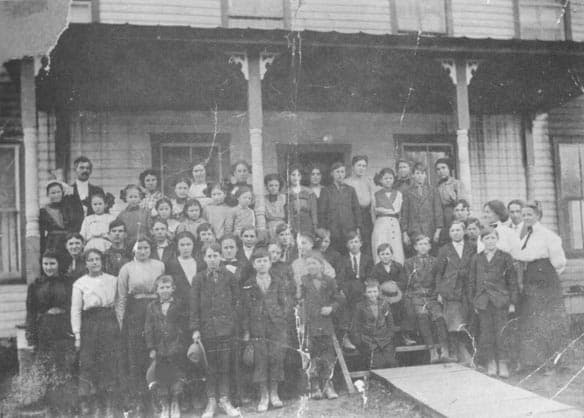
Athenia Academy did not begin as a formal institution dropped into Cow Creek from outside. It took shape from missionary work, family hospitality, donated land, and the kind of local labor that leaves a mark on a place for generations. What survives in the record is an origin story for part of Owsley County itself, built by the Reynolds, Eversole, Moore, and Callahan names that still define the valley.
Mission work at the forks of Cow Creek
The story starts in 1908, when Miss Nellie A. Brownlee of Las Cruses, New Mexico, and Miss Nettie B. McGaffick of Beaver Falls, Pennsylvania arrived in the Cow Creek area under the support of the Associate Presbyterian Church of North America. They first organized Sunday School at the Left Hand Fork school, roomed and boarded with the Lee Reynolds family, and walked about a mile to teach. In the evenings, they organized a Christian Endeavor Society, giving the mission a rhythm that reached beyond daytime classes.
Cow Creek itself carries the same kind of local memory. The place-name history says the creek was named because an early settler killed a buffalo cow there, and the waterway divides into the Left Hand Fork and Right Hand Fork about three miles from its mouth. After several months on Left Hand Fork, the missionaries moved to the Right Fork of Cow Creek and stayed with Jane Moore near the mouth of Beech Fork, a move that tied the mission even more closely to the families and hollows around it. One neighbor’s objection, “I don’t believe in having Sunday School at night,” shows how new the work was in local life and how plainly it challenged older habits.
How a school became a community project
The permanent schoolhouse was a shared enterprise from the start. Woolery Eversole donated one acre for the school site, Daniel Callahan sold another acre for a dormitory, and local people furnished the timber free of charge. The lumber was hauled to Eversole’s Mill and prepared for building, then Raleigh Combs of Milltown was hired to construct the building for $600.
While that work moved ahead, the missionaries lived with the Woolery Eversole family and taught in an old building that had once been a country store and then a corn-and-hay storage house. That practical beginning fits the way Athenia grew: by making use of whatever the community already had. The school enrolled fifty-four students, Tom Eversole was hired as custodian for $2 a month, and the institution first operated as Athenia College before becoming Athenia Academy.
The school’s later roster shows how much it expanded beyond the original missionary pair. A larger school was eventually needed, another story was added, and more teachers came through, including Dr. E. T. Lawrence, Mr. McNeil, J. M. Sterrett, Samuel Vandermere, Earl Moore, Rev. A. E. Smith, Henry M. Tenny, and Seaber Eversole. A preserved photograph identifies Brownlee, McGaffick, and Seaber Eversole among the teachers and students, turning the academy from a name in a history into a visible social world.
What the dates tell you
The timeline is not perfectly neat, and that matters because it shows how Athenia changed form over time. One local account places the establishment of the Athenia Mission School in 1909, while the missionary arrival is dated to 1908. Taken together, those details suggest a first year of organizing, teaching, and building before the school settled into a permanent identity.
The end date is just as layered. One history says Athenia Academy “was no more” by 1939, while the Cow Creek church history says instruction continued until 1960, when Athenia was consolidated with Owsley County Elementary School in Booneville. The old dormitory was then remodeled into a manse, which gave the property a new purpose without erasing its earlier one. In practical terms, the academy did not vanish from Cow Creek overnight; it shifted into another chapter tied to the church and the county school system.
That link between school and church was not incidental. A local research account says the establishment of Athenia Mission School in 1909 was essential to the ongoing development of Cow Creek Presbyterian Church. The school helped stabilize a scattered community by making the church property a place for worship, teaching, boarding, and daily work all at once.
Cow Creek then and now
The academy’s importance makes more sense when measured against Owsley County itself. The U.S. Census Bureau counted 4,051 residents in the county in 2020 and estimated 3,932 in 2025, spread across 197.4 square miles of land area. In a county that small and thinly populated, a mission school could become a true anchor, not just a classroom.
That is why the names tied to Athenia still matter. Reynolds provided boarding, Eversole provided land and labor, Callahan helped make room for a dormitory, Moore gave a place to stay on the Right Fork, and Combs turned donated materials into a schoolhouse. Even today, the Cow Creek Presbyterian Church Cemetery carries 235 memorial records, another sign that the church and school complex remains embedded in family memory and local geography.
Cow Creek’s place names, its forks, its cemetery, and the old academy site together map a community built by both outside mission work and local hands. Athenia Academy stands as proof that in remote Owsley County, institutions lasted when families claimed them as their own.
This article was produced by Prism’s automated news system from verified source data, official records, and press releases, then run through automated quality and moderation checks before publishing. The system is built and supervised by the people who set the standards it runs under. Read our full AI policy.
Did this article answer your question?