Cannelton Cotton Mill remains Perry County's defining historic landmark
The Cannelton Cotton Mill anchors downtown identity and provides 70 affordable apartments; its preservation shapes Perry County’s housing, tourism, and public-health future.
Overview and why it matters
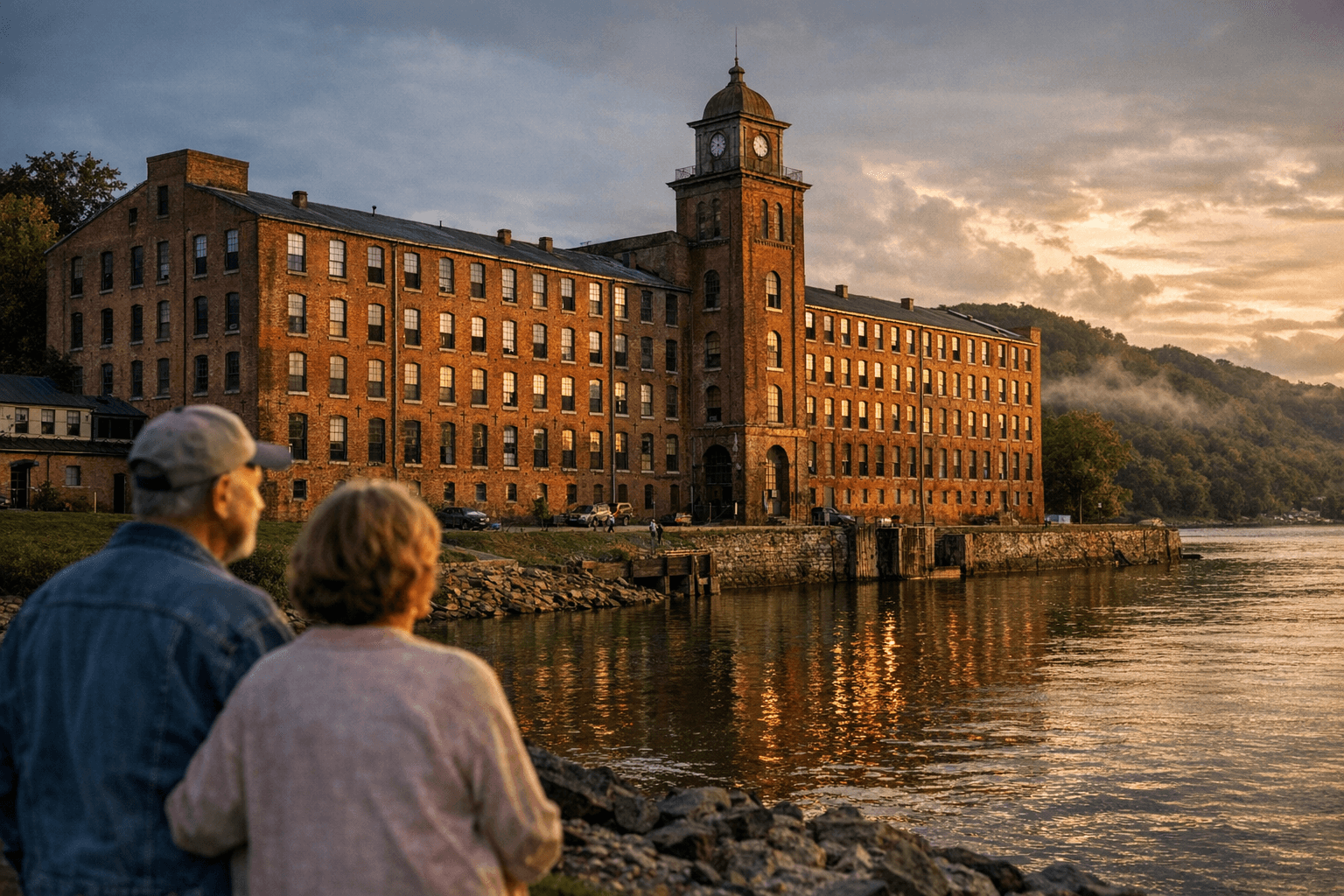
The Cannelton Cotton Mill sits at Washington Street near Third as Perry County’s most recognizable built landmark and a concrete public asset for the community. Chartered by the Indiana legislature on February 15, 1848 and built from cornerstone work begun in May 1849, the mill produced its first cloth on January 7, 1851 and operated continuously until 1954; it was placed on the National Register of Historic Places on August 22, 1975 and became a National Historic Landmark on July 17, 1991. Those designations reflect more than architectural value: the mill’s survival anchors downtown identity, supports heritage tourism, and undergirds ongoing debates about affordable housing and local economic development.
Architectural and industrial history
Thomas Alexander Tefft is widely credited with the mill’s monumental design, executed in native sandstone and rising five stories with twin towers near 100 feet and roughly 70,000 square feet of usable area. The building fronts about 280 feet of Ohio River shoreline, a placement chosen to facilitate raw material and product transport by river and rail. At full capacity the mill was outfitted for about 10,800 spindles and 372 looms, powered by a double horizontal high-pressure steam engine and multiple boilers, enabling annual outputs often cited as roughly 200,000 pounds of cotton batting and 4 million yards of cotton sheeting.
Workforce and social legacy
From its earliest decades the mill employed roughly 400 people and shaped daily life in Cannelton: women and girls performed much of the textile work while boys and men handled heavier tasks and machinery. By 1890 company records show about 309 employees with only 78 men, and secondary summaries document minors employed into the early 1900s, for example accounts listing 35 girls and 19 boys under 18 in company registers. The mill also contributed material to the Civil War effort, producing fabric used for Union uniforms, and its labor history now requires careful interpretation as the community balances pride in local achievement with a frank reckoning of child and adolescent labor practices.
Founders, financiers, and early ownership change
Hamilton Smith served as the primary promoter of the project, advertising Cannelton’s cannel coal and steam-power potential to investors that included nationally recognizable names such as Salmon P. Chase and Charles Tillinghast James. Early promoters underestimated costs for machinery ordered from William Mason & Sons of Taunton, Massachusetts, with initial estimates near $160,000 and final machinery costs closer to $175,000 in mid-19th-century dollars. Financial struggles led to ownership change by 1853 when Horatio Dalton Newcomb acquired interests to settle debts, illustrating how the mill’s local promise was always entangled with wider capital markets.
Preservation, adaptive reuse, and community impact
Community leaders asked Lincoln Hills Development Corporation to purchase the mill in 1999, and LHDC led a major rehabilitation from about 2001 to 2003 using state and federal historic rehabilitation tax credits and more than $8 million in total investment. The project reopened as Cotton Mill Apartments in 2003 with seventy affordable rental units, often described in local materials as low-income and senior housing, converting a former industrial powerhouse into a functioning housing asset for Perry County. The mill’s HAER documentation, recorded as HAER No. IN-1 and preserved at the Library of Congress, supplied measured drawings and photographs that guided rehabilitation and continue to support grant applications and interpretive work.
Public health, housing, and social-equity implications
Adaptive reuse created 70 units of affordable housing at 310 Washington St, a direct daily-life benefit with measurable public-health ties: stable, affordable housing reduces stress, lowers emergency healthcare use, and supports aging-in-place for seniors living in the Cotton Mill Apartments. Preservation also generates indirect health benefits by anchoring downtown activity that sustains nearby small businesses, expanding access to services without long commutes. Yet preservation carries costs: Indiana Landmarks has highlighted the Cannelton Historic District as endangered in recent years, underscoring the difficult policy choices between funding ongoing maintenance, leveraging tourism dollars, and protecting affordable housing stock created through prior rehabilitation.
Interpretation, reckoning, and civic programming
Preservationists in Cannelton have moved beyond celebratory narratives to include the mill’s labor history in public interpretation, a choice that affects school curricula, museum programming, and walking-tour content. Renew Cannelton, the Perry County Historical Society, and the Indiana Historical Bureau are central players in shaping those narratives, and partners such as Indiana Landmarks and the National Park Service provide frameworks for integrating technical history with social context. Thoughtful interpretation that addresses child labor, gendered labor roles, and ownership transitions will be essential to translating the mill’s past into equitable civic learning and to preventing nostalgia from eclipsing historical fact.
Visiting the mill and getting involved
The mill’s commonly listed visitor address is 310 Washington St, Cannelton, IN 47520 and its coordinates are approximately 37.9114°N, 86.7454°W. The site appears on Cannelton walking tours and heritage maps, and records including the National Register nomination and HAER survey are available for residents who want technical or archival detail. Local organizations that coordinate volunteer work, tours, and preservation advocacy include Renew Cannelton, Lincoln Hills Development Corporation, Perry County Historical Society, and Indiana Landmarks; Greg Sekula is a named Indiana Landmarks contact who has been involved in outreach related to the district.
What is at stake and a forward-looking note
The Cannelton Cotton Mill is simultaneously a piece of 19th-century industrial ambition and a 21st-century civic resource: it produced millions of yards of cloth and now houses seventy families, exemplifying the building’s ability to pivot between economic roles. If the sandstone fabric continues to deteriorate without sustained funding and creative policy, Perry County risks losing more than a scenic riverfront building; the county would risk diminished heritage-tourism revenue, eroded downtown identity, and potential threats to the affordable housing that the 2001–2003 rehabilitation created. Preservation is therefore a public-health and equity strategy as much as an architectural one: investing in the mill protects homes, sustains local businesses, and keeps alive a complicated history that, when honestly interpreted, strengthens community resilience.
This article was produced by Prism’s automated news system from verified source data, official records, and press releases, then run through automated quality and moderation checks before publishing. The system is built and supervised by the people who set the standards it runs under. Read our full AI policy.
Did this article answer your question?