Buckhorn’s roots trace to mission school, creek valley geography
Buckhorn’s creek valley still shapes daily travel, church life, and institutions, from Witherspoon’s mission-school legacy to the road changes left by Buckhorn Lake.
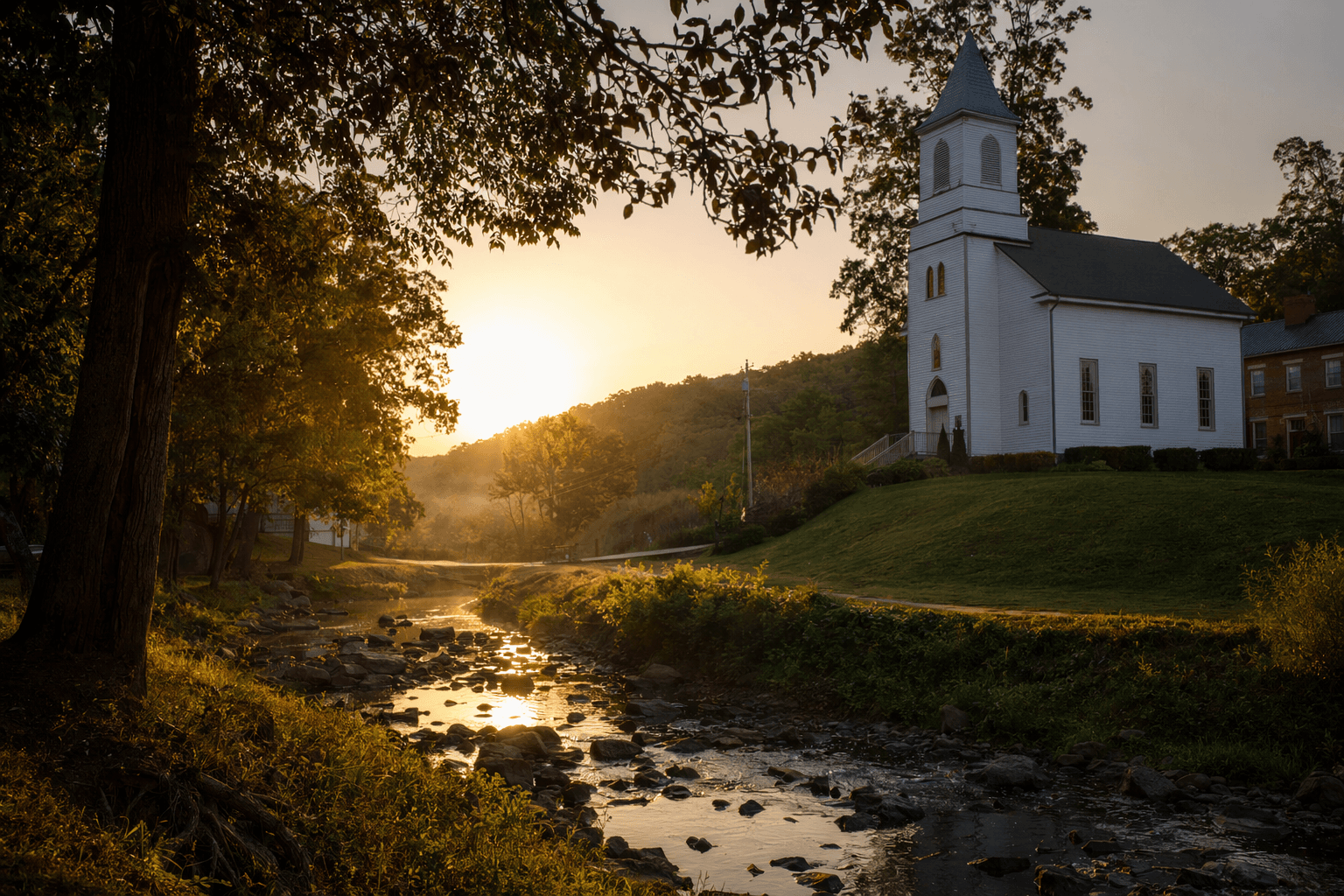
The valley that still defines Buckhorn
At the Buckhorn Presbyterian Church and the Greer Gymnasium, the oldest surviving Witherspoon College buildings, Buckhorn’s past is still visible in the places people recognize today. The same narrow valley that gave the community its shape, where Squabble Creek meets the Middle Fork of the Kentucky River, also shaped how residents traveled, worshiped, learned, and built institutions that still define Perry County’s eastern edge.
That geography mattered from the beginning. Buckhorn formed in a setting that was remote, wooded, and hard to cross, with timber, coal, ridges, and creek bottoms shaping every practical decision. Even now, the community’s identity is tied to that river valley, and the arrival of Buckhorn Lake in the 1960s did not erase the older story so much as layer a new one on top of it.
A mission school built for more than classrooms
The turning point came in 1902, when Harvey Short Murdoch, who came from Brooklyn, New York, founded Witherspoon College while serving as field secretary for E. O. Guerrant’s Society of Soul Winners. The Kentucky Historical Society marker for Murdoch says he remained pastor until his death in 1935, which underscores how closely his personal mission and Buckhorn’s growth were tied together. He did not arrive simply to build a schoolhouse. He came with a larger plan for a religious, educational, and social center.
That broader vision took root because the Buckhorn community helped make it happen. Local residents gathered to discuss the college and donate building materials and cash, showing that the mission school was never just a one-man project. Louise Saunders and her family connections also played a part in the area’s mission work, another reminder that Buckhorn’s early institutions were built through collaboration, not isolation.
The scale of what followed was striking for a mountain community. Between 1903 and 1957, more than 6,000 mountain boys and girls attended Witherspoon College High School, and about 1,500 graduated. For a place at the meeting point of two waterways and several mountain routes, that number says a great deal about the reach of the school and the trust it earned across Perry County and beyond.

How a school became part of community identity
Witherspoon’s influence went far beyond the classroom. The school later served grades 1 through 12, and by the mid-20th century its work had expanded into child welfare as well as education. In 1956, the Synod of Kentucky established the Presbyterian Child Welfare Agency of Buckhorn as a successor to Witherspoon College and Orphanage, creating an institutional bridge that later became Buckhorn Children & Family Services.
That transition matters because it shows how Buckhorn’s mission-school roots still shape the community’s institutional identity. The school’s operation transferred to the Perry County Board of Education in 1957, but the service tradition did not disappear. It evolved into a broader local presence that still traces back to the same mission-driven foundation, linking Buckhorn’s older church-and-school era to the organizations people know now.
The Buckhorn Presbyterian Church itself reflects that continuity. Founded in 1907, the church and the larger Log Cathedral built in 1928 became central landmarks of the mission campus. Together with the Greer Gymnasium, they are the only two surviving buildings from Witherspoon College, and their listing on the National Register of Historic Places in 1975 recognized how much of Buckhorn’s story survives in those structures.
The roads, the lake, and the daily geography of Buckhorn
Buckhorn’s later history is just as much about roads and river control as it is about schools and churches. Buckhorn Lake was created by a dam on the Middle Fork of the Kentucky River in 1961, and that project changed the way people moved through the area. Route 28 east toward Chavies was covered by the lake and had to be rerouted along the ridges, a change that still helps explain why travel in and around Buckhorn feels so closely tied to topography.

That shift matters to residents because it changed more than a map. It altered access, daily commuting patterns, and the relationship between the community and the river valley that had already defined it for decades. Buckhorn Lake State Resort Park is now part of the way many people know the area, but the lake-era identity sits on top of the older mission-school landscape rather than replacing it.
Buckhorn’s post office, established in 1902, shows how closely the community’s modern identity developed alongside the mission school. The town was incorporated much later, in 1996, but the institutional core was already in place long before incorporation. In practical terms, Buckhorn became a recognized community because the post office, the school, the church, and the surrounding valley were all developing together.
Why Buckhorn’s past still matters now
Buckhorn’s history is useful because it explains the place people still live in. The creek valley setting helps account for the tight geography, the ridge roads, and the sense of Buckhorn as a community that has always been connected to larger Appalachian currents while remaining distinctly local. Its mission-school roots explain why education, religion, and social service became so deeply embedded in the town’s identity.
That legacy is visible in the surviving buildings, in Buckhorn Children & Family Services, and in the continued recognition of Witherspoon’s role in the county’s history. It is also visible in the landscape itself. From Squabble Creek to the Middle Fork, from the Log Cathedral to the rerouted stretch of Route 28, Buckhorn remains a Perry County community whose present still makes sense only when its mission-school origins and creek valley geography are read together.
This article was produced by Prism’s automated news system from verified source data, official records, and press releases, then run through automated quality and moderation checks before publishing. The system is built and supervised by the people who set the standards it runs under. Read our full AI policy.
Did this article answer your question?