Hazard’s Challenger Learning Center marks rare rural milestone, serves thousands yearly
Hazard’s Challenger Learning Center gives Perry County a rare rural STEM asset, reaching about 7,500 students a year and opening paths beyond the classroom.
Hazard’s Challenger Learning Center of Kentucky is one of the few places in rural Appalachia where students can walk into a NASA-style mission environment without leaving Perry County. The center was approved in September 1996 as the first rural Challenger Learning Center site ever selected, then opened in March 1999 as the 34th center in the network. For a county that rarely gets to claim a national first, that distinction still matters because it gives local students access to STEM experiences that are usually concentrated in larger cities.
A rare rural first
Perry County describes the center as one of 47 Challenger Learning Centers and the first to be located in a rural area. That history sets Hazard apart from the rest of the network, which Challenger Center says is marking 40 years since its founding in 1986. The organization says its centers are locally operated through partnerships with schools, colleges, museums, science centers, and similar groups, and that model is part of why the Hazard site has endured for decades.
The Kentucky center’s roots also run through a local educator with aviation ties. Its history page profiles Alice Noble, a Hazard High School home economics teacher who held a private pilot’s license and was active in Civil Air Patrol before later teaching at Wright-Patterson Air Force Base. That origin story helps explain why the center’s mission has always mixed classroom learning with hands-on exploration, rather than treating space science as something distant from everyday life in Eastern Kentucky.
What students actually step into
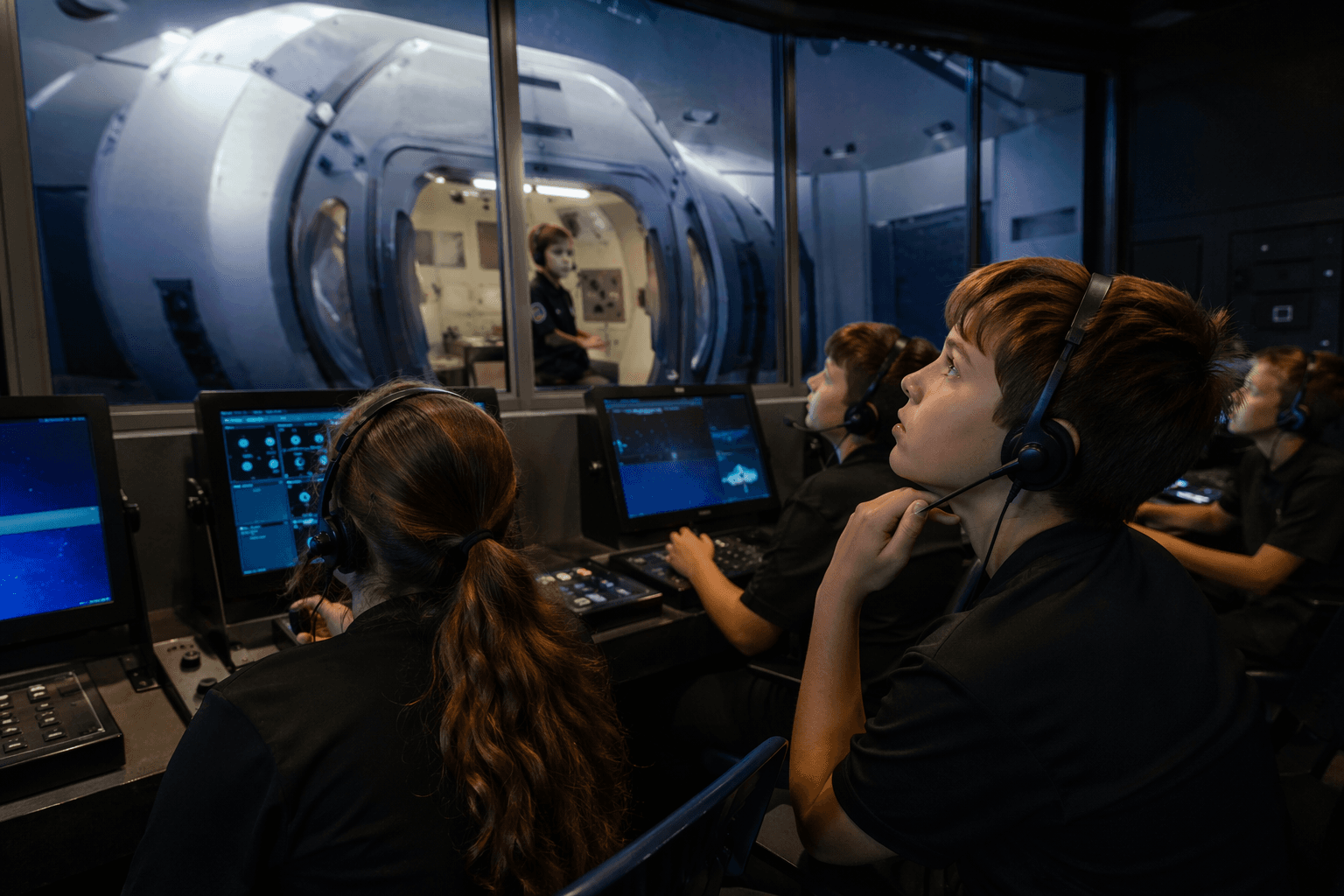
The experience is designed to feel like a working mission. Perry County’s events-and-attractions page describes a Mission Control Center modeled after NASA’s Johnson Space Center, along with a Transporter or Space Shuttle and a spacecraft or space-station simulator where experiments are assembled and launched. That setup gives students more than a field trip. It gives them a chance to practice teamwork, problem-solving, and technical decision-making inside an environment built to look and function like a mission operation.
The center says it serves students, families, seniors, corporate teams, and community groups. Its programs are built around immersive space-themed learning, and the site says it partners with schools across the region while delivering hundreds of hours of in-class lessons in coding, engineering, robotics, and related subjects. For local schools, that means the center is not limited to one-off visits. It becomes part of the instructional calendar through classroom support, simulations, and follow-up work that ties the experience back to science lessons.
How families and schools can use it
Access matters as much as the exhibit space. Perry County says the center is open year-round, and the center’s outreach page says it provides STEM programming for K-12 students as well as customized programs for older students. Its current offerings include advanced robotics, electronics, and coding, which makes the center useful for elementary students just starting to explore STEM and for older students looking for a deeper challenge.
Families also have a path in through summer programming. The center says it runs summer camps for students ages 5 to 16 and beyond, giving parents another way to connect children to structured science learning outside the regular school year. That mix of school partnerships, outreach lessons, camps, and public programs is what makes the center more than a museum-style attraction. It is a year-round education resource for households and schools that do not have easy access to big-city science institutions.
The center’s reach extends well beyond Perry County. It says more than 160,000 students have experienced its programs over the years, and young people from throughout the United States and three other countries have been positively impacted by its work. Perry County says it hosts about 7,500 students per year, which shows the scale of the local pipeline even before counting the broader regional audience.
Why the investment keeps growing
The center has not stayed frozen in its 1990s origins. In 2020, Rep. Hal Rogers announced an $800,000 Appalachian Regional Commission grant for the center to create a new interactive STEM program called Moon, Mars and Beyond, Gateway to Tomorrow. The center says Moon, Mars, and Beyond is an interactive exhibition with more than two dozen exhibits based on NASA’s Artemis mission, and that it was built over two years with ARC support. For a rural county, that kind of capital investment signals something important: the institution is still being built out, updated, and used as a platform for new STEM content.
The center’s outside validation continued in 2022, when it hosted a NASA in-flight education downlink with Lt. Gov. Jacqueline Coleman. NASA said at the time that the center had been providing STEM education to southeastern Kentucky students for 23 years. That combination of federal, state, and local attention is part of the reason the center has remained relevant in a place where many educational opportunities can be hard to sustain over time.
What the local support network says
Community Trust Bank has also backed the center’s outreach programming, saying its support helps bring mobile STEM activities to underserved communities across the region. The center’s fundraising campaign is being chaired by Janice Brafford, a former Hazard Market President of Community Trust Bank, which ties the institution directly to local civic and financial leadership. Hazard Community and Technical College also has a formal local advisory structure, reinforcing how closely the center is linked to higher education and community input in Perry County.
That support network matters because the center’s value is not only symbolic. In a county where young people can see limited career paths if they only encounter the same local institutions every day, the Challenger Learning Center expands what is imaginable. It gives students a place to meet robotics, electronics, engineering, and space science in a setting that feels hands-on and current, and it does so without forcing them to leave the county. For Perry County, that is the real significance of the rare rural first: not just a point of pride, but a working pipeline for education, talent, and opportunity that still reaches thousands every year.
This article was produced by Prism’s automated news system from verified source data, official records, and press releases, then run through automated quality and moderation checks before publishing. The system is built and supervised by the people who set the standards it runs under. Read our full AI policy.
Did this article answer your question?