Perry County officials address cemetery upkeep concerns after resident complaints
Residents pressed Perry County officials over weeds and damaged headstones at cemeteries including Resthaven in Jeff, pushing the issue into public view.

Residents brought cemetery upkeep complaints to Perry County officials Friday, May 1, at the Perry County Fiscal Court building, where Perry County Attorney Derek Campbell led a public meeting focused on how neglected burial grounds are being handled. The concerns were not abstract. Families said some sites had high weeds and damaged headstones, including Resthaven Cemetery in Jeff, turning a maintenance dispute into a question of respect for loved ones’ graves and who is responsible for protecting them.
The meeting put a long-simmering local issue onto the public record. In Perry County, where many burial grounds are tied to churches, family plots and privately owned land, the condition of a cemetery can determine whether relatives can safely visit a grave, care for a marker or even find a plot without stepping through overgrowth and debris. Residents came looking for solutions, and county leaders were forced to confront whether the problem is a county duty, a landowner duty or both.
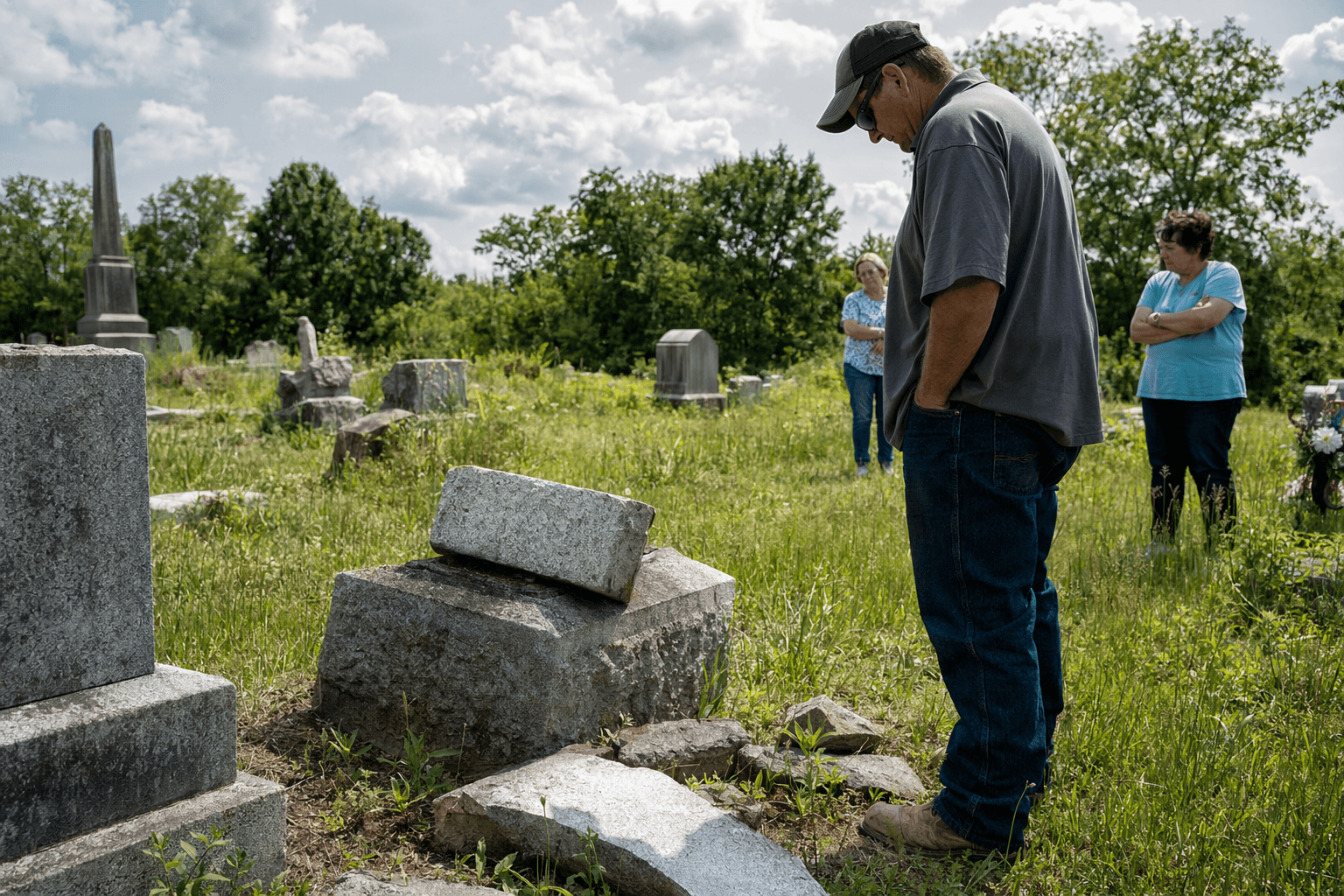
Kentucky law draws a line. Under KRS 381.697, every cemetery in Kentucky except private family cemeteries is supposed to be maintained by its legal owner or owners and kept free of weeds, accumulated debris, displaced tombstones and signs of gross neglect. That standard gives families a clear basis for complaint when a burial ground is left in poor condition, while also limiting what county government can do when the cemetery is privately owned. In local discussions, county maintenance has been treated as a courtesy in many of those cases rather than a blanket county obligation.
State officials also became part of the response. Officials from the Kentucky Attorney General’s Office met with residents at the Perry County Courthouse to hear cemetery complaints directly and take formal concerns from families. That involvement signaled that the issue was not being treated as a routine cleanup request, but as a broader matter involving property rights, ownership, and the handling of sacred community spaces.
For Perry County families, the next test is whether officials can turn the meeting into a concrete plan. Residents left the public discussion with the core questions still hanging over the county: who is responsible for each cemetery, which sites need immediate attention, and what happens when weeds, broken markers and neglect remain in place.
This article was produced by Prism’s automated news system from verified source data, official records, and press releases, then run through automated quality and moderation checks before publishing. The system is built and supervised by the people who set the standards it runs under. Read our full AI policy.
Did this article answer your question?