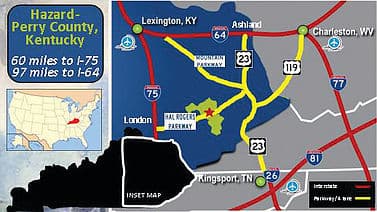
Perry County promotes Hazard as the heart of adventure tourism
Hazard is being sold as more than a stop in Perry County, with trail access, festivals, and parks meant to turn visitors into local spending.
Hazard’s adventure-tourism pitch is built to do one thing: keep people here long enough to spend money. Perry County is not just advertising scenery. It is presenting Hazard and the surrounding communities as a place where trail access, festivals, parks, and downtown events can feed restaurants, shops, lodging, and gas stations in the county seat and beyond.
A trail-town identity with state backing
Perry County’s tourism message is anchored by a simple brand: the “Heart of Adventure Tourism.” The county says the experience includes walking, hiking, biking, kayaking, horseback riding, ATV and dirt-bike use, fishing, camping, quilt-block tours, and specialty shopping. That list matters because it shifts the county’s image from a place people drive through to a place where they can plan a stay around a mix of outdoor recreation and local commerce.
That message is not limited to Perry County’s own website. The same tourism pitch appears on the Kentucky Department of Tourism site, widening the county’s reach and giving Hazard a broader platform inside the state’s travel marketing. The county has also been designated the 20th Kentucky Trail Town, a label that ties Hazard’s identity to the North Fork of the Kentucky River, the trail system, and the recreation economy the county wants to build around them.
Behind that branding sits the Kentucky Mountain Regional Recreation Authority, which says its purpose is to establish, maintain, and promote a recreational trail system throughout the region to increase economic development, tourism, and outdoor recreation. That is the real policy argument underneath the tourism language: trails are not being sold as scenery alone, but as infrastructure for spending, movement, and repeat visits.
Why the county is betting on more than pass-through traffic
The county’s own framing makes clear that tourism is meant to have a local multiplier effect. Visitors drawn in for trails, fishing, or off-road riding are also likely to use restaurants, gas stations, lodging, and retail outlets in Hazard and nearby communities such as Vicco, Buckhorn, and Chavies. That is the difference between a scenic route and a destination economy.
Perry County also tries to make the trip-planning process easier by pulling its attractions, outdoor access, and calendar-based events into one place. For a county trying to convert recreation into sales, that kind of centralization matters. It reduces friction for visitors and gives local businesses a better chance of capturing spending before travelers move on to the next stop.
The broader economic strategy is visible in the Hazard-Perry County Economic Development Alliance, which says it was started by local leaders and business people and now operates under the One East Kentucky umbrella. That puts tourism promotion alongside industrial recruitment and business retention, suggesting Perry County sees downtown Hazard’s future as a mix of recreation, public events, and a wider effort to strengthen the local economy.
Events give the tourism pitch a calendar, not just a brochure
Perry County’s events page shows that the county is trying to make tourism year-round rather than seasonal. The calendar includes the Perry County Fair in June, a Fourth of July Celebration in downtown Hazard, the Black Gold Festival in September, Battle of Leatherwood in Cornettsville in October, North Fork Oktoberfest in downtown Hazard in October, and Christmas in a Small Town in December.
That schedule is important because it gives residents and businesses recurring reasons to see downtown Hazard as an event hub, not just a county seat. The county is not relying on a single festival to carry its tourism image. It is stacking events across the summer, fall, and holiday season so there is always another reason for visitors to return.
Christmas in a Small Town is especially notable because it is described as a two-day holiday event put on by the Perry County Fair Advisory Board and the Hazard/Perry County Chamber of Commerce. That local organizing footprint matters. It shows the county is not outsourcing its public identity to an outside promoter; it is using familiar civic institutions to keep the event calendar active.
The Challenger Learning Center is listed as open year-round, which gives the county one more anchor when the festival season slows down. Between that and the recurring outdoor schedule, Perry County is building a tourism pattern that can keep visitors coming in multiple months, not just during peak summer weekends.
Public spaces are part of the tourism product
Perry County Park shows how closely recreation and local quality of life are being tied together. The park includes a walking track, skateboard park, basketball courts, five picnic shelters, baseball and softball fields, a stage area for concerts, an outdoor pool, putt-putt golf, tennis courts, a boat ramp, a horse park, and a playground. That is not a single-purpose park. It is a multi-use public space that can support both local families and visitors looking for a day outdoors.
The county also highlights Buckhorn Lake State Resort Park and Carr Creek Lake in its quick links, reinforcing that water access and outdoor recreation are central to the county’s public image. Buckhorn Lake State Resort Park is one of the clearest examples of how state and local assets can reinforce the same story: Perry County as a place for recreation, not just passage.
Taken together, the trail-town designation, the recurring events, the county park system, and the state resort park create a tourism framework that is broad enough to catch different kinds of visitors. Some will come for hiking or ATV access. Others will come for Black Gold Festival, Oktoberfest, or the holiday event in December. The county’s bet is that all of them can be directed toward the same local businesses once they arrive.
The real test is whether the traffic stays in Perry County
Perry County’s tourism message is strongest when it links outdoor access to downtown Hazard and nearby communities instead of treating trails as a stand-alone amenity. That is where the economic logic lives. The county wants visitors to move from the North Fork, the trail system, or a state park into a meal, a room, a tank of gas, or a stop at a local shop.
That is also why the county’s branding matters beyond the brochure language. The “Heart of Adventure Tourism” pitch is really a local development strategy dressed as an invitation. If the trails, events, and parks keep producing visible business in Hazard, Vicco, Buckhorn, Chavies, and Cornettsville, then the county’s tourism model will have a measurable payoff. If not, it remains a slogan. For now, Perry County is investing heavily in the version of the story where outdoor recreation and local spending rise together.
This article was produced by Prism’s automated news system from verified source data, official records, and press releases, then run through automated quality and moderation checks before publishing. The system is built and supervised by the people who set the standards it runs under. Read our full AI policy.
Did this article answer your question?