Perry County traces roots to 1821 formation and early settlement
Perry County’s earliest records connect the 1821 county formation, Hazard’s name change, and a 450-piece centennial archive to family, land, and civic research.
Perry County’s history is easy to start and hard to exhaust because its earliest markers are still tied to places residents can visit and records researchers can actually use. The county was formed in 1821 from parts of Clay and Floyd counties, thirty years after Kentucky entered the Union in 1792, and both the county and its seat were named for Commodore Oliver Hazard Perry. That origin matters now because the same early geography that shaped courthouse lines and settlement patterns still shapes how families, landowners, and local historians search for the right county records.
Start with the courthouse lawn
The Kentucky Historical Society marker on the courthouse lawn in Hazard gives the cleanest entry point into the county’s civic beginning. It ties Perry County’s creation to the county seat and identifies the naming connection to Oliver Hazard Perry, the War of 1812 naval hero. For anyone tracing an old family name, this is more than a plaque: it is a clue that early county identity was built around the courthouse and the surrounding settlement, not around a later town map or modern street grid.
That distinction helps when records appear to “move” between counties. Perry County did not exist before 1821, so earlier family, tax, and land references for people who later lived in Perry may appear in Clay or Floyd county materials. The county’s official history puts that formation in the broader arc of Kentucky’s early growth, which is useful context when a deed, census entry, or marriage record seems to point to the wrong place at first glance.
Follow the trail to Perry Court House
The earliest settlement story centers on Perry Court House, a small community on the North Fork of the Kentucky River. The county history notes say the first post office was established there in 1824, and that the settlement was founded by Elijah Combs and his seven brothers. For genealogy research, that detail is a strong clue: the early post office confirms a named place, and the Combs family provides a concrete line to follow in family records, church registers, and local recollections.
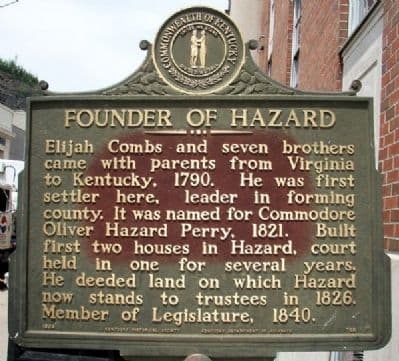
A second Kentucky Historical Society marker deepens that picture. It says Elijah Combs came with his parents and seven brothers to Kentucky in 1790, identifies him as the first settler, and says he helped lead in forming the county. It also notes that he deeded the land on which Hazard stands to trustees in 1826 and later served in the Kentucky legislature in 1840. Those facts connect family history to land ownership in a direct way: if Hazard stands on land Combs deeded to trustees, then the county seat’s earliest legal footprint is part of the same story as the family’s settlement.
Why the name changed from Perry to Hazard
The county seat did not keep its first name. The place originally called Perry was renamed Hazard in 1854, while both the county and the county seat kept honoring Oliver Hazard Perry. That name change matters for anyone searching newspapers, plats, school references, or property records, because older sources may use Perry while later ones use Hazard for the same place.
The renaming also helps explain why local memory can feel split between a settlement name and a county-seat name that point to different chapters of the same history. If a deed, map, or school reference uses Perry instead of Hazard, that does not mean the record is in the wrong place. It may simply be using the earlier name that was still current before 1854, when the county seat took its present identity.
Use the centennial papers as a working archive
The strongest paper trail sits at the University of Kentucky Libraries Special Collections Research Center, where the Perry County historical papers from 1921-1922 are described as 450 pieces tied to the county’s centennial celebration. The collection includes portions of the address delivered at the celebration, notes for a county history, correspondence about the centennial, clippings, and a few printed maps. Judge Samuel M. Wilson collected the papers, which makes the archive useful not just as memorabilia but as a record of how local history was actively assembled.
The named correspondents, Bailey P. Wootton, Willard Rouse Jillson, and Otto Rothert, show that the centennial was not an isolated hometown event. It drew in people who were part of a broader historical conversation, and that gives the collection value for residents trying to understand how Perry County was being framed in 1921. The clippings and printed maps can help with school projects, while the notes for a county history can point family researchers toward names, places, and lines of inquiry that do not always appear in formal government records.
What these records can answer now
Taken together, the 1821 formation, the 1824 post office, the 1826 land deed, the 1854 name change, and the 1921 centennial papers give Perry County a usable historical spine. If you are tracing a family, the Combs settlement story may explain why an ancestor appears in early North Fork references. If you are sorting out land ownership, the Hazard-to-trustees deed and the county’s shift from Clay and Floyd county boundaries can point you toward the right predecessor records.
If you are teaching local history or building a school project, the courthouse lawn marker and the centennial archive work as paired sources: one fixes the county’s origin in public memory, and the other preserves how later residents documented that origin in 450 pieces of correspondence, maps, and history notes. Perry County’s earliest records do not sit behind the past. They still point directly to the names, places, and legal foundations that shape the county’s identity today.
This article was produced by Prism’s automated news system from verified source data, official records, and press releases, then run through automated quality and moderation checks before publishing. The system is built and supervised by the people who set the standards it runs under. Read our full AI policy.
Did this article answer your question?