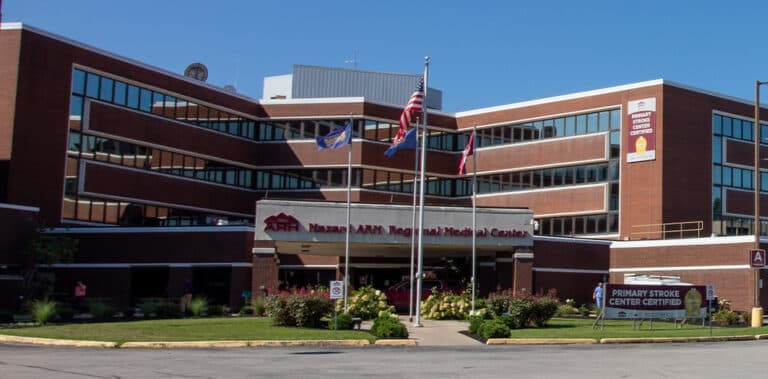
Rogers backs federal funding for rural health, education in Perry County
Rogers backed a bill with $4 million for Pikeville Medical Center childcare, plus LIHEAP, black-lung claims and cancer research funding that could reach Perry County fast.

Rogers’ office said the June funding package included $4 million for Pikeville Medical Center’s AVA Childcare Academy, along with federal money aimed at rural health care, education, opioid response, black-lung claims and LIHEAP. For Perry County families, those are not abstract line items: they connect to whether a clinic has enough capacity, whether a miner’s claim moves faster, and whether a household can keep up with utility bills.
The House Appropriations Committee approved the fiscal 2027 Labor, Health and Human Services, Education and Related Agencies bill on June 9 by a 34-28 vote. The committee’s summary set funding for the National Institutes of Health at $47.3 billion, a $100 million increase over fiscal 2026, and the National Cancer Institute at $7.46 billion, up $110 million. ASCO said those figures show lawmakers are still putting serious money behind cancer research, which matters in a region where families often travel outside the county for specialty care.
LIHEAP is likely the most immediate household issue in Perry County. Kentucky officials say the federally funded program helps about 150,000 Kentucky families pay heating bills each winter, and the state’s version also covers cooling, crisis and weatherization help. That means any increase or protection in the program can show up quickly in a county where utility costs are part of the monthly balance sheet for working families, older residents and people on fixed incomes.
The bill’s black-lung language carries equal weight in a coal county. It directs the Department of Labor to give the House Appropriations Committee quarterly reports on efforts to improve the speed and quality of black-lung claims processing. The Centers for Disease Control and Prevention says coal workers’ pneumoconiosis, or black lung, is caused by inhaling coal mine dust, and the Coal Workers’ Health Surveillance Program provides screenings to miners at no cost.
Rural health also lines up closely with existing services in this part of Eastern Kentucky. The University of Kentucky Center of Excellence in Rural Health was developed in Hazard and says Kentucky Homeplace began as a demonstration project in 14 counties. Since 1994, Kentucky Homeplace has linked tens of thousands of rural Kentuckians with medical, social and environmental services, while the center serves as the federally designated Kentucky Office of Rural Health. In a county like Perry, that kind of network is what turns federal funding into appointments kept, claims processed and services delivered closer to home.
This article was produced by Prism’s automated news system from verified source data, official records, and press releases, then run through automated quality and moderation checks before publishing. The system is built and supervised by the people who set the standards it runs under. Read our full AI policy.
Did this article answer your question?