College Park eateries endure, shape community amid constant change
Three College Park staples have outlasted student turnover, demolition and redevelopment by becoming more than restaurants. They now help define how the city feels, not just how it eats.
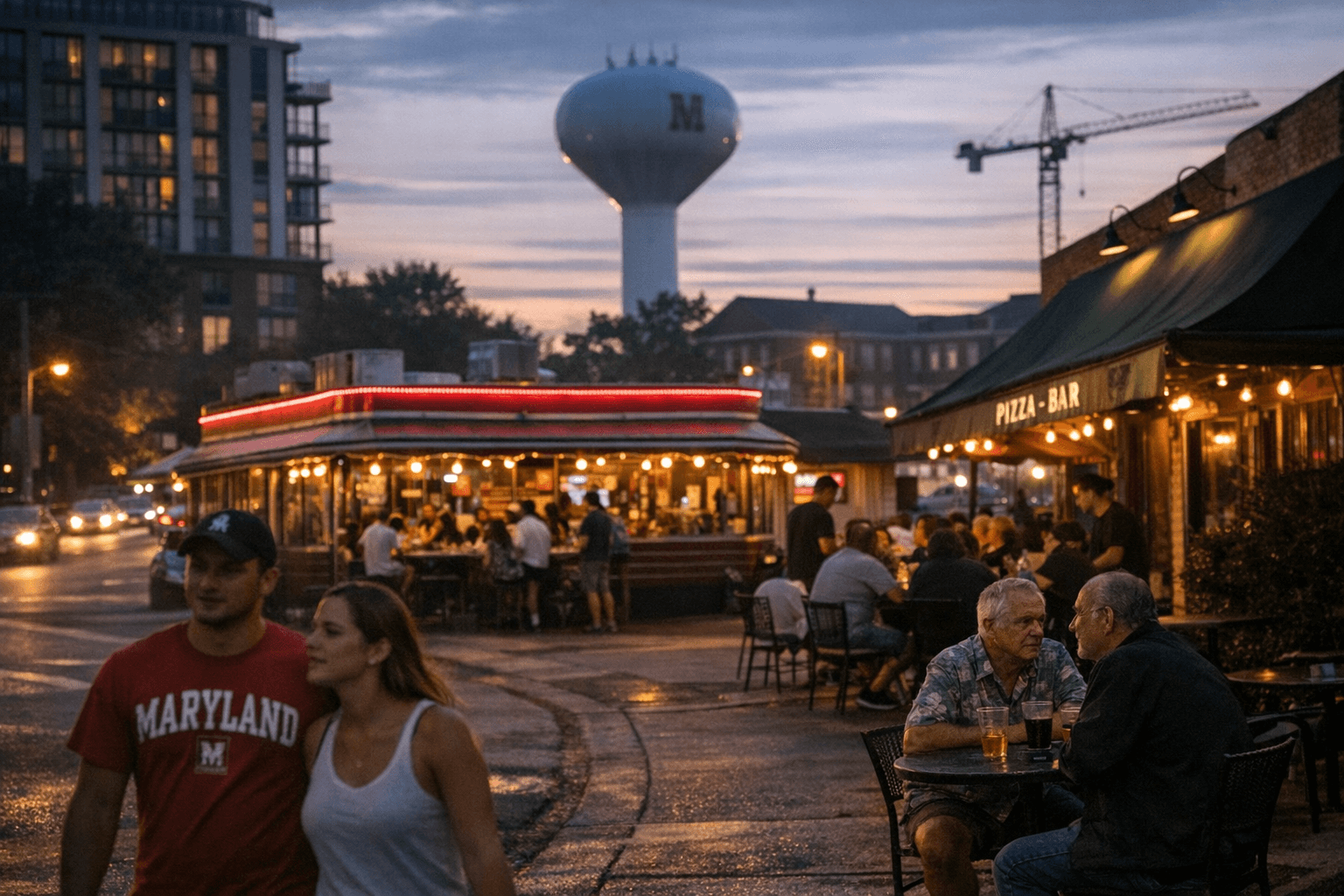
How three eateries became part of College Park’s civic fabric
In College Park, staying power is its own kind of business strategy. Board and Brew, Looney’s Pub and Marathon Deli have survived in a market where students rotate quickly, dining tastes shift and redevelopment keeps rewriting the streetscape, and that endurance has made them part of the city’s identity.
What sets these places apart is not just age. It is the way they serve two audiences at once: University of Maryland students looking for an all-night hangout, and longtime residents who want a place that still feels like College Park even as the city adds new projects, new apartments and new restaurants. In a city of more than 34,000 residents, that balance matters because the places people keep returning to often become the clearest markers of what a neighborhood is trying to preserve.
Why longevity matters in a college town
College Park is not a market that rewards passivity. Student turnover can erase a customer base in a few semesters, and commercial vacancies can appear quickly when a place fails to keep pace with changing habits. At the same time, the city says its dining scene is growing, and it continues to see new restaurant openings, which means established businesses have to compete with fresh concepts as well as with the constant churn that comes with a campus economy.
That is where the College Park City-University Partnership fits into the bigger picture. Created in 1997, the partnership says its mission is to promote economic development and a sustainable community for both the city and the university. The city’s own economic-development materials use similar language, describing work to attract, create and retain jobs while building a resilient tax base. In practice, that means restaurants are not just serving meals. They are helping anchor an economy that depends on repeat visits, recognizable names and a sense of place that can survive the next wave of construction.
Board and Brew found a hangout, not just a dining room
Board and Brew opened in 2014, founded by University of Maryland alumni Brian McClimens and Ben Epstein. Its formula is simple on paper but hard to replicate in a way that lasts: food, drinks and a large board-game library. That combination gives it something many restaurants in a college town never quite achieve, a reason to stay even when nobody is in a rush to order a second round.
The board-game model also explains why the place has become more than a stop between classes or after a game. It works as a social room, not just a service counter, which helps it draw students, faculty and community members into the same space. In a town where customer loyalty can evaporate when a generation of students graduates, a place built around lingering has a stronger chance of staying relevant because it creates repeat behavior instead of one-time traffic.
Looney’s Pub blends neighborhood bar identity with a broader chain
Looney’s Pub shows a different path to endurance. The College Park location opened in September 2011 in the Varsity Apartment Complex next to the University of Maryland campus, putting it right where student life and apartment living overlap. But the brand itself is older and more established, first opening in Canton in 1993 before expanding to other Maryland locations. That matters because the College Park site is not an isolated outpost. It is part of a larger local chain with a built-in understanding of how to serve Maryland crowds.
Its position near campus gives it the advantage of constant foot traffic, but the real value is that it feels familiar enough to be claimed by the neighborhood. That is the kind of business identity that often survives in a place like College Park: local enough to be trusted, but structured enough to adapt when the city changes around it. Even when restaurants come and go nearby, a long-running pub can function like an informal meeting point, especially in a corridor where apartment residents and students overlap.
Marathon Deli is the clearest example of adaptation under pressure
Marathon Deli, which opened in 1972, is the oldest of the three by far, and its history tells the most obvious story of change. The deli moved around the corner in 2020 after its previous site was slated for demolition to make way for new housing and retail. That move is a small but revealing example of what longtime businesses in College Park face: not just competition, but redevelopment that can force a physical relocation while asking the business to preserve its identity at the same time.
Even after moving, Marathon kept the kind of atmosphere that made it a campus fixture. Diamondback reporting in 2025 described it as serving students seven days a week, with late-night crowds, booming music and Terp-themed decor. That mix of schedule, energy and visual identity helps explain why it still matters. It does not merely sell food to students passing through. It participates in university culture, and that role can be just as valuable as square footage when a restaurant is trying to survive decades of change.
What these places figured out about College Park
Taken together, these three businesses show that longevity in College Park depends on more than good food. It depends on understanding that the city is both a campus town and a real residential community, with a customer base that changes fast but still rewards places that feel rooted. Board and Brew, Looney’s Pub and Marathon Deli each found a way to make themselves useful beyond the transaction, whether through community gathering, neighborhood familiarity or a late-night identity that students carry with them long after graduation.
They also reveal something bigger about the city’s direction. College Park is developing, and it wants to grow its tax base, retain jobs and keep building around the university. But the places that survive the churn are often the ones that give the city continuity while that growth unfolds. In a business environment where new openings are common and turnover is part of the landscape, these three eateries have become proof that the strongest local brands are not always the newest ones. Sometimes they are the ones that learned how to change without losing the reasons people came back in the first place.
This article was produced by Prism’s automated news system from verified source data, official records, and press releases, then run through automated quality and moderation checks before publishing. The system is built and supervised by the people who set the standards it runs under. Read our full AI policy.
Did this article answer your question?