PG County Schools Detail Protocol for Immigration Agent Visits on Campus
When immigration agents come within 1,000 feet of a Prince George's County school, principals can now lock the building down before anyone knocks.

A principal at any Prince George's County school can order a lockdown the moment immigration enforcement agents come within 1,000 feet of the building. Doors lock. Every student is located and accounted for. School security officers stand down from any enforcement role. That three-part response, built into a new Board of Education policy announced at a March 26 press conference, defines exactly what happens at a PGCPS campus if federal agents appear.
The Board policy reinforces that immigration enforcement operations are prohibited on school grounds. But those local rules exist in direct tension with a federal shift that prompted the policy in the first place. On January 20, 2025, Acting Department of Homeland Security Secretary Benjamin Hufman issued two directives that stripped schools of their longstanding "sensitive areas" status, opening the door for ICE and other federal agencies to conduct arrests, interviews, searches, or surveillance at or near school campuses. PGCPS's own guidance noted that DHS "trusts them to use common sense," a phrase the district included without further assurance.
Interim superintendent Shawn Joseph addressed that uncertainty directly. "When you drop your children off at our doors, you're handing us your most precious possession," Joseph said. "We owe you a promise that our schools will be places of safety, of joy, and of discovery, not places of worry."
To back that promise operationally, PGCPS assembled a Federal Transition Task Force drawing from across the district: the superintendent's office, the Office of General Counsel, the English Learner's Department, Research and Accountability, and the Office of Equity, Diversity, and Belonging, among other departments. The task force has been issuing rapid-response guidance and has equipped principals and front office staff with internal dashboards and one-pagers covering entry protocols. The district has also held in-person and virtual presentations on immigration resources and English Language Development sessions for staff.
PGCPS said it currently has no indication that ICE agents have been stationed at or permitted onto any of its campuses, but added that it wants to be prepared.
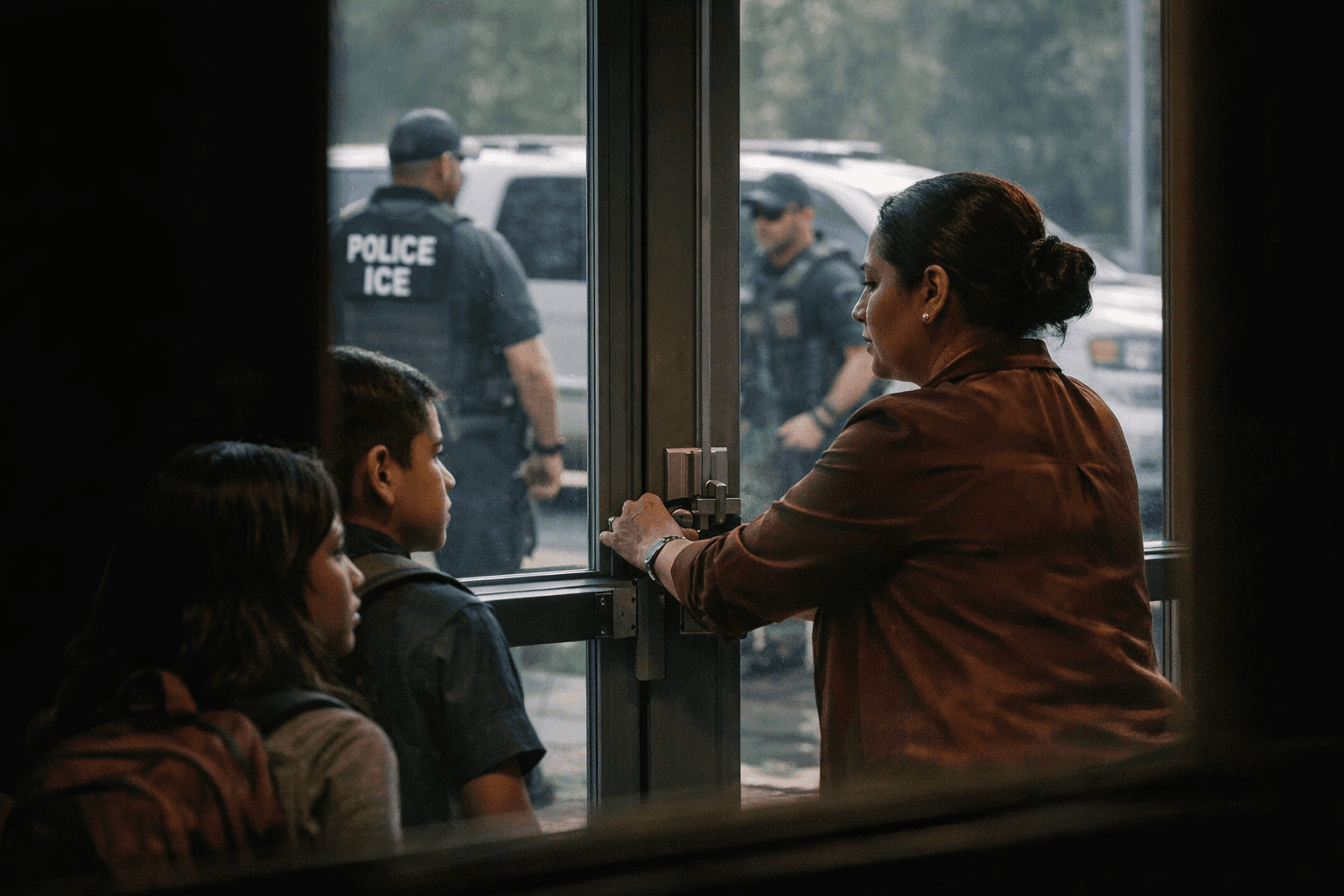
Shannon Wilk, education director at the immigration advocacy group We Are CASA, praised the policy as rooted in direct community experience. "The policy represents months of careful design created in consultation with those most deeply impacted by the racist deportation machine," Wilk said. "All students are welcomed, valued and must be protected."
For families weighing what the policy means in practice: the 1,000-foot perimeter is the trigger, not the school entrance. Principals do not need to wait for agents to reach the front door before initiating a shelter-in-place. School security staff are explicitly barred from assisting immigration enforcement in any capacity. The published guidance does not, however, specify what documentation agents must present to gain entry, outline how or when parents are notified during a shelter-in-place, or address enforcement scenarios at after-school events and student transportation, leaving those questions unanswered for families and advocates to press with district administration.
The policy places Prince George's County alongside Baltimore City Schools, Montgomery County Public Schools, and Anne Arundel County Public Schools in a national compilation of district ICE response protocols that lists dozens of school systems which have published similar guidance since President Trump rescinded the 2011 federal "sensitive locations" memo. PGCPS officials say the rise in ICE activity since Trump returned to office has generated widespread fear among students and families across the county, and the March 26 press conference, posted in full to the district's YouTube channel, was the district's most direct public statement yet that it intends to act on that fear rather than wait for agents to arrive.
This article was produced by Prism’s automated news system from verified source data, official records, and press releases, then run through automated quality and moderation checks before publishing. The system is built and supervised by the people who set the standards it runs under. Read our full AI policy.
Did this article answer your question?


