Prince George's Council Passes Six Bills Restricting Federal Immigration Enforcement
PG County Council unanimously passed six bills Monday blocking ICE from county property, banning ex-agents from county jobs, and requiring police to document enforcement activity.

Rabiatu Kuyateh spent more than 20 years in Maryland working as a nurse after fleeing Sierra Leone's civil war. She was detained during what she believed was a routine annual ICE check-in, transferred to a facility in Ghana, and deported back to Sierra Leone. Her son, Mohamed Algali, told that story to the Prince George's County Council on Monday, the same day the body voted unanimously to pass six pieces of legislation aimed at limiting how federal immigration agents can operate within the county's borders.
The package, four bills and two resolutions first proposed on February 17, passed without a single opposing vote. Council Chair Krystal Oriadha (District 7) led the effort alongside Vice Chair Eric Olson (District 3) and Council Members Tom Dernoga (District 1) and Wanika Fisher (District 2).
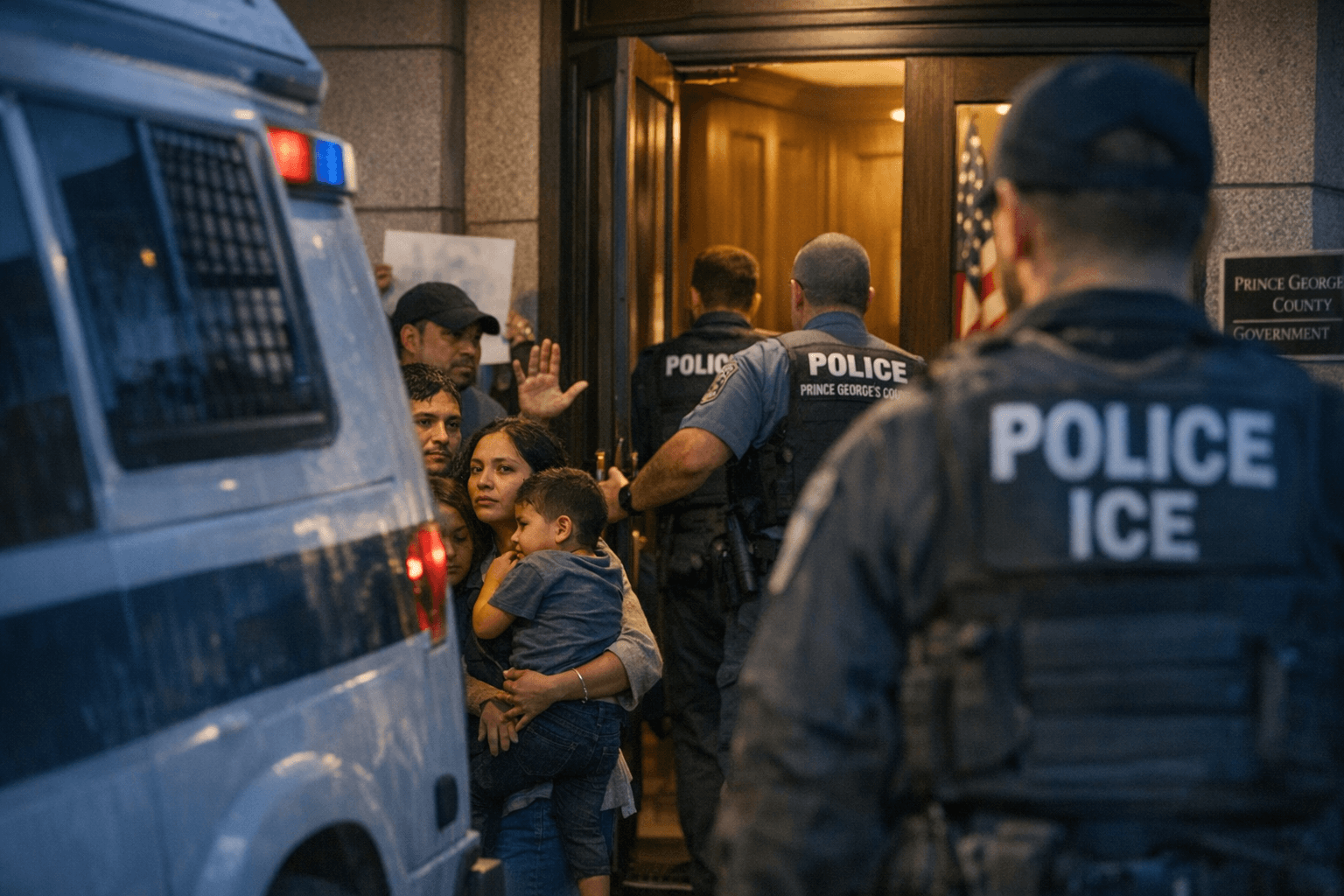
Each bill carries specific, enforceable restrictions with immediate procedural consequences for county agencies. CB-6-2026, the Community Safe Spaces Act, bars federal immigration agents from entering any county-owned facility, including parking lots and garages, without a valid judicial warrant or emergency justification. CB-7-2026, the Resident Kidnapping Protection Act, requires Prince George's County Police to respond to immigration enforcement activity anywhere in the county and log the name, badge number, and agency of every federal agent on scene. CB-5-2026 bans future county employment for anyone who worked for ICE or U.S. Customs and Border Protection after June 30, 2025, a provision legal experts say raises potential constitutional concerns around equal protection and employment discrimination law. A fourth bill prohibits agents from wearing face coverings in public except for legitimate protective gear, a direct answer to community complaints about masked ICE agents appearing near neighborhoods, schools, and courthouses.
Two resolutions complete the package. One creates a streamlined process for family members to recover vehicles whose drivers were detained mid-trip by ICE. The other formally urges schools, parks, libraries, and the county community college to restrict immigration enforcement on their properties.
Oriadha, whose own father immigrated to the United States, opened the March 3 press conference at the Wayne K. Curry Administration Building in Largo with language that left little room for interpretation: "ICE and their terrorist tactics have no place in Prince George's County." Council Member Wala Blegay echoed the urgency at the same event: "People are scared to live their daily lives here because of ICE, and it is not fair." CASA, a prominent immigrant advocacy organization, stood alongside council sponsors at the press conference.
Not all agencies welcomed the new obligations. Police officials privately warned 7News they consider being required to intervene in federal operations both dangerous and inappropriate. Oriadha held her position: "I understand it's a situation they might not want to be in. But we have residents putting their bodies and lives on the line for their community and dying."
The legislation also targets a specific address. ICE has long leased space in Hyattsville for its legal team, but county officials say the agency now appears to be seeking room inside the Metro 1 building at 6505 Belcrest Road, a large facility a few hundred yards from the Hyattsville Immigration Court and near several churches. Oriadha said the council is watching the expansion closely: "They're saying it's for legal-office use, but it's a large facility." An ICE spokesperson declined to confirm any plans.
The vote built on an executive action already in place. County Executive Aisha Braveboy signed Executive Order No. 9-2026 in February, establishing a moratorium on using county property as an immigration detention center. Council members plan to codify that order into statute, though Oriadha said that bill is at least a month from a council vote.
The demographic stakes explain much of the urgency. Immigrants account for roughly 66% of all construction workers in Prince George's County and more than 39% of healthcare and social assistance workers, according to American Immigration Council analysis of census data. Salvadoran immigrants form the county's largest foreign-born national-origin group at 21.6%. Prince George's and neighboring Montgomery County together account for more than half of Maryland's entire foreign-born population.
The council's action is part of a broader coordinated push: more than 80 elected officials across Maryland have joined a statewide coalition, led by Oriadha, calling on the General Assembly to pass the Community Trust Act (HB1575/SB791), which would require judicial warrants statewide for immigration-related detentions and bar local law enforcement from deploying resources to assist federal civil immigration enforcement. The coalition submitted its formal letter to General Assembly leadership on April 2, backed by eight additional Prince George's County Council members and County Executive Braveboy.
In Montgomery County, Councilmember Evan Glass introduced the parallel ICE Out Act on March 3, which would bar private immigration detention centers from operating countywide. County Executive Marc Elrich has already enacted laws requiring warrants for ICE activity on county property and prohibiting voluntary local law enforcement cooperation with the agency. Howard County and Baltimore County had each adopted detention center bans earlier.
KNOW YOUR RIGHTS IN PRINCE GEORGE'S COUNTY
The six bills passed Monday create new legal protections that residents and county workers should understand. Here is what changed and for whom.
County facilities are off-limits to ICE without a warrant. The Community Safe Spaces Act (CB-6-2026) prohibits federal immigration agents from entering any county-owned building, parking lot, or garage without a valid judicial warrant signed by a judge, unless there is an active emergency. That protection covers county offices, libraries, parks, and the community college campus.
County police must respond and put federal agents on record. The Resident Kidnapping Protection Act (CB-7-2026) requires Prince George's County Police to respond to any immigration enforcement activity in the county and document the name, badge number, and agency of every federal agent present. Officers cannot simply observe and withdraw; the department must now change its response procedures immediately.
Families have a new path to recover detained relatives' vehicles. A resolution in the package creates a streamlined process for family members to reclaim a car or truck left behind when a relative was detained by ICE while driving, removing a bureaucratic barrier that previously left families stranded.
County employment is now closed to recent ICE and CBP employees. Anyone who worked for ICE or U.S. Customs and Border Protection after June 30, 2025 is ineligible for county employment under CB-5-2026. Legal challenges are anticipated; constitutional questions around equal protection and employment discrimination have already been raised by legal experts.
Agents cannot cover their faces. Federal agents are prohibited from wearing face coverings in public in Prince George's County except for legitimate protective equipment.
County Executive Braveboy's Executive Order No. 9-2026 remains separately in force: no county property may be used as an immigration detention center, and council members are working to enshrine that prohibition in county law.
This article was produced by Prism’s automated news system from verified source data, official records, and press releases, then run through automated quality and moderation checks before publishing. The system is built and supervised by the people who set the standards it runs under. Read our full AI policy.
Did this article answer your question?