Prince George's County library card unlocks extensive free services
A Prince George’s County library card opens books, Wi-Fi, job help, genealogy tools and meeting rooms, while branches and mobile services fill daily civic gaps.
Prince George’s County Memorial Library System reaches more than 967,000 residents through 19 branches, a 24/7 online library and pop-up services across the county. That footprint makes the library system one of the county’s most practical public institutions: a place for internet access, homework help, job searching, research, language learning and community gathering when people need reliable public space.
What a library card actually opens
A county card does far more than check out books. Prince George’s County residents can use a virtual card to access digital services, place titles on hold and reserve a meeting room without stepping into a branch, then renew that virtual card in person every three years. The system also offers a temporary six-month card for non-residents, with limited benefits.
The digital catalog reaches deep into everyday needs. The library says residents can use databases, audiobooks, eBooks, videos and music, while the Discovery Suite pulls together genealogy and heritage resources such as Ancestry Library Edition, Freedmen’s Bureau records, HeritageQuest and the Maryland State Archives. The Homework Suite adds PebbleGo, Mango language learning and Gale In Context: Biography, and the Creative and Support suites bundle tools including Great Courses, LinkedIn Learning, PressReader, ComicsPlus, Libby and Brainfuse.
That mix matters because one card can serve a student finishing a paper in Bowie, a job seeker in Temple Hills, a family researching records in Upper Marlboro or a senior tracing family history from home. The system’s own service categories, which include Creative Suite, Digital Suite, Discovery Suite, Homework Support Suite, News Suite, Healthy Living Suite and Senior Suite, show how broad the library’s role has become.
A countywide safety net for access, not just a book lender
Prince George’s County’s library system is positioned in county documents as a technology connection, a hub of early literacy and a center for personal skills development. That description matches the way residents actually use it. Public computer sessions and wireless internet access help bridge the digital divide, while reference help and digital media access keep the system useful for people who cannot always make it to a branch.
The mobile app adds another layer of access. Users can search the catalog, manage accounts and download digital media without making a special trip, which is especially useful for residents balancing work hours, childcare, transit gaps or mobility barriers. In a county with a large and diverse population, that kind of flexibility is not a bonus feature. It is basic public access.

The library’s 2024 Annual Report described the year as one of growth and evolution and stressed a seamless transition between in-person and online environments. County performance materials track total library visitors, active registered cardholders, material circulation, reference questions, and public computer and wireless internet sessions, underscoring that the system functions as both a physical gathering place and a digital lifeline.
Where the money goes
The FY 2026 proposed budget for Prince George’s County Memorial Library is $37,945,500. County documents put the proposed county contribution at $28,479,300, which they say represents 75.0% of total agency funding. The FY 2026 proposal is up $409,500, or 1.1%, from FY 2025, with increases tied in part to mandated salary requirements, the lease for the new Langley Park Branch and fringe benefits.
The system reported actual FY 2024 expenditures of $37,747,569, a figure that shows how closely the library’s spending already tracks the scale of its annual proposal. In practical terms, that money supports branches, digital tools, outreach and the staff work that makes a countywide card function from one end of Prince George’s to the other.
The Board of Library Trustees helps guide that system. It is a policy-making body made up of seven volunteer citizens appointed by the County Executive. That governance structure matters because it places the library inside county public administration, not outside it, while still relying on community volunteers to shape service development.
From 1946 to the present
Prince George’s County became the first of the Maryland suburbs around Washington to be run at the county library level in 1946, following a 1945 state law that enabled new county library systems. That history explains why the county library still sits at the center of public life here: it grew alongside the modern county itself.
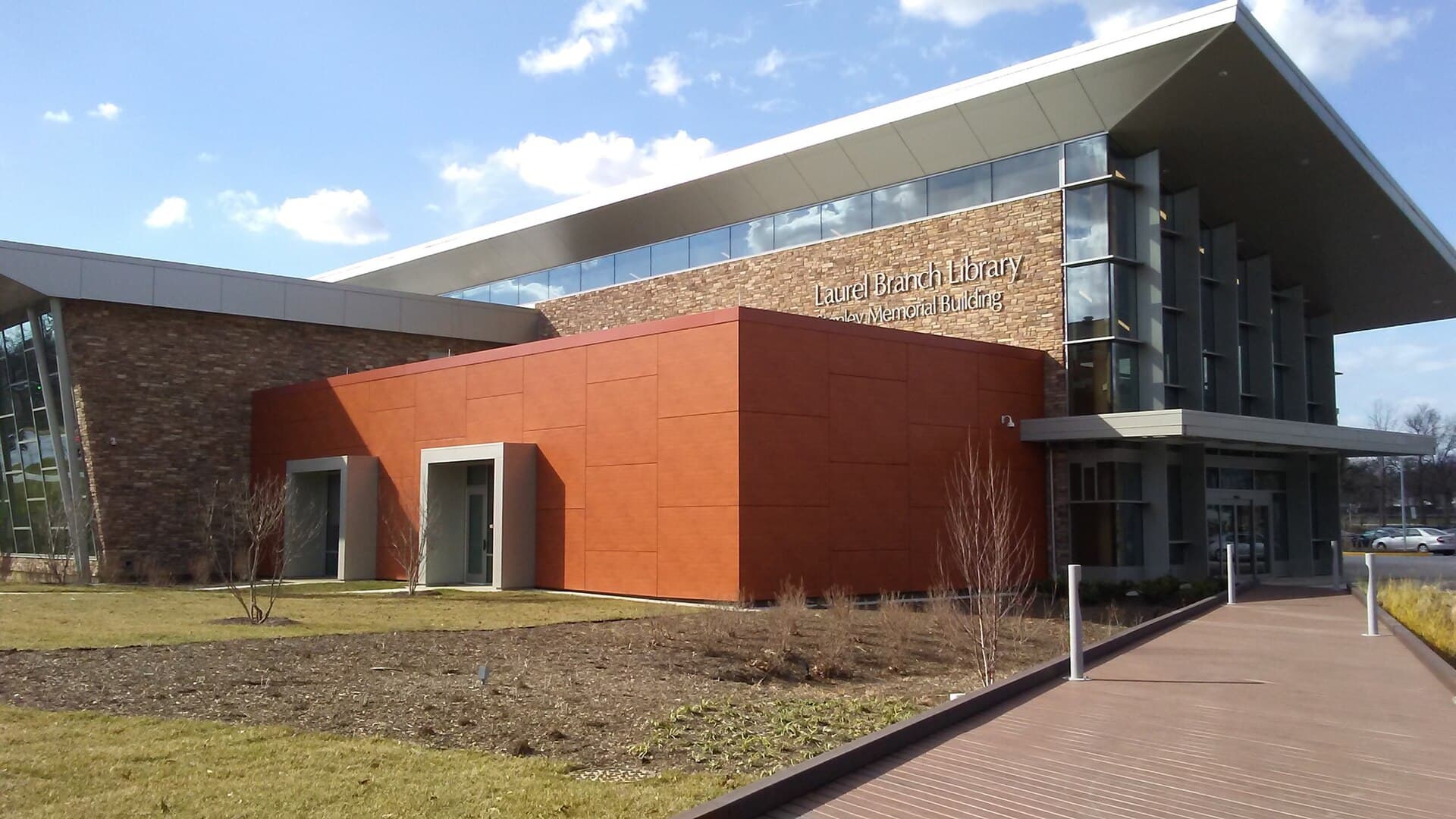
The Stanley Memorial Library, completed in 1967, remains part of that institutional story, but the modern system now stretches well beyond any single building. The current transition in leadership shows how much the system continues to evolve. Megan Sutherland became interim library director effective June 1, 2026, after the departure of CEO Dr. Mark Winston on May 29, 2026. The board later named Catherine E. Hollerbach as library director effective July 13, 2026.
That leadership change arrives at a time when the county expects the library to do more than circulate books. It is expected to keep digital access open, keep branches useful, and keep people connected to county services when other systems fall short.
Programs that reach into the community
One of the clearest examples is Books From Birth. The program sends a free book each month to Prince George’s County children ages 0 to 5 through Dolly Parton’s Imagination Library, with support from the County Executive. In December 2024, the system said the program had sent more than one million free books to children in the county. A donation page says it is currently sending books to around 17,000 children, out of an estimated 59,000 or more children age 5 and under in the county.
The library’s workforce outreach is expanding too. PGCMLS received a $2.2 million U.S. Department of Labor grant for Library2Go: Career Connector, a mobile library vehicle designed for workforce development. The service is used for job search assistance, career readiness training, resume help and access to job seeker books and test guides, making it a moving extension of the county’s employment infrastructure.
Physical branches are being upgraded to match that broader mission. County budget materials say Commons Labs are being constructed or renovated at the Beltsville, Bladensburg, Fairmount Heights, Largo-Kettering and Oxon Hill branches. Those projects signal that the library is not standing still in the digital age; it is building more places for residents to learn, apply for jobs, search online and use new tools close to home.
The calendar reinforces that civic role. Current programming includes storytimes, summer meals in partnership with Prince George’s County Public Schools, and book discussions with county agencies such as the Prince George’s County Office of Human Rights. In practice, that makes the library a place where education, food access, information, culture and public service meet under one roof, and across the county.
This article was produced by Prism’s automated news system from verified source data, official records, and press releases, then run through automated quality and moderation checks before publishing. The system is built and supervised by the people who set the standards it runs under. Read our full AI policy.
Did this article answer your question?