Prince George's County Plants 2,000 Native Trees in Underserved Communities
Capitol Heights and District Heights are getting 2,147 native trees this spring, but the county hasn't named who's responsible for keeping them alive past year one.
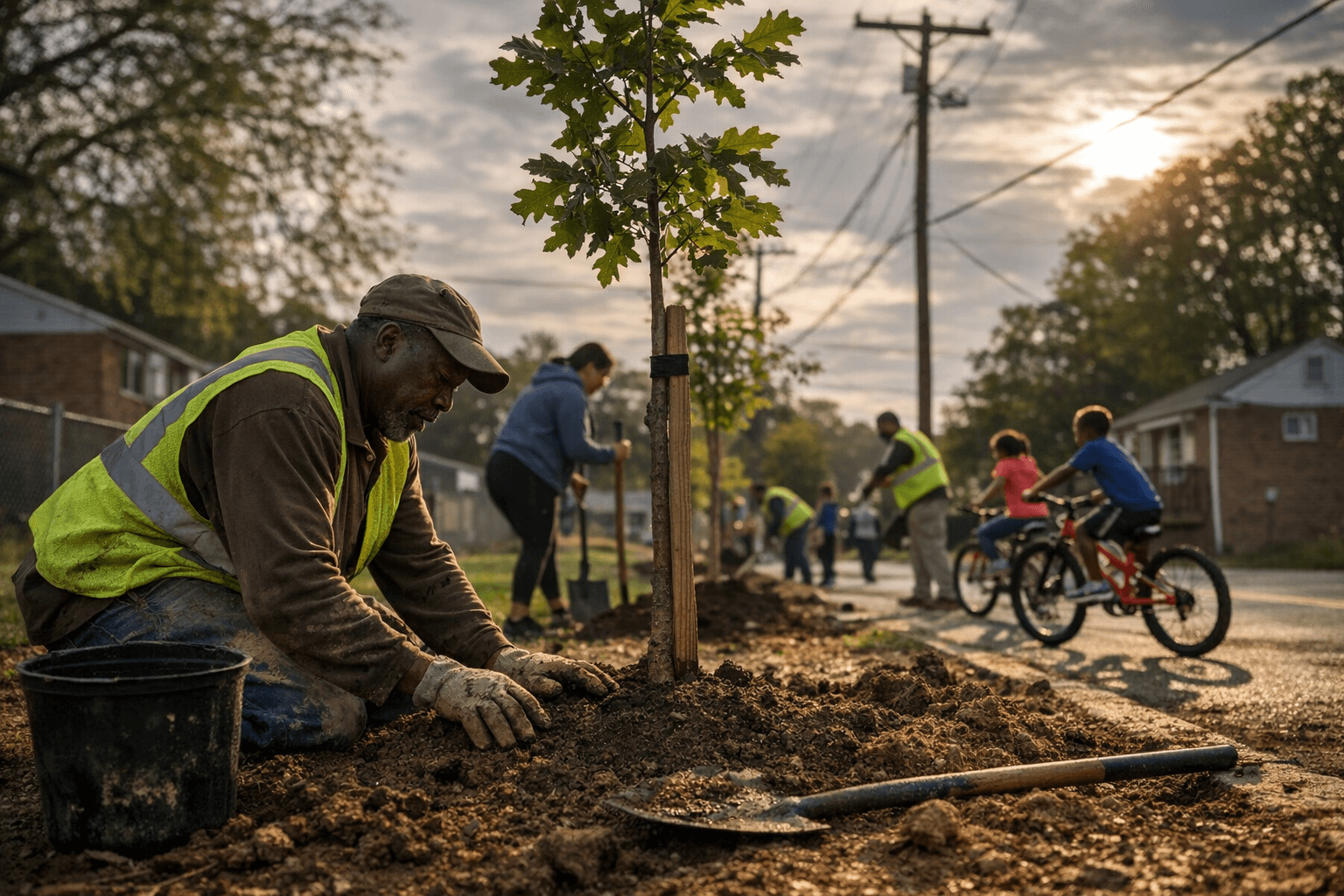
In Capitol Heights, where summers can run 10 to 15 degrees hotter on pavement-heavy blocks than in more canopied parts of the county, crews began planting 2,147 native trees this spring, a number Prince George's officials call a turning point on environmental equity. What they have not yet named is who waters those trees in year two, what survival rate they expect, or how the county will measure whether the promised benefits actually reach the neighborhoods bearing the most heat.
The plantings are underway in public rights-of-way and community spaces across the City of District Heights, the Town of Capitol Heights, and the Town of Bladensburg, with additional sites at homeowners association properties and local churches to be announced in coming weeks. The county set a completion target of late May. Funding flows through the Chesapeake Bay Trust Urban Tree Grant Program, administered by the Maryland Department of Natural Resources with matching dollars from the Department of the Environment's own budget appropriation.
Site selection was driven by two equity-mapping tools: MDEnviroScreen and the county's Tree Equity Mapping Tool, which together identify areas with low canopy coverage, dense impervious surfaces, and elevated exposure to urban heat and stormwater flooding. That methodology placed Capitol Heights, District Heights, and Bladensburg near the top of the priority list, communities that have historically carried far less tree cover than higher-income areas elsewhere in the county.
"For decades, some of our communities have experienced the impacts of historic inequities, including lower tree canopy coverage, higher heat exposure, and greater flood risk," County Executive Aisha Braveboy said. "Planting more than 2,100 street-sized native trees is about restoring balance, improving public health, and ensuring every neighborhood benefits from a greener future."
Dr. Sam Moki, Director of the Department of the Environment, framed the investment in infrastructure terms rather than beautification. "Trees function as natural infrastructure, reducing heat, absorbing stormwater, improving air quality, and strengthening neighborhood well-being," he said. Beyond the 2,147 canopy trees, the county is installing more than 3,000 native understory plantings: shrubs, perennials, and smaller trees intended to build soil health and biodiversity at each site.
What the county has not published are concrete outcome targets. There is no stated temperature reduction benchmark for a specific block in Capitol Heights, no projected stormwater capture volume for a Bladensburg street, and no year-three survival rate for the trees being put in the ground now. County staff say they are documenting installations with before-and-after photography and will coordinate with local municipalities and community leaders as work progresses. Whether that documentation ever surfaces as publicly reported environmental metrics remains unresolved.
The program advances Maryland's Tree Solutions Now Act of 2021, which calls for 5 million native trees planted statewide by 2031. For a resident on a sun-baked street in District Heights, the more immediate test is whether a tree planted this spring still stands, and still cools, two summers from now.
This article was produced by Prism’s automated news system from verified source data, official records, and press releases, then run through automated quality and moderation checks before publishing. The system is built and supervised by the people who set the standards it runs under. Read our full AI policy.
Did this article answer your question?