Prince George's County Police Welcome New Officers From Academy Session 154
Thirty-eight recruits graduated from PGPD's Academy Session 154, but with roughly 300 documented vacancies, the department's hiring pipeline faces tougher math than a ceremony suggests.
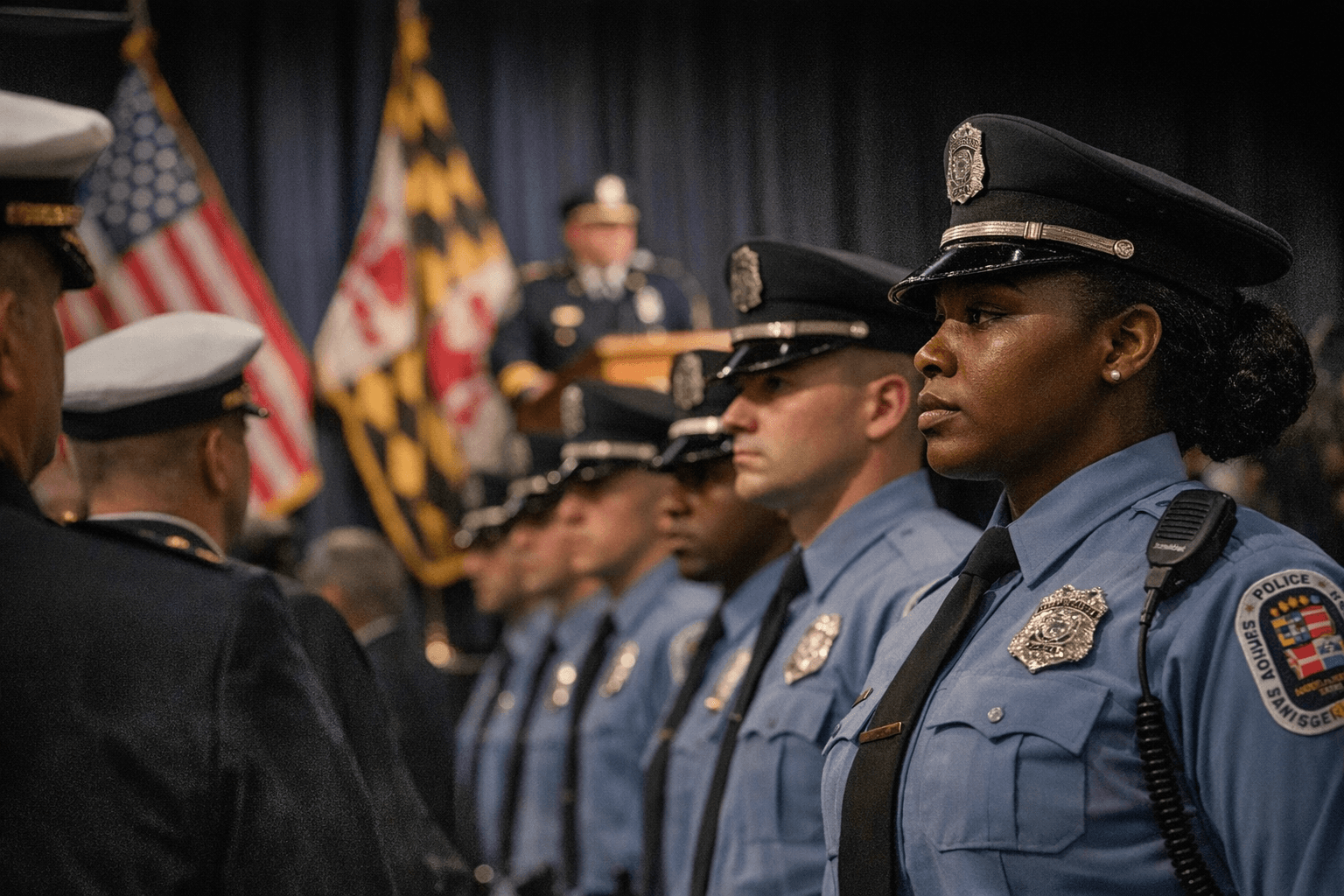
Thirty-eight recruits completed basic training at the Prince George's County Police Department's Police Training Academy in a ceremony held March 20 at First Baptist Church of Glenarden on Watkins Park Drive in Upper Marlboro. Of that class, 23 will be assigned to PGPD patrol districts; the other 15 will join partner law enforcement agencies operating within the county.
The numbers matter for a department working to close a documented staffing gap. County council figures put PGPD's authorized strength at roughly 1,500 sworn officers, and the department's own recruitment division has previously reported working to fill approximately 300 vacancies. Session 154's 23 new PGPD officers narrow that deficit, but not immediately: every graduate must still complete field training alongside a supervising officer and serve a probationary period before operating independently on patrol, a process that typically takes months after graduation day.
That gap between ceremony and solo patrol has real consequences in a county that spans densely populated corridors from Hyattsville and Langley Park to Oxon Hill and Upper Marlboro. Understaffed patrol districts strain response times, and units focused on crime clearance rates and community outreach are among the first to feel thinned rosters. The department has not publicly released specific targets tying its academy cycle to response-time or clearance benchmarks, and neither PGPD leadership nor the Fraternal Order of Police Lodge 89 has detailed publicly whether current graduation rates are keeping pace with attrition and retirements.
What academy training includes is somewhat clearer: recruits complete instruction in law, defensive tactics, emergency vehicle operation, de-escalation techniques, implicit bias, and mental health crisis response, all curriculum that Maryland's Police Training Commission requires and that county oversight bodies and advocacy organizations scrutinize closely. The field training phase that follows puts that instruction against live calls under direct supervisor evaluation.
The 15 Session 154 graduates assigned to partner agencies reflect a feature of PGPD's training model that extends its footprint across the county. The department's academy has long served as a regional resource, helping smaller agencies meet the same statewide certification standard, even as PGPD itself competes nationally for a shrinking applicant pool.
What taxpayers invest per recruit to reach full independent patrol status, including salary during training and the cost of the academy itself, remains an unaddressed question in the department's public communications around these graduations.
This article was produced by Prism’s automated news system from verified source data, official records, and press releases, then run through automated quality and moderation checks before publishing. The system is built and supervised by the people who set the standards it runs under. Read our full AI policy.
Did this article answer your question?