Prince George's County Road Safety: Understanding Recent Fatality Reductions
Prince George’s County saw a sharp drop in traffic deaths from 140 in 2023 to 97 in 2025 as part of a roughly 18% regional decline. This guide explains what drove that change, what remains risky, the local Vision Zero planning and investments underway, and how residents can follow and influence the county’s next steps.
1. Recent fatality numbers and what they mean
Prince George’s County recorded a decline from 140 traffic deaths in 2023 to 97 in 2025, contributing to an approximately 18% decrease in traffic fatalities across the D.C. area in 2025. For residents, that means fewer families experienced the worst outcome of a crash, but the county still records more road deaths than any other local jurisdiction. The headline decline is important, yet it does not eliminate the long-term burden of traffic fatalities in the county or the need for continued action.
2. Key factors credited with the decline
Analysts attribute the recent reduction to several overlapping causes: the return of congestion that reduces risky high-speed driving, stepped-up enforcement, and targeted infrastructure improvements. Returning congestion tends to lower average speeds and the severity of collisions compared with the high-speed conditions seen during previous spikes; stepped-up enforcement (including traffic stops and automated tools) reinforces safer behavior; and infrastructure changes, when placed strategically, physically reduce conflict between road users. Together these elements show how behavioral, regulatory, and design approaches can reduce deaths when applied in concert.
3. Why counts remain a concern despite the drop
Although fatalities fell, total deaths in 2025 remain comparable to levels from about a decade ago, underscoring that the problem is far from solved. The county’s status as the jurisdiction with the highest road death total locally signals persistent systemic risk, certain corridors, intersections and times of day continue to produce severe crashes. This context matters for local policy because it shifts the focus from temporary gains to sustainable strategies that address underlying exposure, equity, and infrastructure deficits.
4. Vision Zero planning: aims and local significance
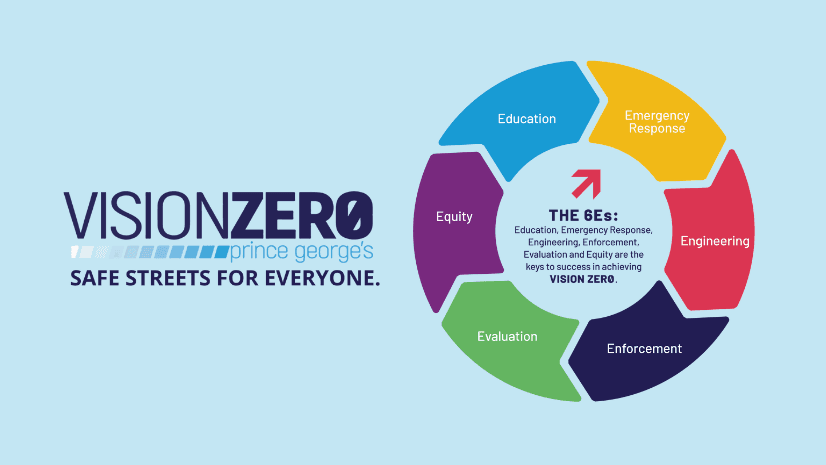
Elected and transportation officials in Prince George’s County are developing a Vision Zero plan, an approach that originated internationally and focuses on eliminating traffic fatalities through safe system principles. A local Vision Zero plan typically coordinates data-driven engineering, enforcement, education and policy changes to prioritize human life over vehicle speed and throughput. For residents, a formal plan can accelerate targeted investments, set measurable goals, and create a structure for long-term accountability if it includes clear timelines, budgets and community input.
5. Targeted investments already in motion
County leaders are investing in several concrete measures: speed cameras, protected bike lanes, sidewalks, and crosswalk improvements. Speed cameras automate enforcement in high-risk locations, reducing excessive speeds while minimizing officer resource constraints. Protected bike lanes physically separate people on bikes from moving traffic, lowering collision risk and encouraging safer active transport. Sidewalk and crosswalk improvements improve pedestrian connectivity and visibility, reducing exposure and creating safer crossing points. Each intervention works best when sited by data showing where crashes concentrate and when paired with community outreach about design and enforcement.
6. Families, advocates and the human dimension
Advocates and families impacted by recent fatal crashes continue to press officials for sustained urgency, drawing on personal loss to emphasize the stakes of policy choices. These firsthand accounts shape public debate and can accelerate political will to move from short-term measures to systemic change. For the community, honoring those voices means incorporating survivor and family perspectives into planning, using their experiences to prioritize the locations and countermeasures that will save lives most effectively.

7. What residents should expect in the coming months
Expect more visible enforcement and staged infrastructure projects as elements of the developing Vision Zero effort move from planning to implementation. Rollouts commonly begin with automated enforcement deployments, targeted lane and sidewalk projects, and pilot protected bike lanes, followed by evaluation and scaling. Residents should watch for official announcements about camera locations, construction timelines, and public input sessions that will define project scopes and mitigation measures.
- Attend or view county transportation and council meetings to hear timeline updates and weigh in on priorities.
- Report hazardous locations to county transportation departments and document near-misses or unsafe conditions to support data-driven decisions.
- Support and advocate for the continued funding of speed cameras, pedestrian infrastructure and protected lanes in your neighborhood.
- Practice and model safe road behavior, obey speed limits, avoid distracted driving, and use crosswalks and lights when available.
8. How residents can engage and practical safety steps
Residents can play a direct role in shaping and sustaining safety improvements by engaging with county processes and adopting safer behaviors. Recommended actions include:
9. Tracking progress and demanding accountability
Sustained reduction in fatalities depends on regular reporting, transparent metrics, and community oversight of implementation. Residents should look for annual or quarterly updates on crash counts, the geographic distribution of serious incidents, enforcement outcomes, and progress on infrastructure milestones. Clear public metrics tied to the Vision Zero plan will help ensure that short-term declines evolve into long-term safety gains rather than reverting to prior spike years.
Conclusion The recent decrease in deaths in Prince George’s County is an important and welcome development, but it is only a step toward eliminating traffic fatalities. Continued political focus, community engagement, targeted engineering and responsible enforcement are all necessary to translate a temporary decline into a durable reduction in harm. Residents’ voices and vigilance will be central to making that transition stick.
This article was produced by Prism’s automated news system from verified source data, official records, and press releases, then run through automated quality and moderation checks before publishing. The system is built and supervised by the people who set the standards it runs under. Read our full AI policy.
Did this article answer your question?