Eudora AME Zion Church marks Quitman County's role in civil rights history
Eudora AME Zion Church is where Marks meets the Poor People’s Campaign, Freedom Riders and local Black leadership history at 301 Martin Luther King Drive.
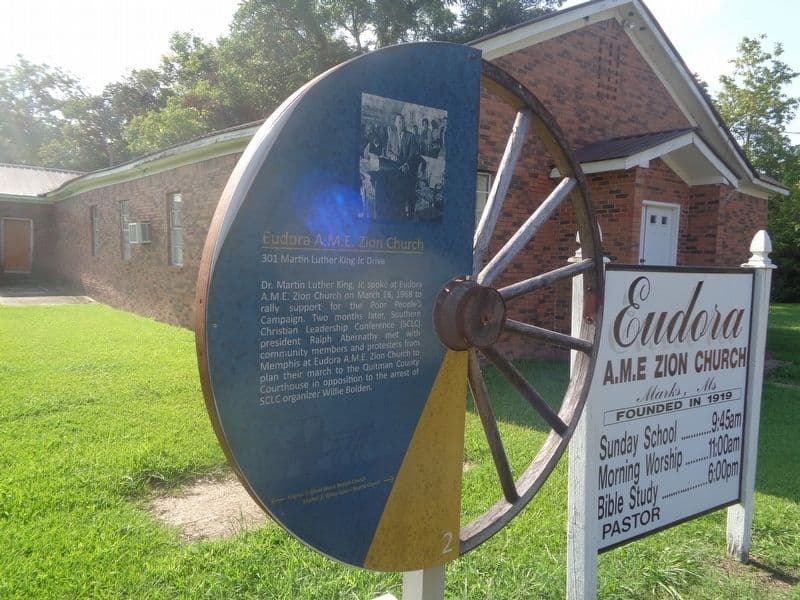
Eudora AME Zion Church sits on Martin Luther King Drive in Marks, but its importance reaches far beyond one address. The church stands as a working landmark of Quitman County’s Black civic life, a place where faith, mutual aid and civil-rights organizing overlapped when rural institutions often shut Black residents out. Dr. Martin Luther King Jr. spoke there in 1968, and the site still helps explain how local people supported national movement work while building leadership at home.
A gathering place, not just a sanctuary
The county’s tourism materials describe Eudora as a church that did practical work as well as spiritual work. It provided meeting space and prepared hot meals for Freedom Riders and Poor People’s Campaign organizers, which places the congregation inside the everyday logistics of movement history. That detail matters because it shows how campaigns did not run only through major cities and headline events; they also depended on churches in places like Marks that could feed people, host conversations and create safe ground for strategy.
Eudora’s role also reflects a broader pattern in the Black South. Churches often functioned as community kitchens, meeting halls and organizing bases, especially when Black people were excluded from formal power structures. In Quitman County, that kind of institution helped sustain both local leadership and the larger push for civil rights.
Why the Poor People’s Campaign mattered in Quitman County
The Stanford University Martin Luther King, Jr. Research and Education Institute places the Poor People’s Campaign in a national frame that makes Quitman County’s involvement easier to understand. King’s campaign ran from May 12, 1968, to June 24, 1968, and was designed to push the country beyond legal desegregation and voting rights toward jobs, unemployment insurance, a fair minimum wage and education for poor adults and children. King wanted an initial group of 2,000 poor people to come from southern states and northern cities to Washington, D.C., to demand economic justice.
That agenda fits Quitman County’s history precisely because the campaign was never only about symbolic access. It was about whether poor Black communities had the resources to live, work and raise children with dignity. Eudora AME Zion Church became part of that strategy, not a passive stop along the way, because it helped connect local residents to a national economic justice campaign.
The March 18 speech and what followed
A historical marker for Eudora A.M.E. Zion Church gives the site a specific date: March 18, 1968. On that day, King spoke at the church to rally support for the Poor People’s Campaign. The county tourism page also says King spoke at both Eudora and Silent Grove Baptist Church in the spring of 1968, underscoring how deeply the campaign reached into Quitman County’s church network.
The days after King’s visit show how quickly the county became part of the movement’s next phase. After King’s death on April 4, 1968, the Southern Christian Leadership Conference organized the Marks Mule Train, which left on May 13, 1968. The historical record ties that effort directly back to the campaign King had already launched, and to the local support structures that made it possible.
Student protests, courthouse violence and the Marks Mule Train
Quitman County’s civil-rights history also includes the pressure that followed King’s visit. One historical marker says that on May 1, 1968, a gathering at Quitman County High School led to the arrest of seven people, including SCLC organizer Willie Bolden, as members of the movement encouraged students to take part in the Mule Train. A separate marker says that after Bolden’s arrest, students and teachers marched to the Quitman County Courthouse and were met with violence from state troopers in riot gear.
That courthouse protest left injuries among demonstrators, including teacher Lydia McKinnon and student Helen Carthan. Those names matter because they show the county’s movement history was not abstract. It involved local teachers, local students and local organizers taking personal risk in public spaces they had every right to claim.
The historical marker database also places Ralph Abernathy at Eudora with community members and protesters from Memphis two months after King’s speech, as they planned a march to the Quitman County Courthouse. That connection links the church to both local mobilization and outside support, showing how Marks became a meeting point for regional civil-rights activity.
How Smithsonian records broaden the picture
Smithsonian archival records connect a Marks rally to Eudora African Methodist Church, adding another layer to the church’s role in the movement. Together with the county’s tourism materials and the historical markers, those records show a consistent pattern: Eudora was a site where people assembled, organized and prepared for action.
The Smithsonian also preserves the wider context of the Freedom Rides, describing the 1961 campaign in which Black and white activists rode buses through the South to challenge segregation and often faced beatings and arrests. Eudora’s hot meals and meeting space for Freedom Riders fit that larger history. The church did not just witness movement history from a distance; it helped carry the movement’s people through town.
Why Eudora still matters to Marks and Quitman County
For younger residents in Marks, Eudora AME Zion Church helps explain why civil-rights history is not confined to distant museums or textbook chapters. It shows how Quitman County’s Black leadership tradition was built through churches, schools and courthouse square struggles, and how ordinary places became organizing centers when national events reached the Delta.
That makes Eudora useful in a very specific way: it connects Black faith, civic courage and community care at one address, 301 Martin Luther King Drive. It also ties local identity to a larger story of economic justice, from King’s call for jobs and fair wages to the people in Quitman County who cooked, hosted, marched and faced down intimidation. In Marks, the church remains one of the clearest places to see how the county helped shape the civil-rights era and why that legacy still defines the town’s sense of itself.
This article was produced by Prism’s automated news system from verified source data, official records, and press releases, then run through automated quality and moderation checks before publishing. The system is built and supervised by the people who set the standards it runs under. Read our full AI policy.
Did this article answer your question?