Marks Mule Train trail brings civil-rights history to Quitman County
Walk Marks’ Mule Train trail to trace King’s Poor People’s Campaign through downtown, with 11 markers, 7 signs, and a stop tied to Silent Grove Baptist Church.

The easiest way to experience civil-rights history in Quitman County is to start at the Marks Mule Train trailhead and follow the markers through downtown Marks and the courthouse square. The route is built for a self-guided walk or drive, with 11 markers, 7 directional pathway signs, and a trailhead marker that doubles as a welcome sign.
Start in downtown Marks
The trail is not a museum behind glass. It sits in the streetscape of Marks, where the wagon-wheel trail markers and wayfinding signs turn ordinary blocks into a readable history route. County tourism material says some of the markers include benches, which makes the trail easier to use for a slower family walk, a church outing, or a stop with visiting relatives who want a quick look at the town’s civil-rights landscape.
The route runs through downtown Marks and the courthouse square, so the history stays tied to the center of town instead of being pushed to the edge. That matters for a place like Quitman County, where the trail is meant to be seen, not just remembered.
Follow the Mule Train story back to 1968
The trail tells the story of the Poor People’s Campaign and the Mule Train that began in Marks. Dr. Martin Luther King Jr. visited Marks in March 1968 to rally support, and he envisioned a march that would start with mule and wagon trains in Mississippi and move toward Washington, D.C.
The Mule Train left Marks on May 13, 1968, and the caravan reached Washington, D.C. for the June 19 Solidarity Day observance. That gives the trail a clear timeline, from King’s stop in Marks to the moment the journey joined the larger national campaign over jobs, wages, and poverty.
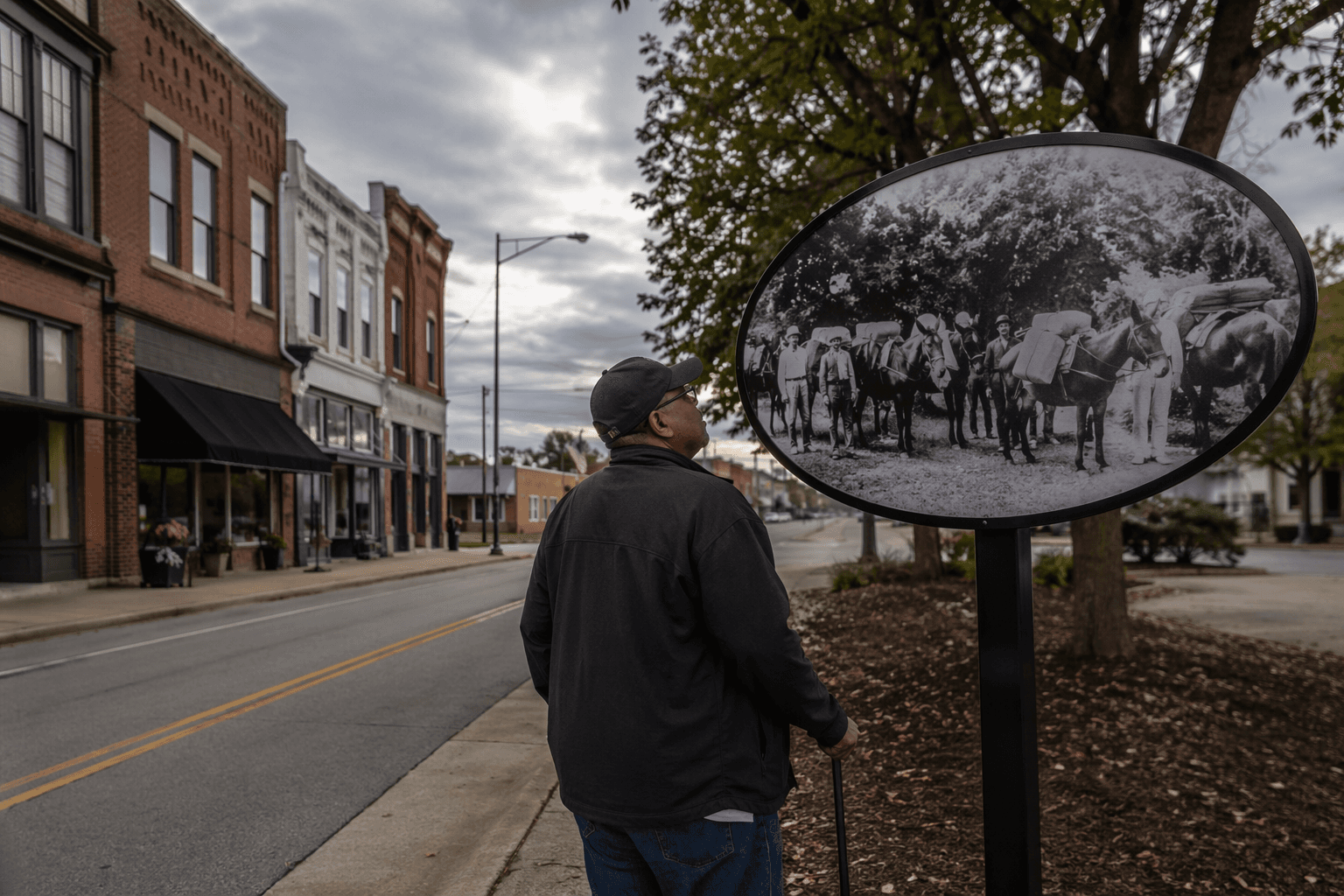
For a parent or grandparent walking with children, that timeline is the most useful part of the route. It turns a few signs in town into a direct explanation of why Marks mattered in a national movement, and why a local route can still carry that weight today.
How the trail was built
The finished trail grew out of a 12-month integrated planning process led by Mississippi State University’s Fred Carl Jr. Small Town Center. In July 2015, the center received a $25,000 Our Town grant from the National Endowment for the Arts to create the trail and plan an interpretive center in Marks telling the story of the 1968 Mule Train.
That planning effort brought in local Marks residents, historians, architects, planners, and state tourism and historic preservation officials. It also included oral histories, a multi-day design charrette, and repeated community feedback, which gave the project a local foundation rather than an outside-scripted one.
The work later received a 2018 National Park Service African American Civil Rights grant of $50,000, helping move the idea from planning into a marked cultural trail. Quitman County says the markers and signs were unveiled at a 50th anniversary event honoring the Poor People’s Campaign.
What you can pair with the trail
The trail fits into a wider civil-rights itinerary in Marks. Quitman County says the county is part of the Mississippi Delta National Heritage Area, and county materials connect Mule Train heritage work with the Marks Rosenwald School and a Civil Rights Freedom Marker.
The Marks site was selected in 2011 from more than 200 sites as one of 30 Mississippi Freedom Trail marker locations. That puts the route within a broader state network of historic places, but the local detail still comes first: the trail begins in Marks, tells a Marks story, and uses Marks streets to do it.
A useful side trip is the Marks Rosenwald School at 400 Humphrey Avenue, which has been designated a Mississippi Landmark. Another county tour description says the first leg began at Silent Grove Baptist Church, where King stopped to rally support. Those two sites deepen the trail’s meaning by linking the march route to the places where local organizing, education, and faith met the national campaign.
Why the trail works for a weekend walk
What makes the Mule Train trail easy to share is its practicality. You do not need a special event, a ticketed program, or a long day to understand it. You can start at the trailhead, follow the signs through downtown Marks, pause at the courthouse square, and then connect the route to Silent Grove Baptist Church or the Marks Rosenwald School if you want the fuller story.
The trail also gives church groups and community organizations a concrete way to talk about civil-rights history without leaving Quitman County. The conversation can stay grounded in named places and dates: March 1968, May 13, June 19, Silent Grove Baptist Church, downtown Marks, and Washington, D.C. That is what makes the Mule Train trail more than a marker project. It is a local route through a national story, laid out where families and neighbors can actually walk it.
This article was produced by Prism’s automated news system from verified source data, official records, and press releases, then run through automated quality and moderation checks before publishing. The system is built and supervised by the people who set the standards it runs under. Read our full AI policy.
Did this article answer your question?