Quitman County Courthouse in Marks Anchors History, Civic Life Since 1911
Built in 1911 and designated a Mississippi Landmark, the Quitman County Courthouse has secured over $700,000 in restoration funding to preserve its dome, windows, and civic services.
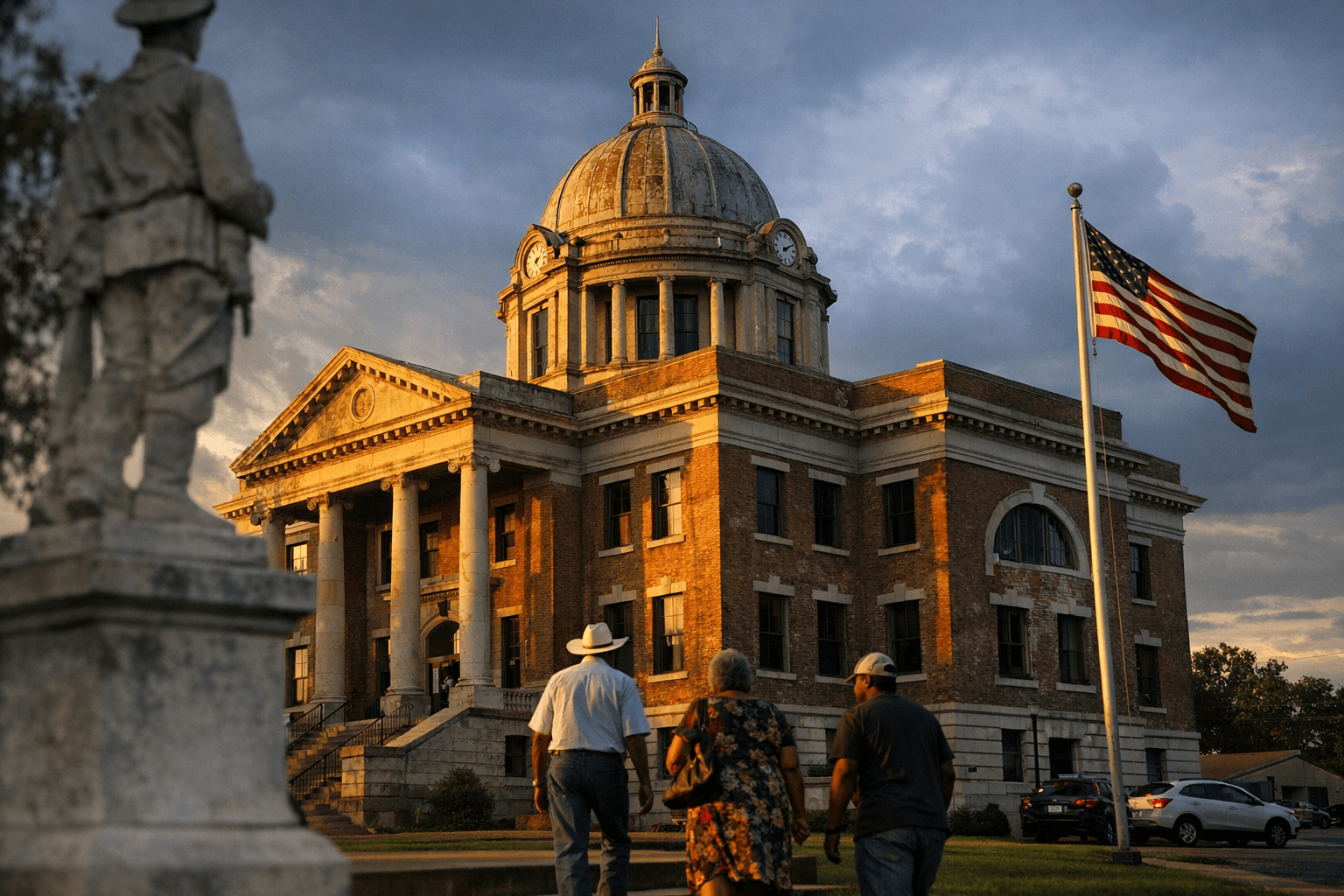
The two-story brick building at 220 Chestnut Street in Marks has held Quitman County's court records, elected officials, and public meeting rooms for more than a century. The $400,000 in state bond funds secured for its restoration, layered on top of hundreds of thousands more in preservation grants from the Mississippi Department of Archives and History, signal that the county's most recognizable structure is not being left to the slow erosion that has claimed courthouses elsewhere across the Delta.
A Building Born From County Conflict
Quitman County's courthouse history is not a straight line. The county was formed in 1877, and while Marks was initially designated the county seat, that arrangement did not hold. By 1883 the seat had moved to Belen, where a second courthouse was constructed in 1894. That building burned in 1908, and by 1910 the county seat had returned to Marks for good. The present courthouse rose from that resolution, completed in 1911 and designed by Chamberlain and Company, a Knoxville-based architecture firm responsible for several Mississippi courthouses during the same era.
The county itself takes its name from John A. Quitman, the tenth governor of Mississippi, a biographical footnote that threads through every deed, court minute, and tax record filed inside those walls.
Classical Revival on the Courthouse Square
Chamberlain and Company produced a building that fit the formal ambitions of early-20th-century county-seat architecture across the Mississippi Delta. The courthouse faces west, built in red brick with stone detailing, and rises two stories before meeting a wide header platform from which a large circular dome, edged in crown-like detailing, sits atop the structure. The County Circuit Court courtroom occupies the second story; chancery and administrative offices occupy the floors below.
The square itself is bounded by Pecan, Locust, Chestnut, and Peach streets. That placement, the formal setback, the classical symmetry, and the dome are all deliberate signals: this building was designed to project institutional permanence in a county that had spent its first decades in an unsettled civic geography. In 1990, the State of Mississippi recognized that permanence formally when it designated the courthouse a Mississippi Landmark.
The Civic Core of a Sparsely Populated County
For a county as rural as Quitman, the courthouse at 220 Chestnut Street is not a symbolic centerpiece but a working hub. The Circuit Clerk, Chancery Clerk, tax assessor, and election officials all operate from within or adjacent to the building. Land deeds are recorded here. Probate files and court minutes are stored here. The Board of Supervisors, the five-member elected body responsible for the county's annual budget, property tax rates, and policy direction, meets here and posts public notices here.
That concentration matters. Residents who need to access vital records, file a document, attend a court proceeding, or appear before the Board of Supervisors have one address. In a county where transportation to larger regional centers is not easily available to everyone, the courthouse's continued operation in Marks is not merely a historical preference; it is a practical necessity.
Restoration Funding: What Has Been Secured
The courthouse has drawn sustained preservation investment over the past decade. The Mississippi Department of Archives and History has awarded the building multiple rounds of Community Heritage Preservation Grant funding: $184,792 for exterior and interior rehabilitation, and a separate $188,008 grant specifically for exterior repairs and window restoration. Those grants are paid on a reimbursable basis tied to completed project phases, meaning the county must carry out the work before drawing down funds.
Beyond MDAH grants, the county secured $400,000 in state bond funds for broader restoration work. The Board of Supervisors has treated courthouse improvement as a stated priority, with recent work including dedicated parking improvements around the courthouse square.
The most consequential pending project is the elevator installation. For more than 110 years, the second-floor Circuit Court courtroom and public meeting rooms were accessible only by stairs, effectively excluding residents with mobility limitations from attending court proceedings and public meetings. The elevator project, paired with historic wood and metal window restoration, interior plaster repairs, exterior masonry work, and updated mechanical and electrical systems, would bring the building into compliance with modern accessibility standards while preserving its Neoclassical character.
Belinda Stewart Architects first engaged with the building's restoration needs as early as 1995, producing a phased condition assessment and scope of work for the county. That foundational planning work set the framework for the grant applications and capital projects that have followed.
The Marks Downtown Historic District Connection
The courthouse does not stand alone as a preservation asset. Marks' central business district, a cohesive collection of early- to mid-20th-century commercial, agricultural, transportation, and governmental buildings, was added to the National Register of Historic Places as the Marks Downtown Historic District. Velma Wilson, Quitman County's Economic and Tourism Director, led that effort and has used MDAH and National Park Service grants to fund courthouse restoration, preserve the Marks Rosenwald School, and develop a cultural trail tied to Martin Luther King Jr.'s 1968 Poor People's Campaign, which launched in part from Quitman County.
That broader historic district context connects the courthouse square to a tourism and heritage economy that extends well beyond civic administration. Visitors who come to Marks to trace the Mule Train route or explore Delta history pass through a downtown anchored by the courthouse's dome.
How to Stay Engaged
Courthouse restoration is funded through a combination of county budgets, state bond allocations, and competitive grant programs, and each of those funding streams runs through public processes. Residents who want to follow or influence the building's future have several direct paths:
- Monitor Board of Supervisors agendas for line items tied to restoration contracts, grant matches, or capital expenditures. Meetings are public, and the Board is required to post notices.
- Visit the historical marker on the courthouse grounds, which provides a compact primer on local history and the county's civic geography.
- Ask the County Administrator or elected supervisors directly about project timelines, particularly how the elevator installation and window restoration work will affect records access and meeting schedules during construction phases.
- Attend budget hearings, where preservation priorities compete with other county expenditures and public attendance signals community support.
The Quitman County Courthouse has already outlasted the building it replaced and the politics that nearly left Marks without a county seat. The question facing the county now is not whether the building deserves to survive, but whether the restoration work moves fast enough to keep its dome, windows, and record vaults in sound condition for the next century of civic life.
This article was produced by Prism’s automated news system from verified source data, official records, and press releases, then run through automated quality and moderation checks before publishing. The system is built and supervised by the people who set the standards it runs under. Read our full AI policy.
Did this article answer your question?

