Quitman County courthouse shaped Marks into county government center
The Quitman County Courthouse still anchors Marks, where county courts, records, and daily business have centered for more than a century. Its return in 1910 helped turn a small town into the county seat again.

The Quitman County Courthouse is why Marks became more than a town on the map. When the county seat returned there in 1910 after the Belen courthouse burned, the new courthouse did not just give Quitman County a place for court sessions. It fixed the county’s government, records, and civic life around one address: 220 Chestnut Street.
How Marks became the county center
Quitman County itself was created in 1877, carved out of parts of Tunica, Coahoma, Panola, and Tallahatchie counties. The bill that created it was introduced by Leopold Marks, a German immigrant who later served in the Mississippi Legislature. The county was named for Mississippi governor John A. Quitman, while the seat took Marks’ name, a reminder that the county and its courthouse were shaped by different men and different political choices.
The county seat did not stay put. It was first at Marks, then moved to Belen in 1883. In 1908, fire destroyed the courthouse in Belen, and the county seat was moved back to Marks in 1910. Leopold Marks donated 10 acres for the new courthouse site, and the present building was completed in 1911. Marks had been incorporated only four years earlier, in 1907, with a population of 350, so the return of county government gave the small town a civic role that still defines it.
That history helps explain why the courthouse shaped the town’s identity so completely. The county seat was not added to an already large downtown. It became the center around which Marks organized its growth, its public business, and its daily routines.
The courthouse building at 220 Chestnut Street
The courthouse now standing in Marks was constructed in 1910-11 and designed by Chamberlin & Associates in the Classical Revival, or Neoclassical, style. It is a two-story red brick, concrete, and stone building with a small dome and a west-facing front porch supported by eight columns. County courtrooms are on the second floor, a layout that has kept the building squarely tied to active government use rather than passive display.

The building has also seen change over time. A 1973 remodel updated the courthouse while preserving its central function as the seat of county justice. Today it houses the County Circuit Court of the 11th Judicial District, the County Chancery Court, and the County Youth Court. For residents who need to file papers, appear in court, or handle family and property matters, the building remains the place where county authority is most visible.
Its historic status is formal, too. The courthouse was designated a Mississippi Landmark in 1990, the state’s highest recognition for publicly owned historic properties. That designation underscores that the building matters not only because it is old, but because it still serves the county every week.
Why the courthouse still shapes daily life in Quitman County
County seats concentrate government in one place. In Quitman County, that means the courthouse area still draws together records, courts, elected offices, and the practical errands that residents cannot do from home. Marks, not a larger city, remains the county’s administrative center for nearby communities such as Lambert, Sledge, Darling, Crowder, and the rural settlements spread across the county.
The scale of the county makes that concentration even more important. The 2020 census put Quitman County’s population at 6,176 and Marks’ population at 1,444. Those numbers show how much of the county’s public life is routed through a single courthouse square and the streets around it. In a small county, the courthouse is not a symbolic backdrop. It is where local government becomes reachable.
The county’s earlier economy and settlement patterns also help explain why a courthouse could become so dominant. In 1880, Quitman County had 62 farms and plantations with an average size of 417 acres, far above the Mississippi average of 156 acres. By 1900, the county’s population had reached 5,435 and was 77 percent African American. Leopold Marks also allowed the Yazoo and Mississippi Valley Railroad to cross his plantation free of charge to encourage growth in the area, a decision that tied transportation, land use, and the county seat’s future together.
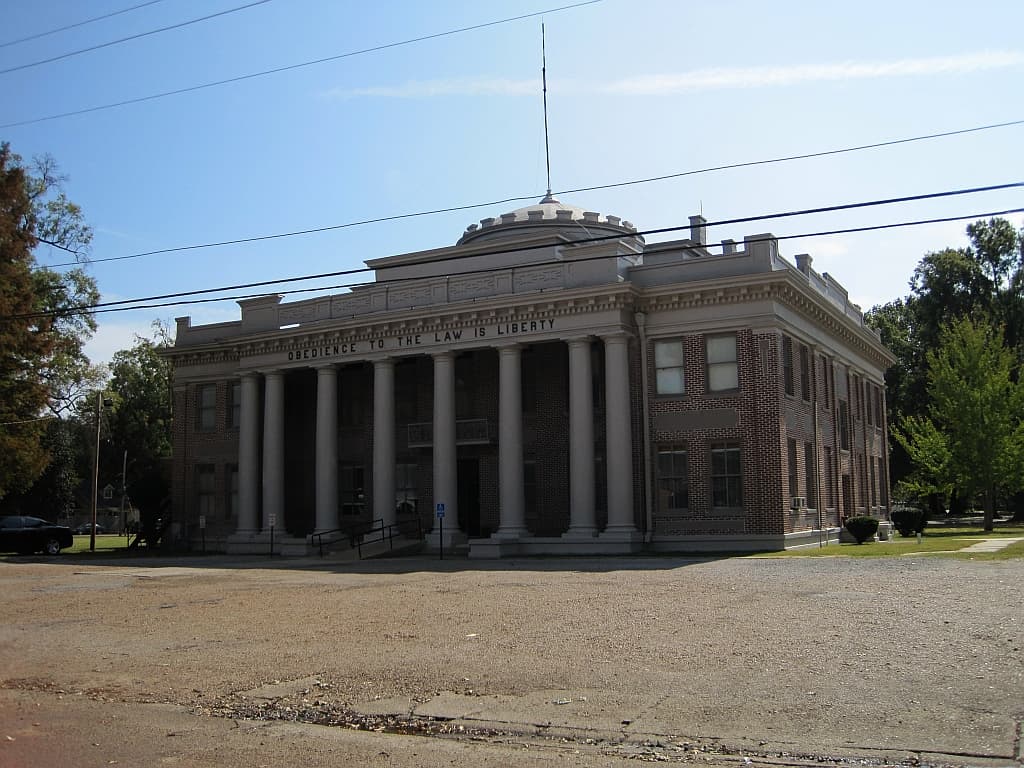
The courthouse therefore sits at the intersection of several forces: courthouse burn and rebuilding, rail access, plantation geography, and county-seat politics. That is why the building matters beyond architecture. It explains where people went when they needed government, why they kept going back, and how Marks became the place where the county’s business happened.
Preservation work that keeps the building active
The courthouse is now part of an active preservation effort, not a finished historical exhibit. The Mississippi Department of Archives and History awarded Quitman County $184,792 for renovations to the roughly 110-year-old courthouse, and the county paired that money with $400,000 in 2020 Legislative Bond funds. The planned work includes an elevator, replacement windows, exterior painting, and limited interior work.
The county has also said it plans to work with Belinda Stewart Architects of Eupora, a firm known for historic preservation projects. That matters because the building still carries the daily load of the circuit, chancery, and youth courts. Upgrades such as an elevator and new windows are not cosmetic details alone; they are the kind of practical improvements that help keep an old public building working for the people who still use it.
In Quitman County, the courthouse is the reason Marks became the county government center and the reason it remains one. The building ties together the county’s founding politics, its shifting seat, its preservation priorities, and the ordinary business of local justice in a town that has long been defined by where the county chose to build.
This article was produced by Prism’s automated news system from verified source data, official records, and press releases, then run through automated quality and moderation checks before publishing. The system is built and supervised by the people who set the standards it runs under. Read our full AI policy.
Did this article answer your question?