Quitman County Residents Can Shape Local Decisions at Public Meetings
The five supervisors who govern Quitman County's roads, tax rates, and flood contracts meet at 220 Chestnut St. in Marks. One prepared voice can change a decision.

The five supervisors who govern every road graded, every property tax rate set, and every HUD-funded contract awarded in Quitman County meet regularly at 220 Chestnut Street in Marks. That courthouse address is the single room where decisions get made for residents of Marks, Crowder, Lambert, and Falcon, and it's where one prepared, specific voice from the public can move an outcome.
Find the Next Meeting Before You Do Anything Else
The Quitman County official website's Events page is the only calendar you should trust. It posts upcoming Board of Supervisors meeting dates into spring, confirms the courthouse location at 220 Chestnut Street, and is updated when meeting times or venues change. Third-party event listings go stale; the county site does not. The Board holds its sessions in the morning, so check the Events page, note the start time, and plan to arrive before that hour.
If you want to confirm a specific agenda item or verify a last-minute change, call the county office directly using the phone numbers listed on the county officials directory page. The County Administrator/Comptroller's office is the right first call for procedural questions. Two named officials you are likely to encounter in-person at the courthouse are Beatrice Pryor (Suite 3, 220 Chestnut Street, 662.326.3062) and T.H. (Butch) Scipper (Suite 2, same building, 662.326.2661). Going through official channels rather than relying on social media posts ensures you have accurate information before making the trip.
What Hangs on These Meetings
The Board of Supervisors is not a ceremonial body. Under Mississippi statute, it adopts the county's annual budget, sets the property tax rate, establishes the policies that direct county growth and development, and awards the contracts that determine whether a drainage ditch gets cleared or a courthouse renovation gets funded. Every procurement tied to flood recovery, every HUD addendum, every decision about road resurfacing in Crowder or water infrastructure near Lambert flows through this room. Attendance is how residents convert frustration about those issues into documented public record.
Get the Packet Before You Walk In
Showing up without the agenda is the most common mistake residents make. The county website posts meeting agendas and supporting documents, including bid packets, procurement specifications, and contract addenda, when they are available ahead of meetings. For example, workforce-development contract documents and HUD addenda have been posted as public PDFs on the county site; those files are the primary references any resident should cite when asking the Board to reconsider a procurement or delay an award.
To get the agenda packet before the meeting:
1. Visit the Quitman County Events page and click the listing for the next Board of Supervisors meeting.
2. Download any linked PDF documents (procurement specs, contract addenda, resolution drafts) and note the specific page numbers you may want to reference aloud.
3. If the agenda references a document that is not yet posted, contact the county clerk in writing to request it. State open-meeting law generally requires that records be made available, and a written request creates a paper trail.
4. Print what you download. Many meeting rooms have unreliable cell service, and a printed document commands more credibility at a podium than a phone screen.
Sign Up to Speak
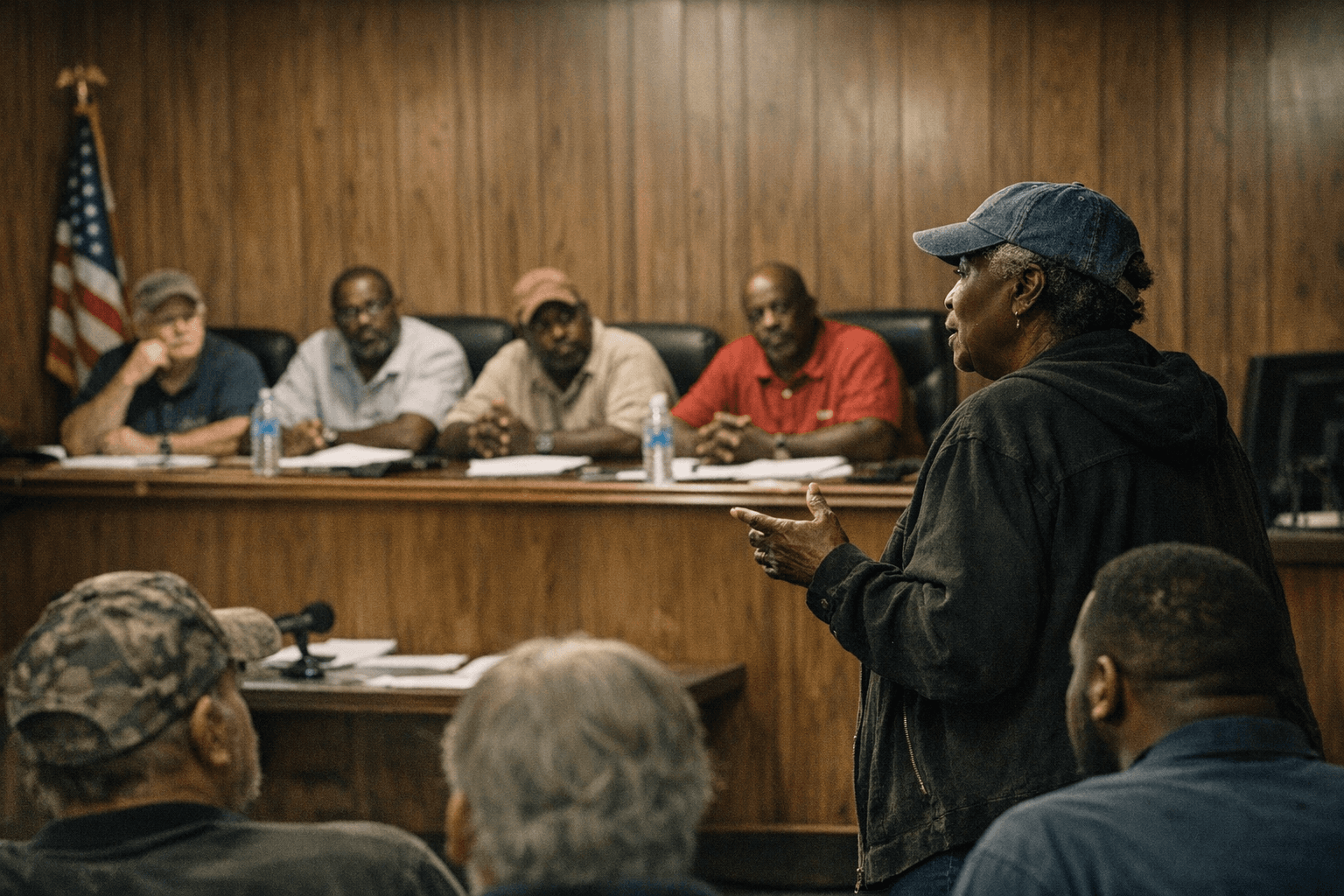
Public participation rules vary by governing body, but for the Quitman County Board of Supervisors, the protocol is clear: contact the county clerk or the Board office ahead of the meeting and ask to be placed on the agenda. Do not simply show up and expect to be recognized. Calling in advance serves two purposes: it guarantees you a slot, and it gives the Board time to pull the relevant documents before you speak, which makes your three minutes more effective.
Submit any written comments or supporting materials at the same time. When a clerk enters your documents into the meeting record, they become part of the official file and cannot be quietly set aside. If you represent a neighborhood association, a church, or a coalition of property owners along a specific road, bring a signed petition. A document with fifty signatures communicates scale in a way a single speaker cannot.
Three Questions Worth Asking on the Record
When you reach the podium, specificity is your sharpest tool. Broad frustration rarely produces a motion; a question that references a document by title and page number does. Here are three questions calibrated to the issues Quitman County residents are most likely tracking:
- "What is the current timeline and budget line for drainage and road work on [specific road or community], and when will the Board receive a status update?"
- "Has the county drawn down its full HUD allocation for flood-recovery projects, and what is the next public milestone residents can use to track progress?"
- "What evaluation criteria did the Board apply when scoring bids for [specific contract], and is the full procurement packet available for public review under Mississippi public records law?"
Each of these questions is answerable from documents already in the public record. If the Board cannot answer on the spot, a supervisor or the County Administrator is expected to follow up in writing before the next meeting cycle.
Watch Remotely If You Cannot Attend
The county website and its social media profiles sometimes post video links or livestreams for county meetings. Check those channels in the days before each meeting. If a live option is not available, the county posts minutes after the meeting concludes; those minutes are the official record of what was said and decided. Reading them promptly matters: if an item was tabled or continued to the next session, that follow-up meeting is your opportunity to engage before a final vote.
Follow Up in Writing Every Time
Attending once without following up is roughly half the work. After the meeting, email the supervisor or county official who received your comment and ask explicitly that your remarks be entered into the official minutes. That request, sent in writing, creates a second layer of documentation and signals that you are monitoring how the Board responds. Officials who know a constituent is tracking a specific project in writing tend to provide more substantive updates than those responding to a general inquiry.
A practical checklist before you leave the building:
- Collect the business card or direct phone number of the official who acknowledged your comment
- Note the exact motion number or agenda item that covers your issue
- Write down any commitments made from the dais, including who made them and in what context
- Set a calendar reminder for the next Board meeting date, already posted on the county Events page
The Quitman County Courthouse at 220 Chestnut Street has housed the Board of Supervisors through flood seasons, budget crises, and contested procurements. The meetings held there are public by law, open by design, and consequential in ways that show up on every property tax bill and every stretch of county road. Preparation is what turns attendance from a passive act into a documented intervention.
Know something we missed? Have a correction or additional information?
Submit a Tip