Rockwall County ambulance service runs through countywide ESC board
Rockwall County’s ambulance system runs through a countywide board, so coverage, costs and contract oversight all sit with county and city leaders together.

Rockwall County’s ambulance service does not sit inside a single county department. It runs through a countywide Emergency Services Corporation, a board-driven structure that ties together Rockwall County and the cities it serves, and that is where coverage, contract oversight and cost-sharing get decided.
The setup matters because the county built it to manage EMS as a shared local service, not a standalone county office. Rockwall County says the Emergency Services Corporation was developed in 2003 and began operating in 2004, with the purpose of spreading the cost of ambulance service across the county while keeping oversight close to the people and cities that depend on it. Texas law gives county commissioners courts authority to provide emergency ambulance service, including equipment, personnel and maintenance, which is the legal backdrop that makes the countywide model possible.
How the county system is organized
The ESC is the spine of the county’s ambulance coverage. Rockwall County describes it as a local government corporation that has also handled other health and safety work on a cost-sharing basis over the years, including a law-enforcement training facility and countywide emergency management support. That means the same public structure that helps govern ambulance service also shows up in other essential pieces of county safety infrastructure.
The emergency management side is not separate from that story. Rockwall County’s emergency-management office says its mission is to preserve life and property and encourage economic recovery after disasters, and the current emergency-management coordinator is Jarod Rosson. The county also says the countywide emergency-management program includes two staff members who help jurisdictions with preparedness, planning, training, exercises and grants. In practice, the ESC is one of the clearest examples of how Rockwall County and its cities share responsibility for services that residents expect to work every time a 911 call comes in.
Who sits at the table
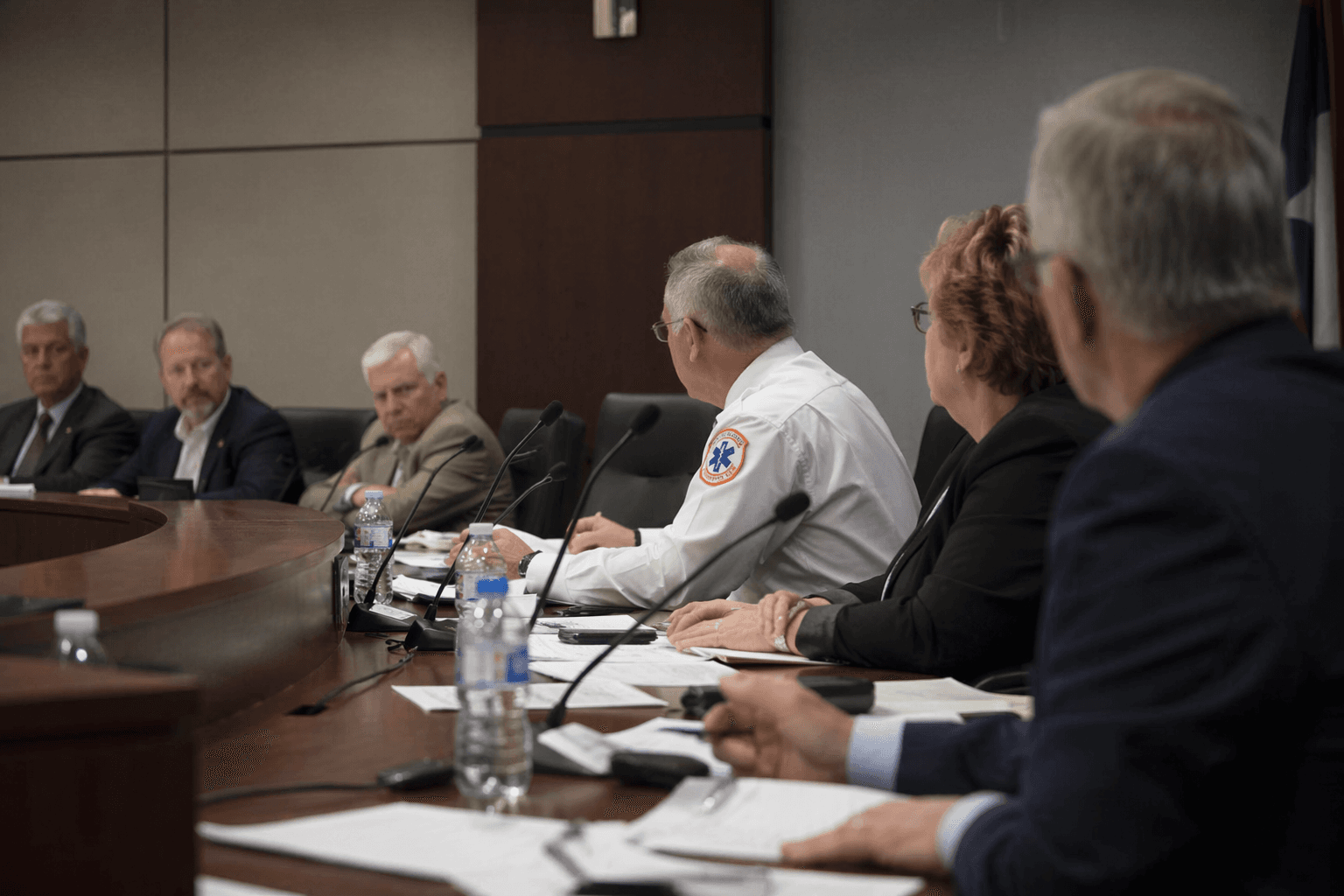
The board is deliberately multi-jurisdictional. Rockwall County says the ESC board includes elected officials from Rockwall County and the cities of Rockwall, Heath, Fate, McLendon-Chisholm, Royse City, Rowlett and Mobile City. That matters because ambulance coverage decisions are not made by one city alone and not by the county in isolation either. The board structure gives each participating community a seat in the conversation about service, response, and the money needed to keep the system running.
Current board leadership listed by the county includes Frank New as president, Dana Macalik as vice president, James Branch as secretary, David Peek as treasurer and Kristy Teague as assistant board secretary. The county’s roster also shows additional municipal representatives and notes a vacant Mobile City seat, which underscores that the corporation is meant to function as a shared regional body rather than a single-city operation. When a seat is open, the absence is visible in the structure itself.
That board makeup is the answer to a basic accountability question: who is responsible if coverage or response becomes a problem? In Rockwall County, the answer runs through the ESC board, the participating city governments and the county officials who sit on it, with the commissioners court operating under the authority Texas law gives it over emergency ambulance service.
What the ambulance service provides
The service itself is Rockwall County EMS, and its public description adds the operational details that residents care about most. The agency says every Mobile Intensive Care Unit is staffed by two paramedics, or by a paramedic and EMT team, and that it provides 911 EMS service across the entire county. It also says the system meets the highest level of ambulance certification recognized by the Texas Department of State Health Services.
That combination of countywide service and board oversight is important in a fast-growing county. The U.S. Census Bureau estimated Rockwall County’s population at 140,738 in July 2025, up from 107,819 in the 2020 census, a gain of 30.5 percent. More people, more homes and more calls all increase the pressure on ambulance coverage, which is why the county’s governance model is more than an administrative detail. It is the mechanism that has to keep pace when demand rises.
How the oversight works in practice
The paperwork shows this is an active system, not a ceremonial board. A 2017 ambulance services contract between the ESC and Medic Rescue, doing business as Rockwall County EMS, was later amended, and board agendas in September 2022 show discussion and action on Amendment 3 to that contract. Another late-2022 agenda shows the board hearing a demo on ambulance-related data and reporting from Matthew Hitt, the deputy emergency management coordinator and ESC ambulance contract administrator.
That detail matters because it shows the board using data, contract language and formal reporting to monitor the service. A 2024 agenda also shows the board discussing annual minute approval plus monthly ambulance services reports and contract compliance, which means the ESC is not just approving budgets and moving on. It is checking whether the system is doing what the county hired it to do.
For households across Rockwall County, the practical stakes are straightforward. The shared ESC model is designed to spread costs across participating governments rather than leaving one city to carry the full load. It also puts service consistency and response oversight in front of a board that includes county and city leaders, so the people answering to voters are the same people expected to watch the contract, track performance and keep the countywide system working when a 911 call turns into a real emergency.
This article was produced by Prism’s automated news system from verified source data, official records, and press releases, then run through automated quality and moderation checks before publishing. The system is built and supervised by the people who set the standards it runs under. Read our full AI policy.
Did this article answer your question?