Rockwall County’s geography explains its rapid suburban growth
Rockwall County’s tiny footprint, Lake Ray Hubbard and fast population growth have turned land, roads and schools into a tight suburban squeeze. The county’s geography is now its biggest growth constraint.
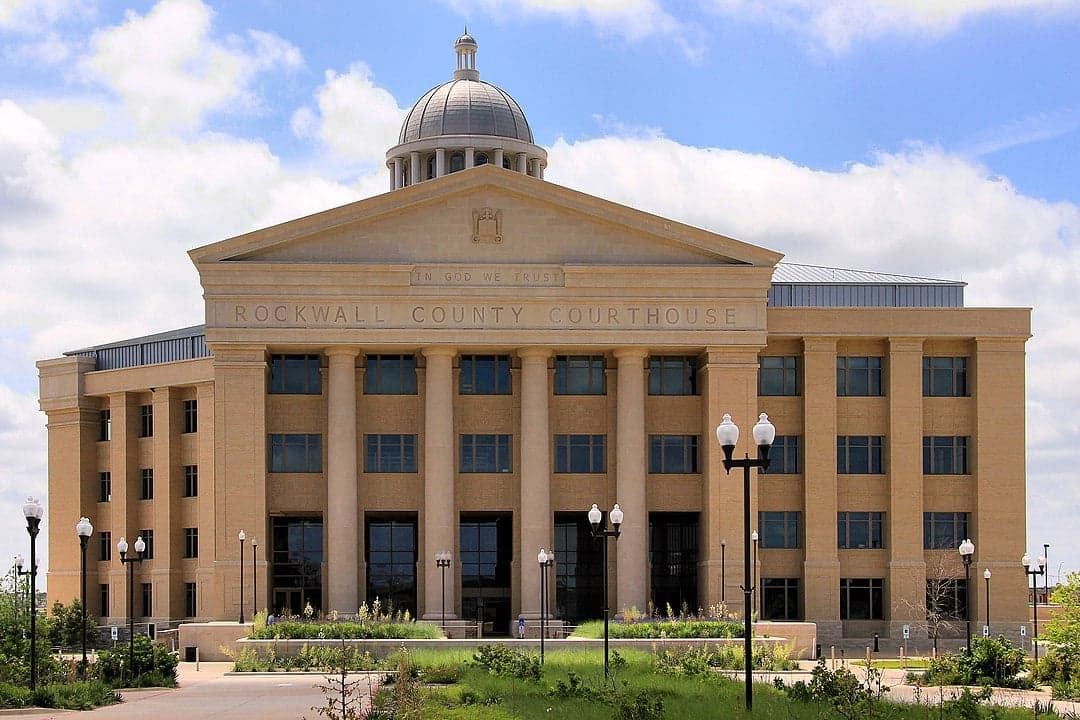
Rockwall County’s growth looks suburban on the surface, but its real story is spatial. With only 147 square miles overall and 127.2 square miles of land, the county has had to absorb housing, retail, schools and road projects inside a compact frame that leaves little slack when Dallas-area growth pushes east. Lake Ray Hubbard takes up 13.55 percent of the county, and the rest of the land is divided between river valley, terrace and uplands, so every new project lands inside a tight, crowded map.
Why the county fills up so quickly
The Texas Almanac places Rockwall County in the Blackland Prairies about 25 miles northeast of Dallas, rising from roughly 390 to 620 feet above sea level. It is nearly square in shape, but its surface is not uniform: the county breaks into the East Fork of the Trinity River valley, a narrow terrace west of the valley and rolling uplands that cover most of the county. That topography matters because it compresses development into a limited number of buildable corridors, especially where roads, utilities and subdivisions can spread without hitting water or steep grade changes.
The land itself explains why the area moved from farm country to suburb so quickly. The Texas Almanac says 93 percent of the county is arable and extremely fertile, and the county history record notes a 236-day growing season and average annual precipitation of 38.68 inches. For much of its history, the greater part of the county was treeless prairie except along creeks and bottoms, which made it ideal for agriculture long before it became attractive to commuters and developers.
From inconvenient county seat to county of its own
Rockwall County was not drawn on a blank map. The area was first part of Nacogdoches County in 1836, then Henderson County in 1845, and then Kaufman County in 1847. By 1873, residents had decided Kaufman County’s seat was too inconvenient, and Rockwall County was formed as a separate county. That split still echoes in the county’s compact layout: it emerged because local travel to government was too cumbersome, so its modern form remains unusually easy to cross compared with larger North Texas counties.
The county’s name comes from one of the region’s most famous local details. In the early 1850s, farmers digging a well discovered a rock wall formation, and the town of Rockwall took its name from that find. The story is more than a local curiosity. It shows how a single geologic feature became a civic identity marker in a county whose settlement pattern was already shaped by soil, water and short travel distances.

Lake Ray Hubbard changed the county’s center of gravity
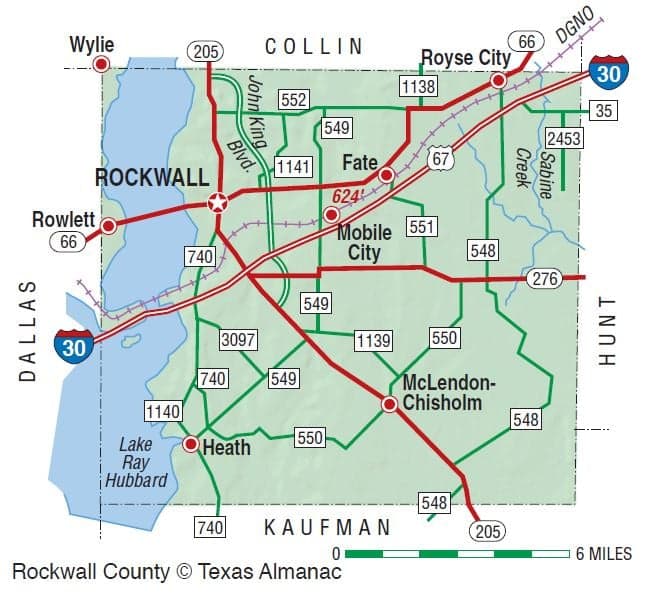
The East Fork of the Trinity River was dammed in 1969 to create Lake Ray Hubbard, a water supply project built for Dallas that now stretches across Dallas, Kaufman, Collin and Rockwall counties. The Texas Water Development Board places the lake about fifteen miles east of Dallas, just north of Forney, and its shoreline now consumes a meaningful share of Rockwall County’s footprint. In a county this small, a lake that occupies 13.55 percent of the land is not just scenery. It is a force that narrows where homes, roads and business sites can go.
Transportation pressure follows the water. TxDOT says the current I-30 configuration is inadequate to handle traffic congestion and population growth, which is why the agency’s expansion project calls for widening I-30 and adding continuous frontage roads, including across Lake Ray Hubbard. That bottleneck is central to understanding Rockwall County’s day-to-day growth pattern: land is limited, the lake limits more of it, and the main east-west highway is already under strain. Shorter travel distances inside the county do not reduce congestion when so much movement is funneled into the same corridor.
Growth now shows up in homes, schools and employers
The population numbers show how quickly that compact geography has been filled in. Rockwall County had 78,337 residents in 2010, 107,819 in the 2020 Census and an estimated 140,738 in July 2025. That pace of growth is unusually fast for a county this small, and it helps explain why the county now feels denser than a map might suggest. The county had 47,926 housing units in 2024 and 2,986 employer establishments in 2023, signs of a place that is adding households and jobs at the same time.
The local economy and housing market reflect that pressure. Rockwall County’s 2024 median household income was $115,884, and the median value of owner-occupied housing units was $415,500. Those figures point to a market where land scarcity and access to the Dallas metro area have become part of the pricing structure. Rockwall ISD adds another layer: the district had 19,185 students across 23 campuses in the most recent Texas Tribune Schools Explorer data, a scale that shows how quickly school-age demand has followed the county’s residential expansion.
Planning is now countywide, not parcel by parcel
Rockwall County’s Strategic Plan 2050 puts the challenge in plain terms by emphasizing infrastructure investment, growth management and the preservation of local culture and traditions. That is not abstract planning language in a county with a fixed shoreline, a constrained highway network and a fast-growing school system. The county’s 2027 Thoroughfare Plan is being updated to support continued growth and manage development, which tells you how quickly the old road map is being overtaken by new traffic.
The County-Wide Planning Consortium ties that process together. Elected officials, county and city staff, TxDOT and the North Central Texas Council of Governments are all part of the effort, which makes sense in a county where one road project or subdivision can affect neighboring jurisdictions almost immediately. In Rockwall County, transportation, land use and utility decisions cannot be separated for long.
A compact county with a distinct civic identity
Rockwall County’s small footprint has also helped preserve a strong local identity even as the suburban edge thickens. The county clerk’s office now lists an unusual distinction: Senate Concurrent Resolution 6, signed by Governor Greg Abbott on May 30, 2025, named Rockwall County the official Marriage Capital of Texas for ten years, through 2035. It is a symbolic title, but it fits a place where local government, community memory and rapid growth all sit close together.
That closeness is the point. Rockwall County’s geography has not just limited where people can build. It has shaped how they drive, where schools expand, why housing values rise and how infrastructure gets prioritized. In a county this compact, growth does not spread outward in soft rings. It presses directly against the lake, the highway and the next available parcel, making every land-use decision feel immediate.
This article was produced by Prism’s automated news system from verified source data, official records, and press releases, then run through automated quality and moderation checks before publishing. The system is built and supervised by the people who set the standards it runs under. Read our full AI policy.
Did this article answer your question?