Eight Must-See Destinations Await Visitors Across Sagadahoc County
Sagadahoc County packs a 20-acre maritime campus, Maine's busiest state park beach, and a free world-class art museum into one tightly connected day-trip circuit.
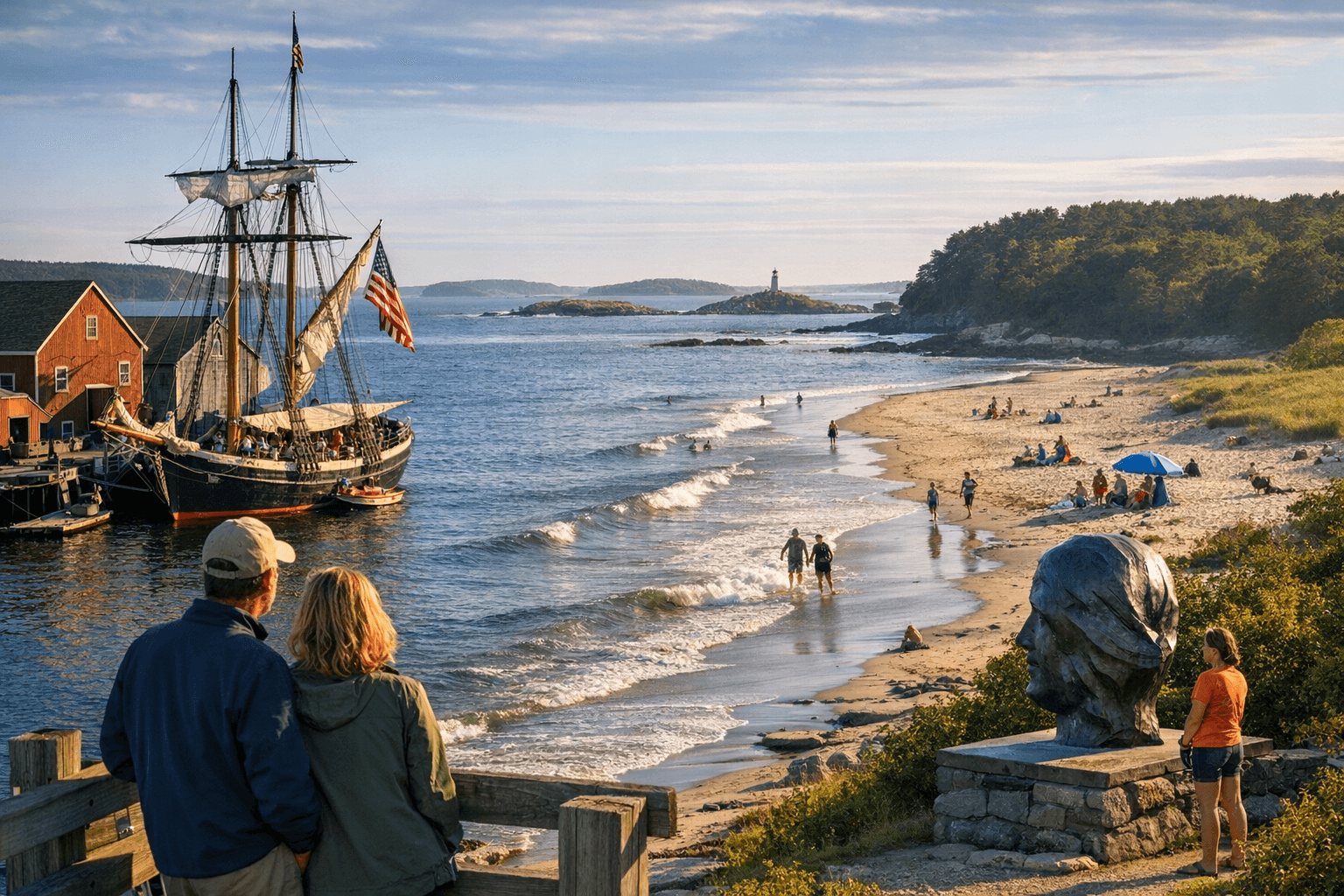
Few Maine counties can deliver a granite Civil War fortress, a living shipyard, and a free college art museum holding 20,000 works before lunch. Sagadahoc County, anchored by Bath on the Kennebec River and stretching south to the Atlantic edge of Phippsburg, packs that density into a geography small enough to navigate without a highway. What follows is an eight-stop guide to the destinations that reward both first-time visitors and locals who think they already know the place.
Maine Maritime Museum
The Maine Maritime Museum occupies 20 open acres on the Bath waterfront and is the single most efficient way to absorb four centuries of Maine shipbuilding history. The intact Percy & Small shipyard, the only surviving large wooden shipyard in the United States, anchors the campus, and docent-led tours of the grounds run daily at 11:00 a.m. and 1:00 p.m., included with admission, from mid-May through October. The Victorian-era Donnell House, home to one of Bath's shipbuilding families, opens seasonally for separate docent tours, and blacksmith demonstrations round out the working-history feel. Seasonal lighthouse and nature cruises operate on the Kennebec; check the museum's calendar before visiting because program schedules shift. Hours run 9:30 a.m. to 5:00 p.m. daily. Parking is available on-site, and the campus connects directly to downtown Bath's walkable streets, where independent restaurants and shops line Front and Centre Streets within a few blocks.
Popham Beach State Park
Described by Maine's own parks agency as the state's busiest state park beach, Popham Beach sits at the southern tip of the Phippsburg peninsula and delivers a long, sandy barrier beach, active tidal pools, and some of the county's most dramatic coastal scenery. The park is open year-round from 9:00 a.m. to sunset, with fees collected at the entry booth daily. The surprising hook here is geological rather than historical: the East Picnic Area was lost entirely to the sea during winter storms in 2024, a visible reminder of how fast this coastline reshapes itself. Arrive early in summer, because parking fills quickly, and check the Maine DACF park advisories before any visit. The sandbar crossing to Fox Island is possible only at low tide and demands caution; tide tables, not instinct, should govern that decision.
Fort Popham and the Popham Colony Sites
Fort Popham, a semicircular granite fortification on the mouth of the Kennebec, was built during the Civil War to guard the river approach to Bath's shipyards. Most visitors treat it as a scenic footnote to the beach, but the surrounding Phippsburg peninsula carries a far older story: the Popham Colony was established here in 1607, making it one of the earliest English settlements attempted in North America, predating Plymouth Colony by thirteen years. Interpretive markers trace the colonial-era settlement along the peninsula, and a half-day itinerary combining Fort Popham with a Popham Beach visit covers both the Civil War-era fortifications and that deeper colonial context efficiently. No separate admission is charged at Fort Popham itself. The drive down Route 209 from Bath takes roughly 30 minutes.
Downtown Bath Waterfront and Shipyard Viewpoints
Bath's downtown waterfront is a working landscape, not a sanitized tourist corridor, and that is its appeal. The Kennebec River frontage offers unobstructed views of Bath Iron Works operations; destroyers under construction move through stages visible from public piers, and the surrounding streets are lined with 19th-century commercial architecture largely intact. The walkable downtown connects directly to the Maine Maritime Museum campus and hosts independent retailers, bakeries, and a handful of restaurants within a few blocks of the river. Best light for photography falls in the morning hours, when the river reflects sun from the east and the shipyard cranes stand in silhouette. Street parking is generally available outside summer weekends.
Chocolate Church Arts Center
The Chocolate Church Arts Center is Bath's primary performing arts venue and takes its name, appropriately, from the chocolate-brown Gothic Revival church building it occupies on Washington Street. The venue runs a Main Stage and an Annex space, hosting regional theater, concerts ranging from folk to jazz, film screenings, and community programming year-round. The 2026-2027 calendar is already stacked, with performers including The Rumble featuring Chief Joseph Boudreaux and the Soggy Po' Boys on the concert schedule, and a co-produced event with Maine Humanities coming in spring with tickets on sale in early April. Many shows sell out in advance; the box office calendar is the essential planning tool. Parking is available along Washington Street and in nearby lots.
Bowdoin College Campus
Bowdoin College's compact historic campus in Brunswick anchors the county's northern cultural corridor and contains one of the finest college art museums in the United States. The Bowdoin College Museum of Art holds a collection of more than 20,000 works spanning human history, housed in the Walker Art Building, designed by Charles F. McKim in 1894. Admission is always free, and hours run Tuesday through Saturday from 10:00 a.m. to 5:00 p.m., with extended Thursday evening hours until 8:30 p.m. and Sunday hours from 1:00 to 5:00 p.m. The Thursday evening window is the insider move: attendance is lighter, and the McKim building's architecture reads differently in evening light. Campus parking is available in visitor lots off Maine Street (GPS: 255 Maine Street, Brunswick). Several well-regarded independent restaurants operate within walking distance on Maine Street.
Main Streets: Brunswick, Topsham, and Bowdoinham
The three Main Streets of Brunswick, Topsham, and Bowdoinham reward the kind of unhurried browsing that anchors local spending in small-town retail ecosystems. Brunswick's downtown, organized around Maine Street and supported by the Brunswick Downtown Association, runs a seasonal outdoor farmers' market and hosts anchor annual events including the Earth Day festival and the People Plus Music in April fundraiser, an online auction that draws significant community participation each spring. Topsham's commercial strip across the Androscoggin River offers a complementary mix of locally owned shops and services, while Bowdoinham, smaller and quieter, functions as an agricultural community with seasonal market activity. Planning a visit around one of Brunswick's annual events adds a layer of local texture that no museum can replicate; the Brunswick Downtown Association's online events calendar is the practical resource for current schedules.
Outdoor Recreation: Kayaking, Birding, and Short Hikes
The Kennebec River corridor and the tidal marshes spreading across Sagadahoc's quieter peninsulas and coves represent the county's least-crowded and most ecologically rich geography. The tidal marshes in particular are prime habitat for migratory shorebirds during spring and fall migration, drawing birders who rarely appear in tourism guides. Local outfitters in Brunswick and Bath provide seasonal kayak and canoe rentals along with guided paddling experiences on the Kennebec and surrounding tidal waters. Short nature walks are accessible from trailheads near Popham and along the Back River corridor without requiring significant gear or planning. Early morning in spring and fall delivers the best birding conditions and the calmest water for paddling; summer afternoons bring afternoon wind that makes the estuary noticeably choppier.
Taken together, these eight destinations form a logical circuit rather than a scattered checklist. Pair the Maine Maritime Museum with Popham Beach and Fort Popham for a single full-day arc that moves from river to coast. Save Bowdoin's museum and Brunswick's Main Street for a quieter half-day anchored in the county's northern corner. The county's strength is that its best stops are genuine places, still shaped by the industries and communities that built them.
This article was produced by Prism’s automated news system from verified source data, official records, and press releases, then run through automated quality and moderation checks before publishing. The system is built and supervised by the people who set the standards it runs under. Read our full AI policy.
Did this article answer your question?