250 San Franciscans Gather at Ocean Beach to Dig One Enormous Communal Hole
250 San Franciscans dug a communal pit at Ocean Beach Saturday deep enough to swallow an adult standing upright, and at least one digger started worrying about the walls coming down.
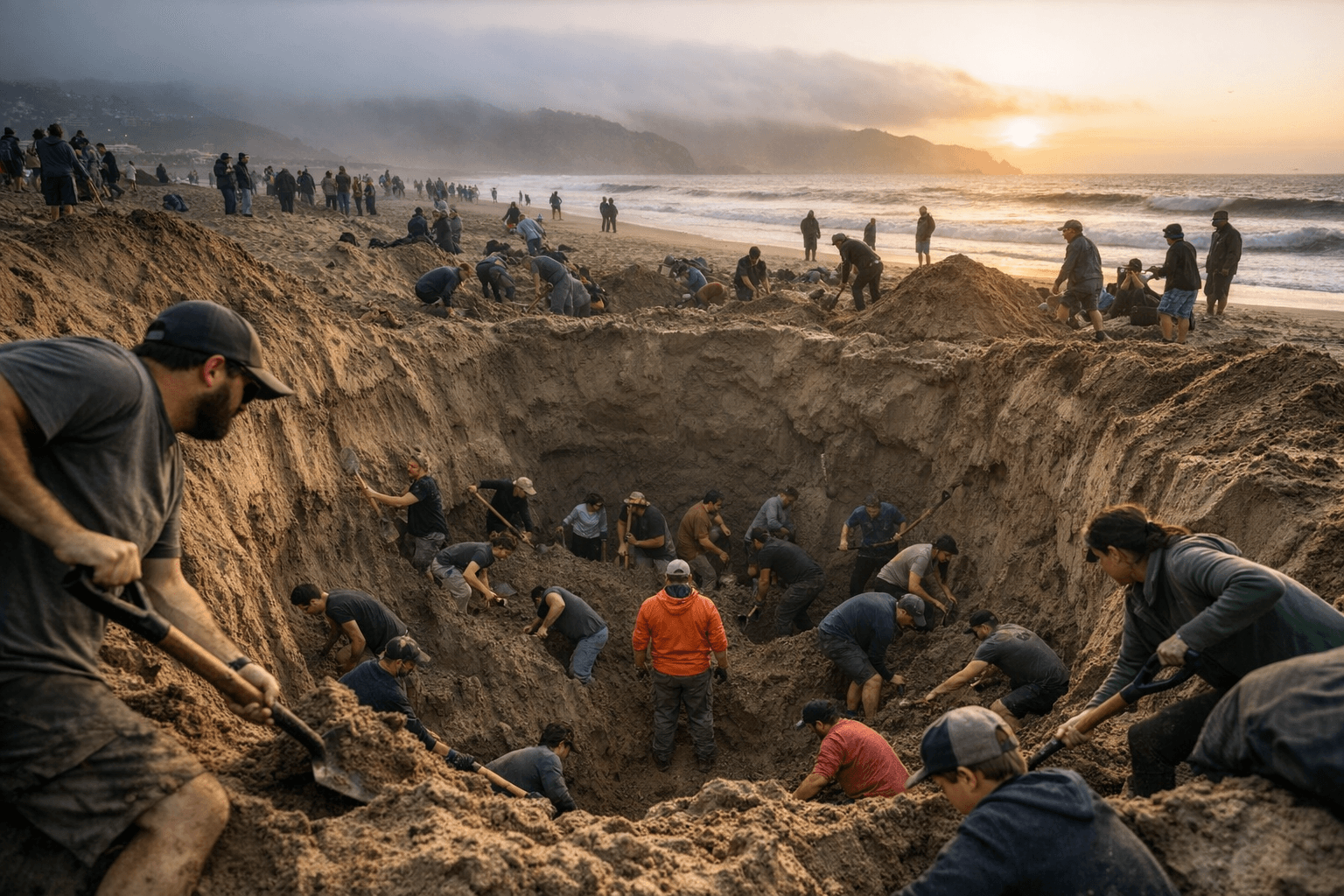
The walls of the pit at Ocean Beach were, at their deepest, tall enough to swallow a standing adult. That realization settled in slowly on Saturday as 250 San Franciscans worked their way down with garden spades and hand shovels, adding tendrils and side channels to what had started as a communal dig.
The event, called a "Hole Party," was organized by Anna Magruder, a 29-year-old forestry worker who has staged a dozen such gatherings at Ocean Beach. The crowd was a cross-section of the city: students, roller skaters, blue-collar workers, queer nightlife regulars and casual beachgoers, all converging on the same patch of sand for a shared, deliberately pointless physical task. Magruder said she had not been sure anyone would come. "There's no real reason," she said, "but it is a surprisingly good way to bring people together."
The excavation spread not in a circle but in an amoeba shape, sprouting side channels and smaller, deeper pockets with a puddle at the bottom. Joseph Peralta, 29, spent hours digging the deepest section and was reportedly spent afterward. At one point a participant executed a clean side flip into the pit and received applause from the rim. Some diggers tried to channel a shallow trench toward the waterline, though the outgoing tide was not cooperating.
The festive mood did not fully quiet the anxiety at the bottom of the hole. As the walls grew steeper, at least one digger said what others were probably thinking: "Now there's a concern about it coming down on me." That concern has a documented body count. A study in the New England Journal of Medicine tracking sand-hole incidents in the United States between 1990 and 2007 recorded 52 collapses, more than half of them fatal. The holes ranged from two to twelve feet deep, and victims became fully buried when walls gave way, sometimes leaving no surface evidence of the collapse.
Ocean Beach compounds those risks. The shoreline has no traditional lifeguards; the Golden Gate National Recreation Area deploys Ocean Rescue personnel whose primary job is educating visitors about ocean hazards. The soft, tide-saturated sand that makes digging easy also makes walls structurally unstable. At night, after crowds leave, an incompletely filled hole becomes invisible to anyone walking the dark shoreline, including the emergency vehicles that patrol that stretch of beach. The American Lifeguard Association has specifically flagged unfilled beach holes as hazards for sea turtles and emergency responders alike.
Magruder's group did fill the hole before leaving Saturday evening, which matters more than it might seem. Coastal researchers note that collapse can occur at as little as two feet of depth, and that the specific actions most likely to trigger it, tunneling and jumping into walls, were both on display at this gathering.
If a large unattended hole appears at Ocean Beach, the GGNRA's Ocean Rescue is reachable through the Golden Gate National Recreation Area's main visitor line. The most effective response is immediate backfilling rather than marking and walking away; markers shift, and the beach's frequent fog can reduce visibility to near zero. Jumping into an unsupported wall, or undercutting it to see how far it goes, is the fastest path from novelty to emergency.
Saturday's hole has been filled. The beach looks the way it always does. But the day illustrated something worth remembering the next time someone arrives at Ocean Beach with a shovel: the deeper the fun goes, the harder the physics push back.
This article was produced by Prism’s automated news system from verified source data, official records, and press releases, then run through automated quality and moderation checks before publishing. The system is built and supervised by the people who set the standards it runs under. Read our full AI policy.
Did this article answer your question?