China consul in San Francisco links AI ties, pandas and diplomacy
China’s consul in San Francisco cast AI, tourism and pandas as local levers in the U.S.-China relationship, from City Hall to the zoo.
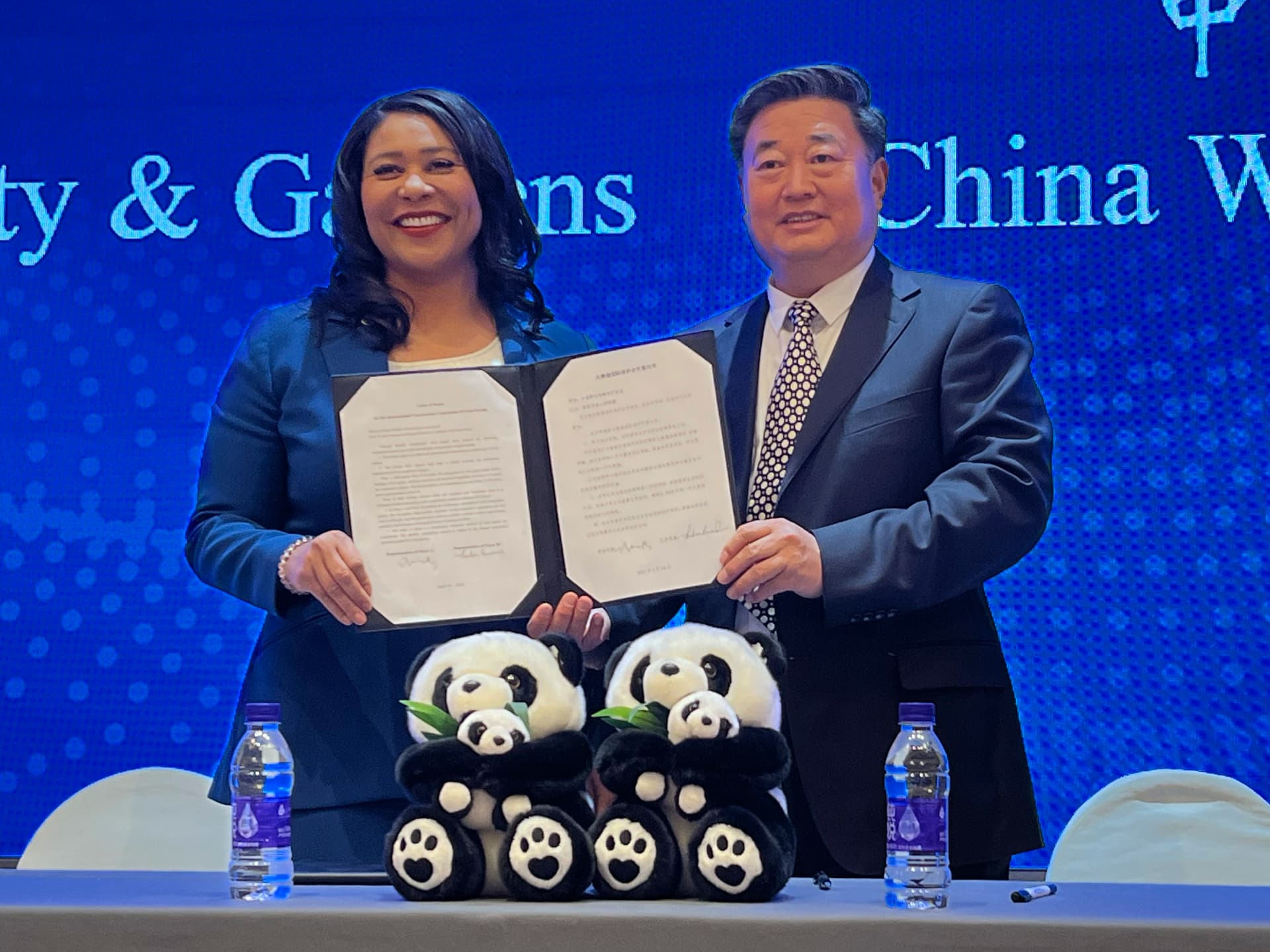
A San Francisco appearance by China’s consul general put a sharp local frame around a global rivalry: artificial intelligence, Chinese American civic power and the long-running push to bring pandas back to the San Francisco Zoo.
Consul General Zhang Jianmin used a Tuesday news conference and one-on-one interview in San Francisco to argue that cooperation between the United States and China still matters, especially in AI. He said the Bay Area’s Chinese American community is uniquely positioned to help bridge the two countries and push those partnerships forward. The Chinese Consulate General in San Francisco said Zhang’s May 26 interview with ABC7 focused on China-U.S. summit issues and subnational cooperation, and that he emphasized people-to-people exchanges as a priority.
The remarks landed in a city where diplomacy is already being handled through local institutions. On April 20, Mayor Daniel Lurie signed a three-year memorandum of understanding with Shanghai, marking the 46th anniversary of the sister-city relationship and expanding collaboration in arts and culture, tourism, sports, education and youth exchange. The consulate said Zhang pointed to recent trips to China by President Donald Trump and Lurie as signs that engagement still matters, and said Lurie had shown a commitment to cultural cooperation during his visit to Shanghai.
San Francisco’s economic stakes were part of the backdrop. NBC Bay Area reported that in 2019 mainland Chinese travelers represented about a $1.2 billion segment of the city’s tourism economy. December arrivals from mainland China were about 20,000, far below roughly 40,000 before the pandemic, underscoring how much the city still depends on a rebound in international visitation.
The panda question, long treated as a feel-good symbol, now sits at the center of that broader relationship. In April 2025, San Francisco Zoo chief executive Tanya Peterson said panda plans were still moving ahead, with the animals expected to arrive by the end of 2025 and open to the public in April 2026 if all went as planned. KQED reported the arrangement would be a three-year loan at about $1 million annually and would require about $25 million in fundraising.
That optimism has since collided with political and financial strain. In March, advocates including In Defense of Animals and SF ZooWatch said the panda deal had collapsed and urged the zoo to become an Ecopark SF. Last week, the Board of Supervisors unanimously approved a resolution allowing the city to loan the San Francisco Zoo up to $8.5 million. Zhang said there had been progress and pointed to the zoo, City Hall and the Board of Supervisors as partners, but the bigger picture is clear: in San Francisco, AI competition, sister-city diplomacy, tourism recovery and the fate of giant pandas are now part of the same conversation.
This article was produced by Prism’s automated news system from verified source data, official records, and press releases, then run through automated quality and moderation checks before publishing. The system is built and supervised by the people who set the standards it runs under. Read our full AI policy.
Did this article answer your question?