Fort Point’s brick fort guarded San Francisco Bay before the bridge
Fort Point sits under the Golden Gate Bridge, but its brick walls once guarded San Francisco Bay as a Civil War-era fortress with more than 170 years of history.
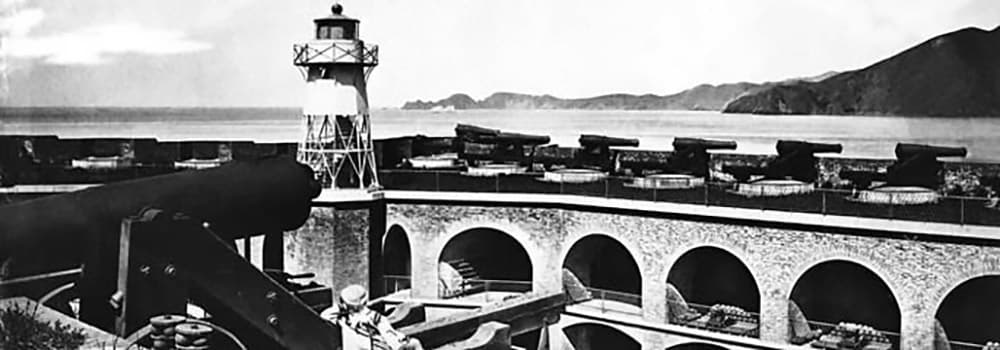
The most dramatic view under the Golden Gate Bridge is also a brick fort that once stood guard over San Francisco Bay. Fort Point’s heavy masonry, four tiers, and position at the bridge’s southern approach make it one of the clearest places in the city to see military history and modern engineering in the same frame.
A fort built to hold the gate
Fort Point was built between 1853 and 1861 by the U.S. Army Engineers as part of a defense system for San Francisco Bay. The National Park Service says the project was planned at the height of the California Gold Rush, when federal planners wanted the most formidable deterrent the United States could offer against a naval attack on California.
That purpose still reads in the site’s position. The fort sits at the Golden Gate, where ships once had to pass through the narrow entrance to the bay, and the National Archives says it was vital to San Francisco’s harbor defense during and after the Civil War. Military officials called it the “key to the whole Pacific coast,” a phrase that captures how closely the city’s growth, trade, and defense were tied to this single point of land.
What stands in front of you now
The fort’s scale is easy to understand once you are there in person. It rises in four tiers, a stacked brick form that looks nothing like the steel span above it. That contrast is the site’s strongest visual lesson: the lower structure reflects mid-19th-century coastal defense thinking, while the bridge overhead represents 20th-century transportation ambition and the confidence of a different era.
Fort Point is also the only example of Third System coastal defense architecture west of the Mississippi River. That makes the building unusually important not just for San Francisco, but for the history of American military engineering. Historians have also described it as “the pride of the Pacific,” “the Gibraltar of the West Coast,” and “one of the most perfect models of masonry in America,” language that reflects how unusual its brick construction was even in its own time.
Standing below the bridge, you can feel the fort’s original logic. The walls face the strait, the bay, and the open water beyond, and the bridge’s shadow now cuts across a landscape that was once measured in cannons, not commuter traffic. The Presidio of San Francisco describes Fort Point as a signature landmark beneath the Golden Gate Bridge’s southern approach, and that is exactly how it reads on the ground: a defensive work turned public overlook.
How the bridge and fort survived each other
Fort Point almost disappeared when the bridge was planned. The bridge was nearly going to require the fort to be torn down, but the design changed after chief engineer Joseph Strauss recognized the fort’s architectural value. Instead of clearing the site, the bridge was redesigned to preserve it, leaving the brick fortress in place under one of the world’s most recognizable spans.
That decision gives the site an unusually clear preservation story. San Francisco did not simply keep an old structure on the waterfront; it kept the old structure in the middle of a new one, where millions of people can still see it from the bridge, from the water, and from the shore. Fort Point became a National Historic Site on October 16, 1970, when President Richard Nixon signed the legislation creating Fort Point National Historic Site, and one account says the site opened to the public that fall.
The deeper history under the brick
The military story is only one layer here. A Golden Gate National Parks Conservancy timeline says the area was used by Ohlone and Miwok American Indian tribes for more than 10,000 years before 1776. That longer history matters because it places the fort inside a much older human landscape, one that predates the United States, the Civil War, and even the brickwork that now defines the site.
That context changes the way the fort reads. It is not just a relic of federal military planning or a scenic stop under the bridge. It is part of a place that has supported native communities, anchored a harbor, and then been folded into the city’s modern identity as the Golden Gate Bridge rose above it.
How to visit Fort Point today
Fort Point remains a place to experience San Francisco’s history physically, not just read about it. The outdoor areas are open Friday through Sunday from 10 a.m. to 5 p.m., which makes the site easy to pair with a walk along the waterfront or a visit through the Presidio of San Francisco. The best approach is to slow down and look in both directions: toward the bay the fort was built to defend, and up at the bridge that was saved around it.
What makes Fort Point memorable is the way its details still line up with its purpose. The brick, the tiers, and the view at the Golden Gate all point back to a time when San Francisco’s survival depended on controlling the waterway in front of it. The bridge may define the skyline, but the fort explains why this corner of the city mattered long before the span arrived.
This article was produced by Prism’s automated news system from verified source data, official records, and press releases, then run through automated quality and moderation checks before publishing. The system is built and supervised by the people who set the standards it runs under. Read our full AI policy.
Did this article answer your question?