Golden Gate Park's Forgotten Prayer Book Cross Gets a Second Look
A nearly 60-foot sandstone cross has stood in Golden Gate Park since 1894, but most visitors walk right past it. Here's the story it's been waiting to tell.
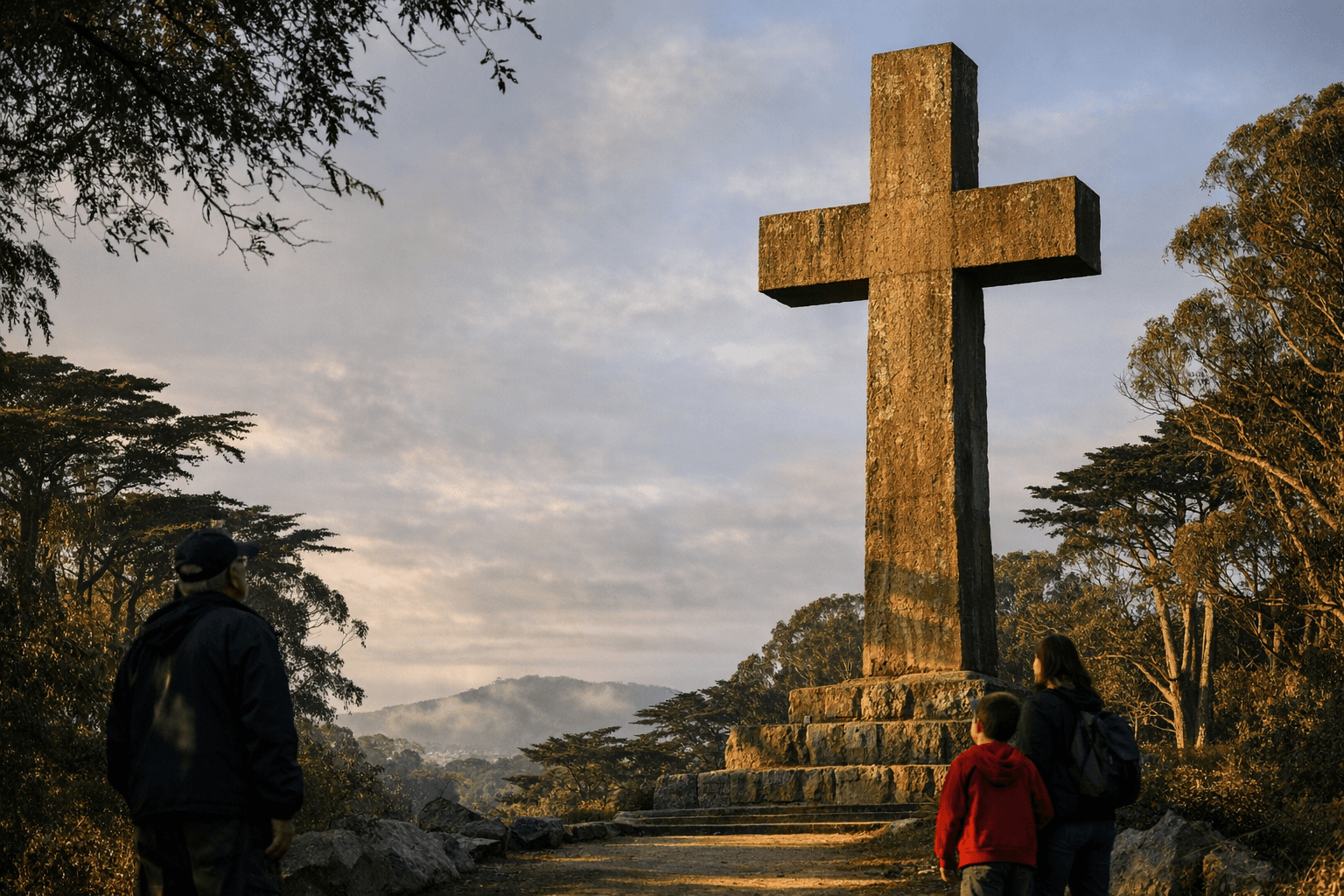
Tucked above Rainbow Falls on John F. Kennedy Drive, just east of Crossover Drive, stands one of San Francisco's tallest and most thoroughly ignored monuments. At nearly 60 feet high, the Prayer Book Cross commands a hilltop position in the heart of Golden Gate Park. Yet most people who walk or bike past it on a given afternoon have no idea it exists, let alone that it has been standing there since the Victorian era. A recent feature rekindled attention on this sandstone landmark and the larger questions it raises about civic memory, historic preservation, and who decides which pieces of the past get to be remembered.
A 16th-Century Voyage, a 19th-Century Monument
The cross's origins reach back to June 24, 1579, the feast of Saint John the Baptist, when Francis Fletcher, chaplain to Sir Francis Drake and a priest of the Church of England, led what is believed to be the first Christian service conducted in the English language on the American continent. The congregation gathered on the shores of what is now Drakes Bay in Marin County, using the Book of Common Prayer, and the occasion lodged itself permanently in Anglican memory.
More than three centuries later, the Church of England decided to mark that moment in stone. The result was the Prayer Book Cross, also known as Drake's Cross or the Sir Francis Drake Cross, presented to Golden Gate Park on January 1, 1894, at the opening of the Midwinter International Exposition, San Francisco's own answer to the world's fair craze that defined that era. The inscription carved into the front of the monument states it plainly: a memorial to the service held on Drakes Bay "about Saint John Baptists Day June 24 Anno Domini 1579 by Francis Fletcher priest of the Church of England and chaplain of Sir Francis Drake." The reverse side reads, in part: "First Christian service in the English tongue on our coast." Notably, the cross was originally intended to be erected at Drakes Bay itself, the actual site of the 1579 service, but it ultimately found its permanent home in the park.
Ernest Coxhead's Celtic Vision
The man who gave the monument its form was Ernest Coxhead, an architect born in Sussex, England, who had relocated to San Francisco and would become a significant figure in what historians later identified as the Bay Area style of architecture. Coxhead shaped the cross in the Celtic tradition, a form with deep roots in the British Isles, and used sandstone as his material. The result is a structure that feels simultaneously ancient in idiom and Victorian in execution: a massive, intricately worked cross rising nearly 60 feet from one of the park's highest natural points, set against a canopy of trees that simultaneously frames and obscures it depending on the angle of approach.
The Midwinter International Exposition of 1894 was a defining moment for Golden Gate Park itself. The fair, which also gave the city the band shell and the Music Concourse area, drew visitors from across California and beyond, and the Prayer Book Cross was presented in that charged civic context, meant to be a centerpiece among the park's collection of commemorative objects. Golden Gate Park had itself only been established in 1874, barely two decades before the cross arrived, and civic boosters were eager to fill it with monuments that proclaimed San Francisco's place in a larger historical narrative.
How a 60-Foot Cross Became Invisible
That the Prayer Book Cross could be overlooked by thousands of park visitors each year is a testament to how thoroughly a monument can be absorbed into its surroundings. Positioned above Rainbow Falls and screened by mature trees, it does not announce itself from the main pathways. Visitors who do not specifically seek it out must first find the manmade waterfall along JFK Drive, then follow a steep paved path up the hill behind the falls, roughly 100 yards east of Rainbow Falls itself. The cross sits at the top, on one of the highest points in the park, and the climb rewards those who make it with both the monument and a quiet remove from the park's busier corridors.
But elevation and tree cover alone do not explain decades of obscurity. The broader issue, as historians and longtime park observers have noted, is one of interpretation. There is no prominent wayfinding that connects casual visitors to the cross's story, and the monument sits outside the well-marked circuits that guide tourists through the de Young Museum, the Japanese Tea Garden, the Conservatory of Flowers, and the other attractions that anchor Golden Gate Park's identity in the public imagination. The cross is present; its context is largely absent.
Memory, Signage, and Civic Priorities
The questions that swirl around the Prayer Book Cross are not unique to this monument. Historians and park officials who have examined the cross and its situation have raised a layered set of concerns: whether the monument should be more prominently marked and incorporated into official park tours, or whether its quiet obscurity is itself part of what makes Golden Gate Park the historically textured place it is. Not every corner of a 1,017-acre park can or should be curated into a visitor attraction, and there is a reasonable argument that the cross's relative solitude gives it a dignity that heavy foot traffic and interpretive panels might undermine.
At the same time, the cross has occasionally surfaced in civic debate for reasons beyond simple neglect. KQED has noted that the Prayer Book Cross is a religious symbol on public land, and that the City of San Francisco has allowed it to remain without the legal challenges that have met similar monuments elsewhere in the country. That the cross has not sparked a lawsuit is itself a piece of its history, a quiet exemption from conflicts that have reshaped public spaces across the United States.
The broader San Francisco conversation about which historic sites receive active stewardship and which quietly recede is sharpened by examples like this one. The city's parks and streetscapes are dense with monuments, murals, and markers, some celebrated, some contested, some simply forgotten. The Prayer Book Cross falls into a category of its own: neither controversial enough to attract sustained attention nor celebrated enough to pull crowds, it occupies a strange middle ground where a genuinely significant artifact of civic and religious history has been allowed to become, in effect, a secret.
Finding It for Yourself
For anyone who wants to visit, the route is straightforward if not obvious. Head to Golden Gate Park along John F. Kennedy Drive, locate Rainbow Falls just east of where Crossover Drive passes over JFK Drive, and follow the paved path up the hill behind the falls. The cross stands at the top, sandstone against sky, the inscription still legible after more than 130 years.
The renewed attention brought by this moment of public reflection is a reminder that Golden Gate Park's history is far wider than its most-visited attractions suggest. The Prayer Book Cross was placed here in 1894 by people who assumed it would be seen and remembered. Whether San Francisco chooses to make good on that assumption is a question the Parks Department, local historians, and neighborhood groups are now in a better position to answer.
This article was produced by Prism’s automated news system from verified source data, official records, and press releases, then run through automated quality and moderation checks before publishing. The system is built and supervised by the people who set the standards it runs under. Read our full AI policy.
Did this article answer your question?