San Francisco cable cars trace roots to 1873 test run
The cable cars still climb San Francisco's steep hills on a hidden system that started with Hallidie's 1873 Clay Street test. Keeping them alive now means subsidies, repairs, and hard choices.
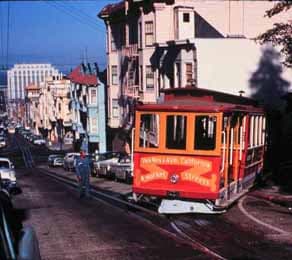
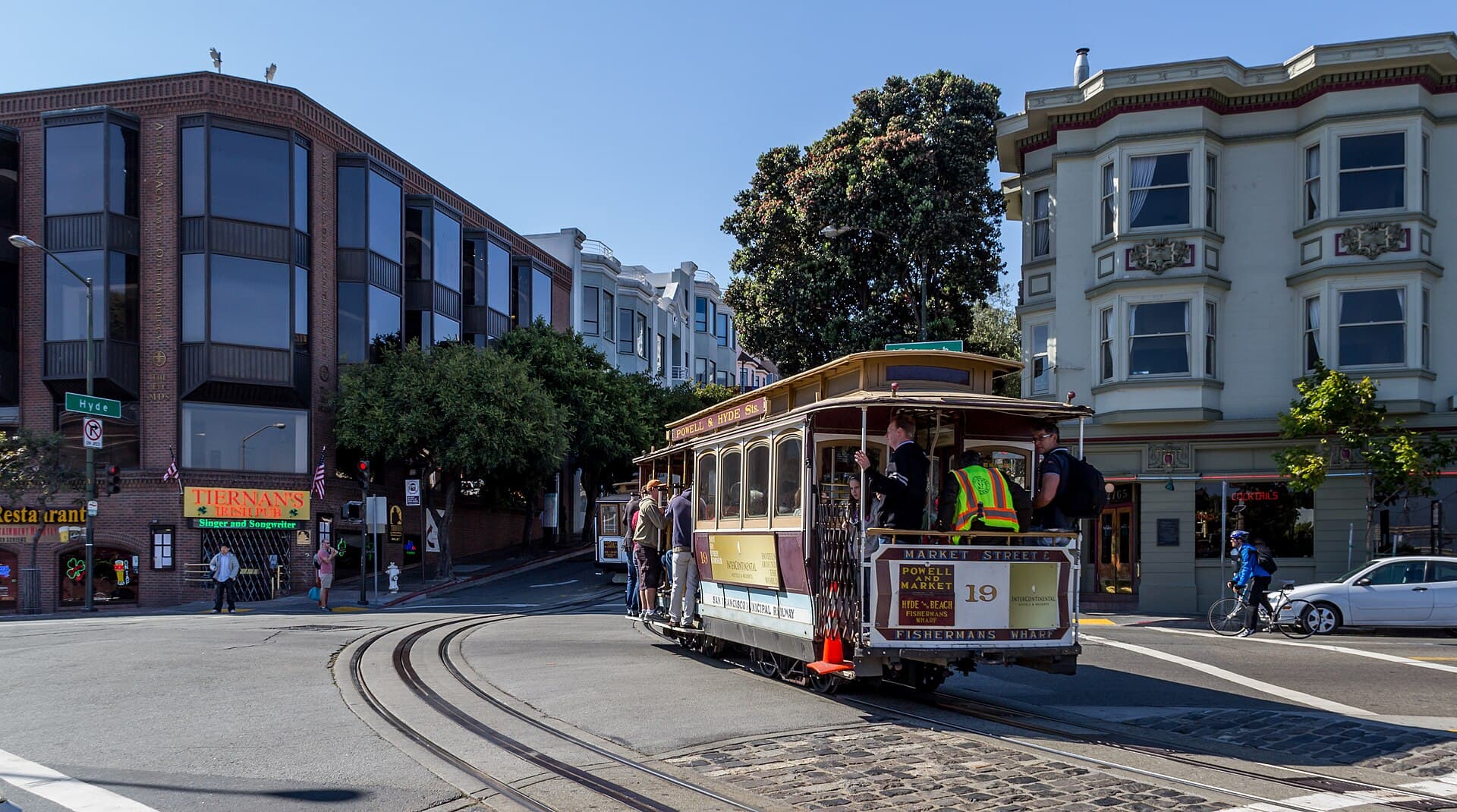
On Hyde Street between Bay and Francisco, where the listed grade hits 21%, the cable cars still do the job they were built to do: pull people up San Francisco’s hills with a grip on a moving steel rope hidden under the pavement. That everyday climb reaches back to Andrew Smith Hallidie’s test run on Clay Street on August 2, 1873, the first successful cable car trial in the world. Public service followed on September 1, 1873, and the system has remained one of the city’s most visible pieces of civic infrastructure ever since.
How the system works today
San Francisco’s cable cars are part of the San Francisco Municipal Railway, or Muni, and sit inside the broader network run by the San Francisco Municipal Transportation Agency. The system has three lines, California, Powell-Mason, and Powell-Hyde, with a combined one-way mileage of 5.09 miles. It is widely described as the world’s last manually operated cable car system, which makes it less a museum display than a working transit line that still carries riders through the center of the city.
The machinery beneath the streets is the reason the cars move at all. The cables are 1.25 inches in diameter, made of steel with a hemp center, and four continuous steel ropes move at 9.5 miles an hour from the Washington-Mason powerhouse. Each cable is driven by a 510-horsepower electric motor, and the whole system uses about 3.7 million kilowatt-hours a year. The operator is called a “Grip Person,” and that title reflects the actual work: the grip device seizes the cable, the car is drawn forward, and the line keeps moving without an onboard engine.
The San Francisco Cable Car Museum, located in the Washington-Mason powerhouse and carbarn, is one of the clearest places to understand that arrangement. It ties the romantic image of the cars to the engineering that keeps them moving, showing that the system depends on constant power, precise maintenance, and a specialized workforce, not on nostalgia alone.
Why the hills still matter
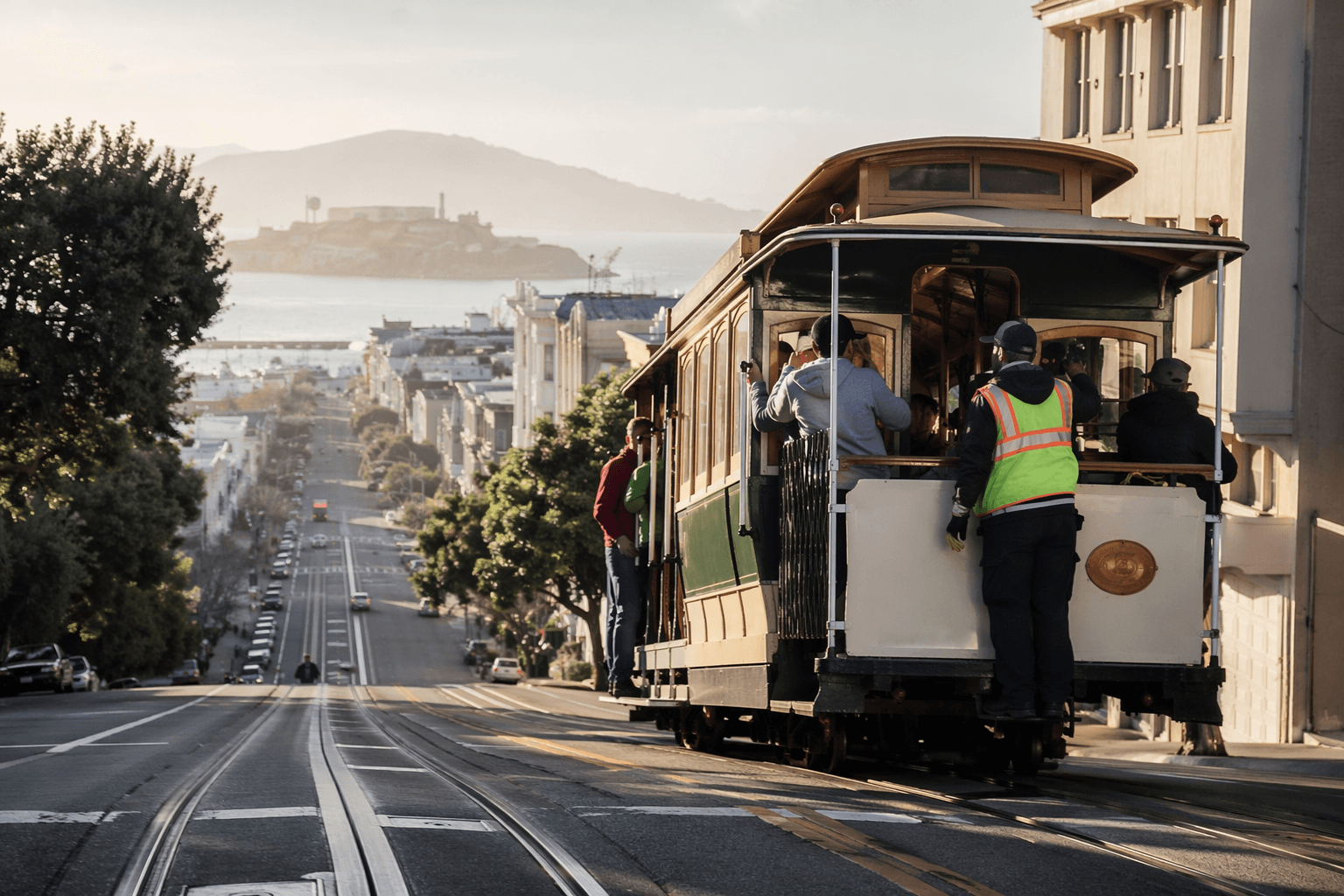
The steepest stretches explain why the system still exists at all. Hyde Street between Bay and Francisco reaches 21%, California Street between Grant Avenue and Stockton is listed at 18%, and Mason between Union and Green and Powell between Bush and Pine both reach 17%. Those grades turn the cable cars from a sentimental symbol into a practical answer to San Francisco’s street grid, where ordinary buses and private cars have always had to contend with terrain that is unusually punishing for a dense city.
That geography also explains why the lines became a political cause. In 1947, Mayor Roger Lapham proposed closing the two Powell Street cable car lines, and Friedel Klussmann organized the Citizens’ Committee to Save the Cable Cars in response. The 1947 ballot measure was framed as preserving the cable cars in perpetuity, and the fight made clear that San Francisco was deciding more than whether to keep an old transit mode alive. It was deciding how much of the city’s identity and street pattern should continue to shape public investment.
The current system took its modern form later, on Sunday, December 22, 1957, when California Street cable car No. 51 rolled out of the Washington-Mason cable car barn and the three-line system became reality. That moment matters because it marked the line between the older, fragmented cable network and the version residents still see today: compact, continuous, and tied directly to the city’s steepest corridors.

What it costs to keep running
The cable cars remain a heavily subsidized service, and the numbers make that plain. Fares cover about 48% of operating costs, and the cost per cable car passenger trip was about $20.64 in 2024 National Transit Database reporting. The standard single ride fare is $8, while the California Cable Car Line Day Pass is $5, a pricing structure that reflects both the city’s desire to keep the system accessible and the reality that riders do not come close to paying the full cost of operation.
That subsidy is not an abstraction. SFMTA has said a loss of electricity could stop cable cars citywide, which means the system depends on reliable power as much as on iconic status. For residents, that makes the cable cars part of a larger transit budget conversation: every dollar spent on keeping them running is a dollar that could otherwise go to buses, light rail, streets, or other maintenance priorities. The cable cars persist because the city keeps choosing to fund a service that is both symbolic and operational.
Ridership shows the tension between those roles. The system carried roughly 5.7 million riders in 2019, but weekday ridership in early 2026 was about 8,100, far below pre-pandemic levels. That gap helps explain why cable cars can be celebrated as a landmark and still face scrutiny as an expensive transit asset with a very specific user base.
The barn, the repairs, and the next capital bill
The most important preservation work is happening where most riders never look, at 1201 Mason Street. The Cable Car Barn there is a National Historic Landmark, built in 1907 and 1908 after the 1906 earthquake and fire destroyed the previous powerhouse and car barn. It is not just a historic building but the operational heart of the system, housing the equipment and work that keep the line alive day after day.
SFMTA has been planning rehabilitation and electrification work that includes upgrades to HVAC, fire and life safety systems, the roof, cranes, cable rewinder and holdback machinery, restrooms, and electrical infrastructure. The agency says the electrical infrastructure is more than 40 years old and beyond its useful life, and it has sought $25 million in BUILD grant funding with a $6.25 million non-federal match. That is the practical cost of preserving a transit icon: the city has to replace systems that most riders never see, because without them the cars stop.
That is the core civic tradeoff built into the cable car system. San Francisco keeps paying to maintain a manually operated line because the city’s hills, history, and transit network are still bound together on those 5.09 miles of track. What survives is not just a relic from 1873, but an operating public asset that still demands labor, power, and capital in 2026.
This article was produced by Prism’s automated news system from verified source data, official records, and press releases, then run through automated quality and moderation checks before publishing. The system is built and supervised by the people who set the standards it runs under. Read our full AI policy.
Did this article answer your question?